
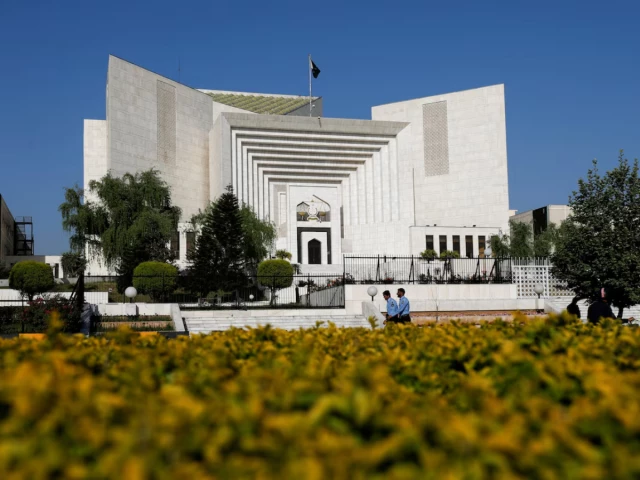
Police officers walk past the Supreme Court of Pakistan building in Islamabad, Pakistan April 6, 2022. REUTERS
ISLAMABAD:
The Supreme Court has directed the police in the provinces and in Islamabad to ensure that no reference to caste, tribe, biradari, conversion status or any classificatory or derogatory term is mentioned along with the names of the complainant, accused persons, victims or witnesses in FIRs, arrest memos, recovery memos, investigation reports, statements or other records.
While hearing a criminal case, a three-judge bench headed by Justice Muhammad Hasham Kakar warned that any deviation from this rule would be permissible only if the investigating officer, for bona fide investigative reasons directly connected with the offense and laid down in writing, believes that such identification is strictly necessary.
“The Registrar of this Court shall send copies of this judgment to all Inspector Generals of Police in all provinces and the Islamabad Capital Territory as well as to the respective Interior Secretaries/Chief Commissioners for immediate compliance and circulation to all field formations,” read a six-page judgment authored by Justice Kakar.
“We are deeply disheartened to witness society continuing to determine whether a human being deserves respect based solely on the nature of their profession, rather than on their inherent dignity,” the judgment said.
The judgment notes that human dignity is not a privilege that can be conferred; it is an inalienable right inherent in every individual by virtue of their humanity as stated in Article 14 of the Constitution.
“It is noteworthy that the terms bhangi, chura, morassi, jamadar, dam and musalli are no longer used to define a caste but instead are used as derogatory remarks against the members of that particular caste,” the judgment said.
“We are apprehensive about a society that depends on cleanliness to survive, yet dehumanizes those who make it possible. Those who clean up society’s waste are described as ‘dirty’, and those who make cities vibrant are seen as lives inherently less deserving of respect.”
The court said that the very moral failure of the social order is revealed by a system that dehumanizes individuals to earn a living by doing sanitary or similar tasks, rather than the filth of workers.
“Dignity, respect and equality are the rights of every person, regardless of their occupation, in the eyes of the law and society. Pakistan’s international human rights obligations serve to strengthen this claim,” the judgment underlined.
The court referred to Articles 1 and 7 of the Universal Declaration of Human Rights (UDHR), Articles 2 and 26 of the International Covenant on Civil and Political Rights (ICCPR) and Article 3 of the International Covenant on Economic, Social and Cultural Rights (ICESCR), which mandate equality before the law and protection against discrimination based on religion or social origin.
The court said that the use of any qualifying term that marks a convert as “new” or otherwise distinct has no sanction either in Islamic teachings or in law. “Any term which merely identifies the caste or social origin to which a person belongs and which does not in itself carry anything inherently objectionable.”
It noted that they become offensive when they are used to disparage, stigmatize or portray a person as belonging to an inferior social status.
“The term ‘Nau Muslim Sheikh’ (or similar terms like ‘Dhobi’, ‘Naahi’, ‘Jamadar’, ‘Bhangi’ or ‘Dam’ as occasionally used in police records’) appears to be a derogatory or coded reference implying a stigmatized or lower caste status,” the court said.


