
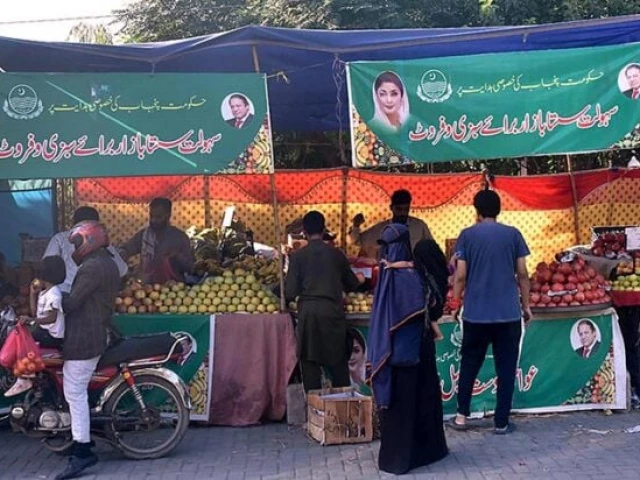
Sahulat Bazaar Punjab. Photo: APP (file)
RAWALPINDI:
The district administration has approved the establishment of only three Ramazan Cart Bazaars this year, ending the long-standing system of setting up 16 subsidized Ramazan bazaars across the city. The three cart bazaars will be set up near Allama Iqbal Park, at Haidri Chowk and at Chohar Chowk.
Following the directions of Punjab Chief Minister Maryam Nawaz Sharif, the Rawalpindi district administration has initiated special measures to provide relief to the citizens during the holy month of Ramazan. Following instructions from Deputy Commissioner Dr. Hassan Waqar Cheema, Ramazan bazaars and cart bazaars are being established to ensure the availability of essential food items at affordable and controlled prices.
A Ramazan bazaar will be set up in Chohar Chowk area under the supervision of Assistant Commissioner (Cantonment), while two cart bazaars at Iqbal Park and Haidri Chowk will be supervised by Assistant Commissioner (City) Iman Zafar.
Flour, sugar, pulses, vegetables, fruits and other essential commodities will be available at official and controlled prices to provide direct relief to the public.
The Deputy Commissioner has directed that cleanliness should be ensured, official price lists should be displayed prominently and that the quality of the goods should not be compromised. Price control judges have been instructed to carry out continuous monitoring and take arbitrary action against hoarders, profiteers and those who charge excessive prices.
According to the district administration, the establishment of these Ramazan and cart bazaars will facilitate access to affordable and quality products for daily use and help curb inflation during the holy month.
Food inflation bites before holy month
With the advent of the holy month of Ramazan, prices of fruits and essential items for sehri and iftar have risen dramatically in the open market in the city, putting a heavy burden on consumers. Price magistrates appear to be powerless to rein in rising inflation.
In the open market, gram flour is sold at Rs 400 per kilogram, white chickpeas at Rs 430 per kg, red beans at Rs 400 per kg and premium large red beans at Rs 500 per kg. Cooking oil is priced at Rs520 per kg (bag). Split chickpeas cost Rs 330 per kg, while black gram is available at Rs 500 per kg.
Meat prices have also risen sharply, with mutton at Rs 2,600. per kg, beef at Rs 1,500. per kg and chicken at Rs.600. per kg. Milk costs Rs 230 per liter and yogurt at Rs 250 per kg.
Among fruits, guava is sold at Rs200 to Rs250 per kg, pomegranate at Rs700 per kg, grapes at Rs500 to Rs650 per kg, papaya at Rs400 per kg and apples at Rs250 to Rs400 per kg.
Bananas are priced between Rs220 and Rs250 per dozen. Oranges, kinnow and sweet lime are sold at Rs200 to Rs400 per dozen, while coconuts are priced at Rs500 each.
Vegetable prices show a similar upward trend: new potatoes are selling at Rs 40 per kg and old potatoes at Rs 80 per kg; onions at Rs60 per kg; okra at Rs250 per kg; peas at Rs 90 per kg; ginger at Rs 400 per kg; garlic at Rs300 per kg; cauliflower at Rs100 per kg; bitter gourd at Rs130 per kg; lemons at Rs 80 per kg; and colocasia at Rs 80 per kg.
The security plan comes into effect
The Punjab Home Ministry has imposed the strictest security arrangements for the holy month of Ramazan starting this week, enforcing a complete ban on eating and drinking in open public places across the district.
The sale of ready-made food in eateries, hotels, canteens and carts for immediate consumption has been banned.
To ensure peaceful observance of Ramazan, the district administration and police have issued a comprehensive security plan.
All relevant departments have been put on alert to protect the lives and property of worshipers and maintain law and order.
Additional staff will be deployed at major mosques, imambargahs, Eidgahs and other places of worship. Special security measures will be implemented during Sehri, Iftar, Taraweeh and Friday congregations. Additional reinforcements may be called in on important nights, including Shab-e-Qadr.
Mobile and foot patrols will be increased in sensitive areas, while checkpoints will be set up at key entry and exit points. Surveillance through CCTV cameras will be strengthened and checks on suspicious persons and vehicles will continue.
The traffic police have been asked to prepare special plans to ensure smooth traffic flow around mosques and markets. Barriers will be installed at major assembly points to regulate entry and exit routes.


