
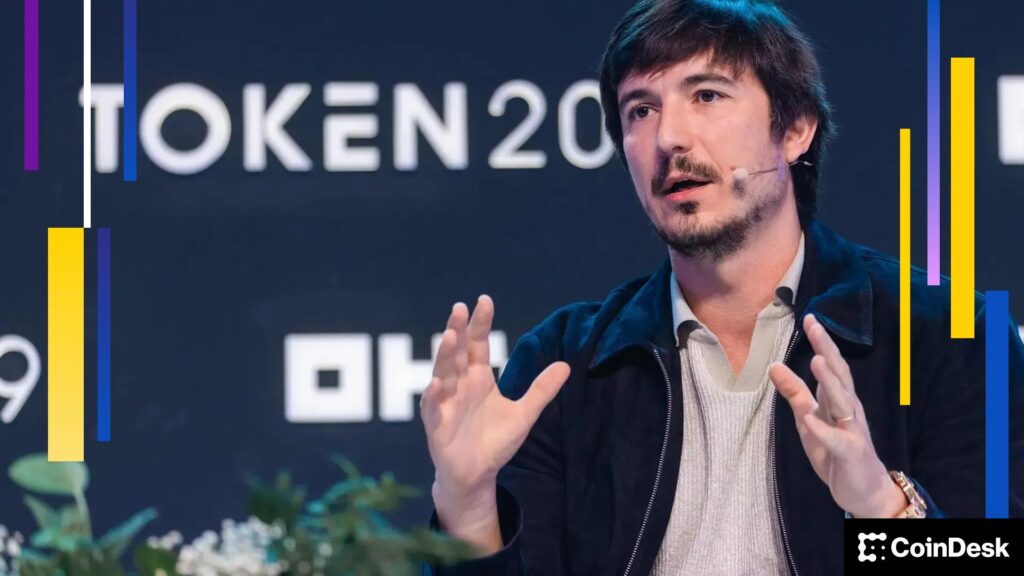
Robinhood’s ( HOOD ) testnet has logged four million transactions in its first week of its testnet chain being live, investment platform CEO Vlad Tenev said on X Thursday.
The Robinhood chain, which focuses on tokenization and trading, comes at a time when centralized exchanges are looking to build their own blockchain infrastructure, even as the broader Ethereum ecosystem debates its future.
“Developers are already building on our L2, designed for real-world tokenized assets and onchain financial services,” Tenev wrote.
Testnets are risk-free environments for developers to test code and experimental features before its mainnet goes live. The two stages of a network’s development can be compared to a flight simulator and a commercial flight.
Robinhood Chain’s testnet has arrived on the back of a major accounting in the Ethereum world.
Earlier this month, Ethereum co-founder Vitalik Buterin declared that the protocol’s long-standing layer-2 (L2) rollup-centric roadmap “no longer makes sense,” arguing that many rollups have failed to achieve full decentralization and that Ethereum’s base layer is scaling faster than expected.
The philosophical shift has fueled talk in the Ethereum community about what scaling and meaningful decentralization might look like in 2026. But while some in the developer community are pushing for a new framework, Tenev and other centralized players appear to be doubling down on proprietary chains and tokenized markets as a way to capture users and liquidity.
The contrast underscores a growing gap in crypto’s direction. While Ethereum’s core architects are rethinking how scaling should evolve at the base layer, major trading platforms are seeking to control more of the stack themselves. For exchanges, owning the infrastructure can mean tighter user capture, new revenue streams, and greater influence over how tokenized markets take shape.
Read more: Robinhood begins testing its own blockchain as crypto and tokenization push deepens


