
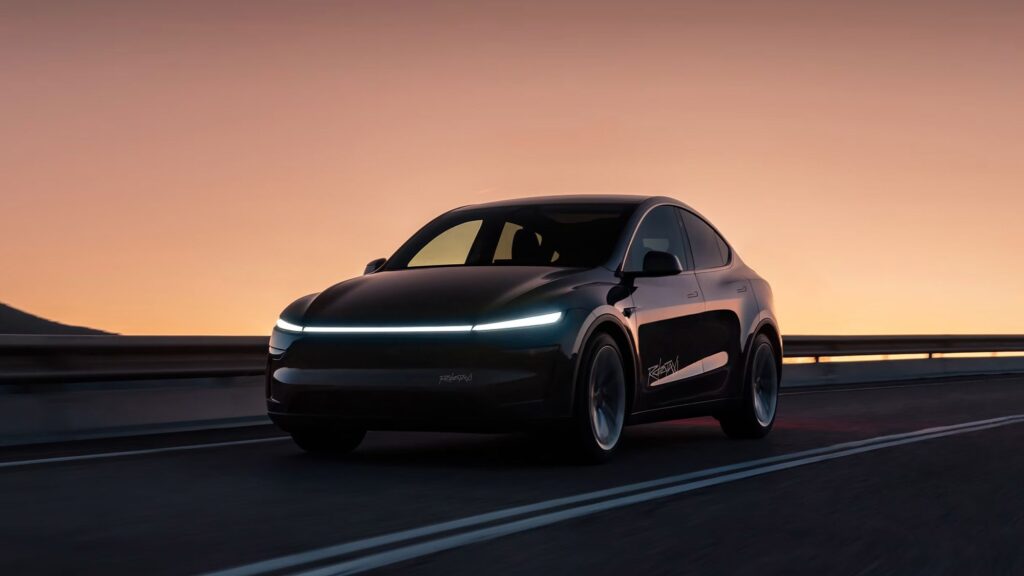
- Tesla’s first ‘Cybercab’ has rolled off the production line
- But its Robotaxi operation is crashing at an alarming rate
- Human drivers are safer by comparison
Tesla has celebrated a milestone this week as the first production Cybercab rolled off the production line at its Gigafactory Texas facility.
The golden, highly autonomous machine does away with a conventional steering wheel and pedals, meaning it relies entirely on software to navigate planned routes in busy cities across the United States.
But despite submissions from the company the X, ongoing production of the Cybercab won’t start in earnest until April of this year, according to Electrek.
In addition, Tesla has faced several hurdles as the US Patent and Trademark Office (USPTO) has only obtained intellectual property rights on the name alone.
This means that the Cybercab may not actually be called ‘Cybercab’. Even more troubling is new evidence showing that Tesla’s current Robotaxi fleet (you know, the one with a real driver on hand in case things go wrong) reported five new accidents in Austin, Texas recently.
First Cybercab off the production line at Giga Texas pic.twitter.com/kY8vCqtrCA17 February 2026
This brings the total number of incidents to 14 since the service launched in June 2025, which according to Tesla’s own benchmarking means that its Robotaxi fleet experiences a crash every 57,000 miles, according to Electrek.
Compared to data from human drivers, who experience a minor collision every 229,000 miles and a major collision every 699,000 miles in North America, Tesla’s Robotaxi service experiences an incident four times as often.
Perhaps even more troubling is the fact that a report submitted to the National Highway Traffic Safety Administration (NHTSA), which closely monitors all self-driving vehicle projects, shows that a July 2025 crash was upgraded from “property damage only” to “Minor W/ Hospitalization.”
Other recorded Tesla incidents include a collision with a fixed object at 27 km/h while the vehicle was traveling straight ahead, a collision with a bus while the Tesla was stationary, a collision with a heavy truck at 4 km/h, plus two separate incidents where the Tesla backed into objects (one into a pole or tree at 1 km/h and another into a fixed object at 2 km/h).
All of this reportedly happened during daytime and in good weather conditions, which casts even more doubt on Tesla’s decision to tackle advanced levels of autonomous driving without LiDAR and other sensors, instead relying on cameras.
Run before walking
While these incidents all (thankfully) sound like relatively minor collisions, the crash data submitted to NHTSA is concerning. It is predicted that Tesla only has about 42 Robotaxis in relatively sporadic operation around Austin, but they collide at a rate worse than human drivers.
What’s more, Tesla is one of the only autonomous taxi services that redacts all of its crash information under the guise of “confidential business information.” This means that it is impossible to see who or what was to blame for the incident – whether it was Tesla’s autonomous driving systems or the safety driver’s failure to react in time.
By comparison, Waymo has posted 51 incidents in Austin alone over a similar time frame. But as of last count, the company had logged 6.337 million fully autonomous miles in Austin, Texas, since launching the service in March, according to Austin American statesman.
Tesla is predicted to have covered 800,000 cumulative miles … with a safety driver at the wheel or a chase car in place for safety reasons. In other words, hail the golden ‘Cybercab’ at your own risk.
Follow TechRadar on Google News and add us as a preferred source to get our expert news, reviews and opinions in your feeds. Be sure to click the Follow button!
And of course you can also follow TechRadar on YouTube and TikTok for news, reviews, video unboxings, and get regular updates from us on WhatsApp also.


