
CM Murad warns that any attempt to separate Karachi from Sindh will undermine national unity and federal structure
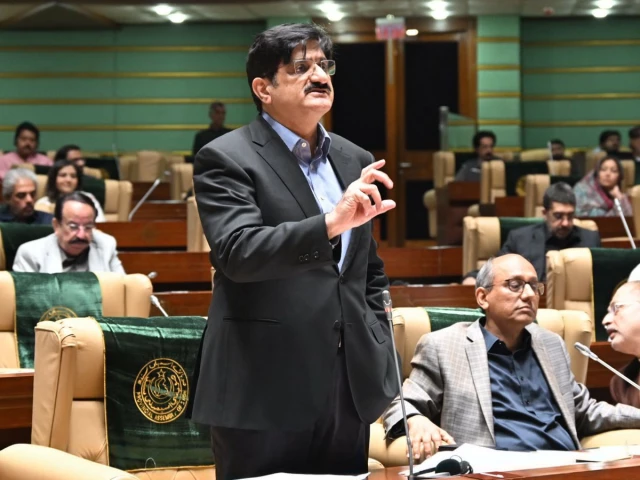
Sindh Chief Minister Syed Murad Ali Shah addressed the Sindh Assembly session on Saturday while moving a resolution condemning calls for disintegration of Sindh or separation of Karachi. Photo: X
The Sindh Assembly on Saturday passed a resolution declaring that Karachi was and would remain an integral and inseparable part of the province amid a renewed debate over the city’s constitutional status.
The resolution, presented by Chief Minister Syed Murad Ali Shah, came last month as Muttahida Qaumi Movement-Pakistan (MQM-P) leader and Health Minister Mustafa Kamal called for Karachi to be declared Pakistan’s economic capital and placed under federal control, arguing that the metropolis had paid an “unbearable price” for political compromises elsewhere.
Kamal had demanded that Karachi be declared a Federal Territory under Articles 148 and 149 of the Constitution and formally recognized as the economic capital of the country within the existing constitutional framework.
During the session of the Sindh Provincial Assembly, the Honorable Chief Minister of Sindh, Syed Murad Ali Shah, spoke in favor of the resolution and asserted that:
Sindh is an ancient, historically unified civilization with a distinct identity that predates modern borders and… pic.twitter.com/qv9gVQ3gip
— Sindh Provincial Assembly (@pasgovofficial) 21 February 2026
The assembly meeting, presided over by Speaker Syed Owais Qadir Shah, passed the resolution which said that any attempt to divide Sindh or create a separate province consisting of Karachi would be contrary to history, the constitution and democratic values and a threat to national unity and the federal structure.
Presenting the resolution, the chief minister said that discussions had taken place in certain quarters to separate Karachi from Sindh, which he strongly condemned. He said that Pakistan was created out of Sindh and expressed hope that members across party lines would support the motion.
He clarified that the resolution did not name any individual or political party.
Read: From tragedy to guilt, MQM and PPP trade fire over Karachi government
The text described Sindh as not just an administrative entity, but one of the world’s oldest living civilizations – the land of Mohenjo Daro and the cradle of the Indus Valley Civilization – with a distinct cultural and historical identity that preceded modern political boundaries.
It noted that Karachi, historically known as Kolachi, emerged from the soil of Sindh and remained its port, commercial hub and gateway to the world even after becoming the country’s first capital in 1947.
Referring to the separation of Sindh from the Bombay Presidency in 1936 and the Pakistan Resolution passed by the Sindh Assembly in 1943, the resolution said that the province had played a fundamental role in the creation of the country and could not allow partition of its historic land.
It further cited opposition to the One Unit Scheme in 1955 and the restoration of Sindh’s separate status in 1970 as examples of public resolve, adding that under Article 239 of the 1973 Constitution, provincial boundaries could not be changed without a two-thirds majority.
Sindh Assembly in the Sindh Assembly.
Sindh is not only a management unit but also a country with a long history. मुआन जू ड़ू की सर्जेजन, वादीٔ सिंद्ध का गहवारह is Sindh شاه عبداللطيف بحتای, ساھل سرمست, عبدالله شاه غازی اور لعل د pic.twitter.com/7wJlpHao3Y
— Sindh Provincial Assembly (@pasgovofficial) 21 February 2026
The resolution described Karachi as Pakistan’s economic lifeline and warned that any move to separate it from Sindh would undermine national unity and the federal structure.
“This House unequivocally condemns and rejects any conspiracy aimed at the partition of Sindh or the creation of a separate province comprising Karachi,” the resolution said, declaring that Karachi is and will forever remain an integral and inseparable part of Sindh.
The resolution reaffirmed that Sindh’s unity, territorial integrity and historical identity were sacred trusts inherited from forefathers and would be defended through constitutional, democratic and political means.
It called on all political stakeholders to desist from divisive rhetoric or actions that could threaten provincial harmony and national cohesion.
“The House stands united – across party lines – in defense of Sindh’s integrity, dignity and unbroken heritage,” the resolution said.
Members from both the treasury and the opposition spoke during the debate.
Local Government Minister Syed Nasir Hussain Shah supported the motion, saying historical claims that Karachi had never been part of Sindh distorted the facts. He asked whether the partition of Sindh should be discussed simply because roads or sewer lines had not been built.
PPP’s Saadia Javed also supported the decision and criticized what she called divisive rhetoric.
She alleged that inflammatory remarks had been made in the governor’s house and questioned why the governor was ruling Karachi against ethnic divisions. She demanded that anyone advocating division of the province be removed from office.
Pakistan Tehreek-e-Insaf’s (PTI) Shabbir Qureshi supported the resolution but questioned persistent urban-rural divides, while MQM’s Aamir Siddiqui and Moeed Mehboob opposed it, arguing that discussion of Karachi’s governance should not be treated as a conspiracy.
PTI’s Bilal Jadoon supported the resolution, saying that the division of Sindh was unacceptable, but called for equal rights across cities.
Responding to criticism, the chief minister said the resolution did not violate the constitution and was only aimed at opposing any move to divide Sindh. He recalled that a similar resolution had been adopted unanimously in 2019.
Senior Minister Sharjeel Inam Memon also supported the proposal, rejecting calls to place Karachi under federal control.
However, opposition leader Ali Khurshidi expressed concern over what he described as a growing atmosphere of dictation.
Referring to the recently passed resolution condemning conspiracies, he questioned what conspiracy was actually underway. “Karachi is the capital of Sindh. You first broke Karachi apart and then divided Malir to create Korangi. You are the ones who are breaking Sindh,” he said.
Criticizing those who had been in power for 18 years, he said: “There are 50,000 children enrolled in the governor’s IT programme, so the pain is real.”
Khurshidi added that discussions about Karachi’s future had taken place in the Governor’s House and that even Sindhi-speaking officials acknowledged that Karachi had been destroyed.
Calling the official narrative a facade, he said, “PPP is supposed to be a national party, but today it seems more like a nationalist party.”


