
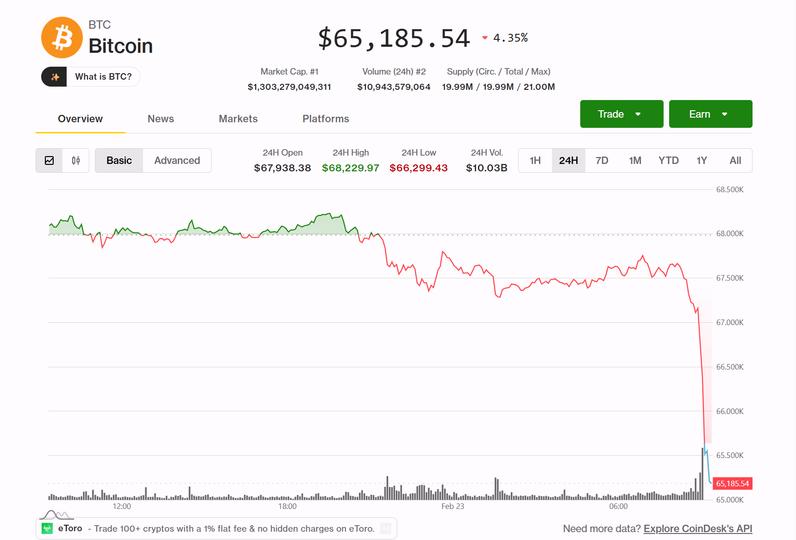
Bitcoin is trading around $65,000 as Asia’s trading week begins, down 4.4%, according to CoinDesk market data.
The move follows a sharp flush from the $67,000 range where it traded over the weekend, and comes as on-chain data from Glassnode and CryptoQuant suggest the worst of the panic may be over, but the broader structure remains under pressure.
Glassnode data shows that recent Bitcoin buyers realized large losses earlier this month. A smoothed 7-day measure of short-term holder gains and losses fell to -$1.24 billion per day on February 6, meaning recent investors collectively locked in more than $1 billion in losses each day.
The 7D EMA for net realized gains and losses for recent investors fell to -1.24 billion. USD/day on February 6 before moderating to -0.48 billion. USD/day today.
While intensity has cooled, the broader regime still signals a market under pressure, with participants in the base formation phase… pic.twitter.com/00zibdP1om— glassnode (@glassnode) 23 February 2026
That figure has since improved to around $0.48 billion per day. In other words, the panic selling has slowed, but has not completely stopped. Recent buyers are still selling at a loss overall, a dynamic that typically occurs during bottom-building phases rather than during strong uptrends.
Exchange flow data from CryptoQuant paints a similar picture of changing market dynamics.
Data from CryptoQuant’s latest weekly report shows that the amount of bitcoin sent to exchanges increased to around 60,000 BTC per day in early February, falling towards $60,000. This number has since fallen to around 23,000 BTC on a 7-day smoothed basis, suggesting that the wave of instant selling has cooled.
But who sells has changed. CryptoQuant’s “whale of exchange ratio” has risen to 0.64, the highest level since 2015. This means that nearly two-thirds of bitcoin flowing into exchanges comes from just the top 10 deposits each day.
In other words, large owners, often referred to as whales, account for most of the supply that hits the exchanges. The average size of each bitcoin deposit has also increased to levels last seen in mid-2022, reinforcing the idea that bigger players, not small retailers, are driving the current exchange activity.
Altcoins face wider distribution. CryptoQuant data shows that average daily altcoin exchange deposits have increased to around 49,000 so far in 2026, up from around 40,000 in Q4 2025. Increased deposit activity across alternative tokens has historically coincided with higher volatility and weaker risk appetite.
Liquidity buffers are also thinning. Net USDT inflows to exchanges have compressed sharply from a one-year high of $616 million in November to just $27 million and briefly turned negative in late January per CryptoQuant. Stablecoin inflows typically expand during rallies. Their contraction suggests reduced marginal purchasing power.
Taken together, Glassnode’s loss realization data and CryptoQuant’s exchange metrics describe a market that is digesting a capitulation event but has yet to rebuild strong demand.
As the week begins, the key question is whether the $65,000 level will hold as a short-term pivot or whether BTC will remain in a prolonged base-building phase.


