
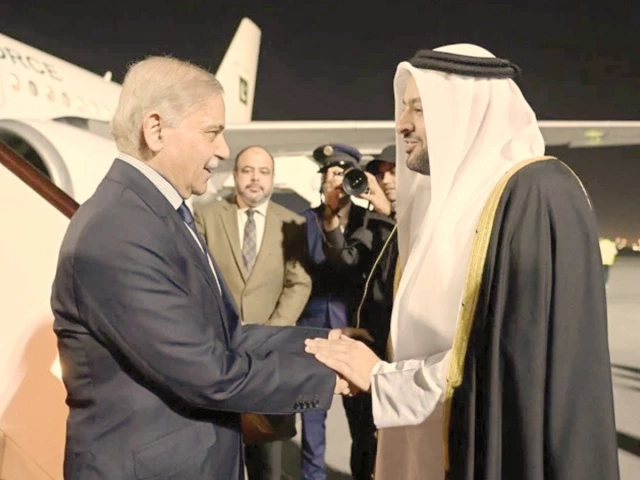
The Prime Minister will hold a bilateral meeting with the Amir covering the full spectrum of relations
ISLAMABAD:
Prime Minister Shehbaz Sharif is set to meet Qatar’s Amir, Sheikh Tamim bin Hamad Al Thani, on Tuesday (today) with a wide-ranging agenda that includes the latest escalation in tensions between Pakistan and Afghanistan, the Gaza peace plan, the US-Iran standoff and other pressing regional developments.
This marks the third visit by the prime minister to Qatar in the last five months, underscoring the growing strategic importance of relations between Islamabad and Doha. The prime minister had traveled to Doha twice in September – first to express solidarity with Qatar after Israeli strikes, and later to attend the Arab-Islamic summit held in the Qatari capital.
The latest trip comes against the backdrop of a number of significant regional developments, particularly on Pakistan’s western border.
Prime Minister Shehbaz arrived in Doha on Monday for a two-day official visit at the invitation of the Amir. He was received at Hamad International Airport by Qatar’s Minister of Foreign Affairs, Dr. Mohammed bin Abdulaziz Al Khulaifi. Pakistan Ambassador to Qatar Muhammad Aamer and senior diplomatic officials were also present to welcome the visiting delegation.
Deputy Prime Minister and Foreign Minister Ishaq Dar accompanies the Prime Minister along with Information Minister Attaullah Tarar and Special Assistant to the Prime Minister Tariq Fatemi. According to the Ministry of Foreign Affairs, the visit reflects the deep-rooted fraternal ties between the two countries and emphasizes their shared commitment to strengthening multifaceted cooperation.
During his stay, the Prime Minister will hold a bilateral meeting with the Amir, covering the full spectrum of relations, including political engagement, economic cooperation, energy partnership and people-to-people exchanges. But officials said regional security issues would dominate the discussions.
The prime minister’s visit comes days after Pakistan carried out cross-border strikes inside Afghanistan, targeting terrorist hideouts responsible for a series of deadly attacks on Pakistani soil. The attacks followed a series of suicide bombings that further strained already fragile ties between Islamabad and Kabul.
Sources said the prime minister will brief Qatar’s leadership on the latest situation, particularly Pakistan’s concerns regarding the use of Afghan territory by militant groups to launch cross-border attacks. Islamabad has long claimed that banned outfits have found havens inside Afghanistan.
Qatar has previously played a quiet but significant mediating role between Pakistan and Afghanistan. Doha had facilitated backchannel contacts and helped broker a ceasefire at a critical juncture. However, a comprehensive deal on Pakistan’s long-standing security problems remained elusive.
Diplomatic sources believe that Islamabad is keen to once again leverage Qatar’s good offices because of its close ties with various stakeholders in Afghanistan and its established role as a regional mediator. The other key issue likely to feature prominently in the talks is the Gaza peace plan and proposals for an international stabilization force.
Pakistan and Qatar are part of an eight-nation Muslim bloc that backed former US President Donald Trump’s Gaza peace initiative and joined the “Peace Council”, a platform aimed at coordinating diplomatic efforts for a ceasefire and post-conflict reconstruction.
With the humanitarian crisis in Gaza deepening and ceasefire efforts facing obstacles, both Islamabad and Doha are expected to exchange views on the next phase of diplomatic engagement and wider Muslim world coordination.
The simmering tensions between Iran and the US are also expected to come up for discussion. Qatar and Pakistan, along with other regional countries, have engaged in quiet diplomacy to dissuade Washington from launching strikes against Tehran amid rising hostilities.
Officials said both countries view any escalation involving Iran as deeply destabilizing to the wider region, particularly the Gulf, where millions of Pakistani expatriates live and work.
Maintaining regional stability remains a shared priority for Islamabad and Doha.
In addition to regional politics, the two sides are expected to explore new avenues for cooperation in trade, investment, energy and infrastructure development.
The Foreign Ministry said the visit would provide an opportunity for both leaderships to exchange views on regional and global developments of mutual interest, reaffirming their willingness to work closely together for peace, stability and prosperity in the region.


