
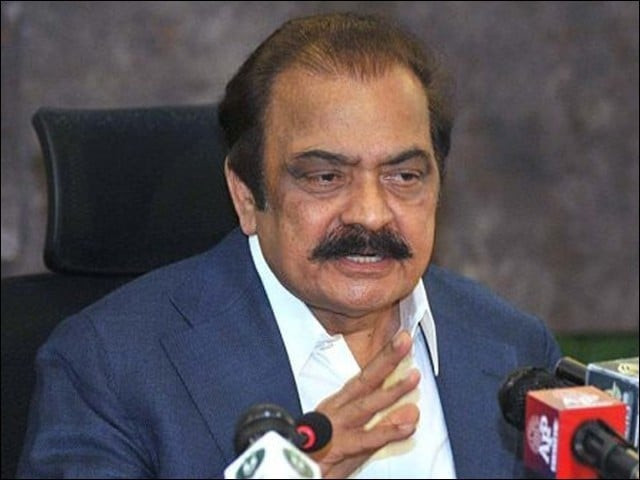
PML-N leader Rana Sanaullah. PHOTO: Express
ISLAMABAD:
The Senate was informed on Monday that the government had repeatedly invited the Pakistan Tehreek-e-Insaf (PTI) for dialogue, but the opposition remained reluctant to sit at the negotiating table.
Speaking in the Senate, the Prime Minister’s Adviser on Political and Public Affairs, Rana Sanaullah, emphasized that political progress and national stability could be achieved through consultation rather than confrontation.
He urged the opposition parties to join the “Charter of Economy” and “Charter of Democracy” for the country’s development, stressing that democratic systems flourish through dialogue rather than political deadlock.
During the Senate meeting, chaired by Chairman Syed Yusuf Raza Gilani, Sanaullah also addressed concerns regarding PTI founder Imran Khan’s health. He said a medical report on Khan’s condition had been submitted to the court in accordance with court orders.
He added that anyone dissatisfied with the medical assessment can approach the Supreme Court. He said all legal requirements regarding the treatment of the jailed PTI leader had been met and a panel of doctors conducted a detailed examination under the supervision of the court.
The statement came as opposition members, including PTI senators, again demanded that Khan be shifted to the hospital for specialized eye treatment. Opposition leader Raja Nasir Abbas, along with Mohsin Aziz and others, called for medical treatment to be allowed outside prison.
Abbas claimed that false cases were registered against Khan and that his sisters were not allowed to meet him in Adiala jail. He demanded the formation of a joint parliamentary committee to facilitate Khan’s meetings.
He called for establishing the tradition of allowing peaceful protests. “Isn’t it an insult to Parliament to lock Parliament and imprison parliamentarians?” he asked. He said if the government improved its relations with Imran Khan, “we will not let the government fall”.
Responding to the opposition’s demands, Rana Sanaullah said the government had ensured that legal medical facilities were provided. He said further objections could be addressed through judicial channels.
He said the opposition did not want dialogue. “What can be done if someone remains stubborn and is not willing to accept any point,” he said. “You do not negotiate with those who will talk to you while you have submitted requests to those who will not negotiate.”
Sindh Unity
The Senate also witnessed a heated debate on a resolution of the Sindh Assembly passed on 21 February. Senator Sherry Rehman of the Pakistan Peoples Party (PPP) strongly opposed any proposal to split Sindh, saying such ideas were against constitutional and democratic principles.
She warned that any attempt to divide the province would require a two-thirds majority and would ultimately weaken national unity. She described Sindh as a symbol of harmony and rejected what she called backdoor political manoeuvres.
Muttahida Qaumi Movement-Pakistan (MQM-P) Senator Khalida Ateeb opposed the interpretation of the resolution as a move to partition the province. She said her party was in favor of administrative reforms and creation of administrative units.
Afghan strikes
The government also clarified its position on air operations in Afghanistan. Federal Minister Tariq Fazal Chaudhry said the airstrikes only targeted terrorist hideouts and training camps in three Afghan provinces, where more than 100 terrorists were killed.
Chaudhry stressed that no civilian casualties were reported in Pakistan Air Force (PAF) strikes, adding that the operations were carried out in response to terrorist attacks inside Pakistan, including incidents in Tarlai, Bannu and Bajaur.
The minister said that Pakistan had repeatedly held talks with the Afghan Taliban regime on the removal of terrorist hideouts from the border area. He said the Afghan Taliban had asked Pakistan to provide Rs 10 billion to shift terrorist camps across the border, but even after the demand, no guarantee was given of complete elimination of terrorism.
He reiterated that Pakistan reserves the right of self-defense and will continue operations until the terrorist network is dismantled. He said that Pakistan would avenge the blood of every martyr and would respond not by merely collecting bodies but by delivering decisive action.
Meanwhile, the Senate unanimously passed four private members’ bills, including amendments related to Zakat and Ushr administration, ban on corporal punishment in the Islamabad Capital Territory, the National Security Council and criminal justice laws.
Two other bills – Al-Biruni International University Bill, 2025 and Corporate Social Responsibility Bill, 2026 – were referred to relevant standing committees for further deliberation.
The meeting was later postponed until Tuesday.
(WITH INPUT FROM NEWS DESK)


