
Budget drops to 11%, only 19% of schools have digital devices; girls perform better than boys in NAT 2023
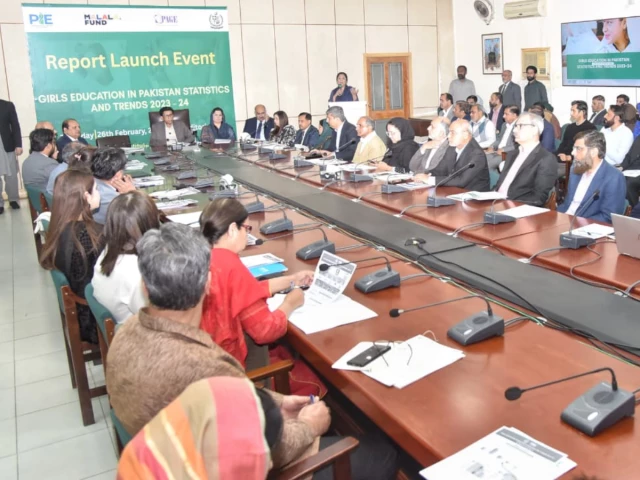
A ceremony was held for the release of the PIE Girls Education Statistics and Trends Report 2023/24, 26 February 2026. PHOTO: EXPRESS
ISLAMABAD:
The Statistics and Trends Report 2023-24 on Girls’ Education reveals that a total of 26.2 million children are still out of school, of which 13.4 million are girls.
In terms of facilities for students with disabilities, the report revealed that 23% of schools have ramps, but fewer educational institutions provide special educational materials or aids.
Read: HEC makes AI course mandatory for all degree programs from 2026
The report also mentions that 23% of the teachers in the girls’ schools are educated at primary level. Only 19% of schools have digital devices. Furthermore, the education budget has fallen from 13% to 11%, with 94% of the total funds spent on salaries, leaving no room for development work. The number of women in higher education is now approaching that of men, but their participation in employment is only 24%, which is a significant loss of human capital.
96% of schools have solid buildings, 92% have toilets and 82% have access to clean drinking water. The primary education completion rate for girls has increased from 75% to 89%; however, malnutrition affects children’s height and weight.
Read more: Obesity, diabetes increase called alarming
According to the National Achievement Test (NAT) 2023, girls scored better than boys in English, Urdu/Sindhi and Mathematics. In the eighth grade, they were also ahead in science and mathematics. The report highlights that the number of schools per 1,000 children has fallen due to population pressure.
While expressing his thoughts on the results, the Federal Minister for Education and Training, Dr. Khalid Maqbool Siddiqui that the data presented on girls’ education will serve as a basis for policy making. He stressed that without accurate data it is not possible to solve problems.
“History shows that no country develops in isolation; the entire region develops together,” he said. “After the data, we need to take concrete steps, because successful policies have always been formulated based on data.”
He said that the path to prevent dropout in girls’ education can only be blocked by changing our attitudes and broadening our thinking, and that it is crucial to decide whether to treat Pakistan’s population of 140 million youth as a burden or provide them with opportunities to turn them into an asset.
“We have to start the fight against ignorance from our homes,” he added. “The state gives a girl a degree or skill and it’s her right to be allowed to progress.”
While parents should give their daughters domestic responsibilities, they should also allow them to continue their professional work. “It is a waste of human capital to keep capable women confined to their homes.”
Siddiqui concluded by stating that serious measures for girls’ education have become an urgent necessity and the government will use all resources for this purpose.
Read also: Degrees of dysfunction
Education and Vocational Training Minister Wajiha Qamar discussed the key highlights of the report and said an action plan needs to be developed.
Director General (DG) of Pakistan Institute of Education (PIE), Dr. Mohammad Shahid Soroya said that the daughters of Pakistan are proving their exceptional abilities in education. The results of the National Achievement Test (NAT) show that when girls are provided with a favorable environment, they can outperform boys in all areas. “Our goal is to identify the gaps through data that are impeding our daughters’ progress so we can improve policymaking.”
The report was developed in collaboration between the Pakistan Institute of Education (PIE), the Malala Fund, the Pakistan Alliance for Girls Education (PAGE) and the Ministry of Education. Federal Parliamentary Secretary, Farah Naz Akbar, Senator Fawzia Arshad, partners’ representatives and education experts also attended the event.


