
Modi’s public allegiance to Netanyahu puts him at odds with widespread disdain for the ongoing war in Gaza
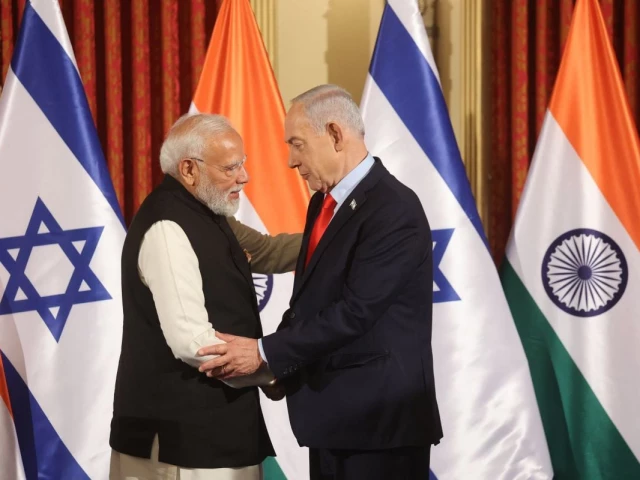
Israeli Prime Minister Benjamin Netanyahu shakes hands with his Indian counterpart Narendra Modi during a press conference in Jerusalem on February 26, 2026. PHOTO: AFP
KARACHI:
In Israel, Narendra Modi has been crowned with the Knesset Medal, the first ever foreign leader to receive the highest parliamentary honour. The award is much more than a diplomatic showpiece – it rewards the Indian leader for his unwavering loyalty to Benjamin Netanyahu, a position that by Modi’s own standards is no anomaly.
What makes it striking, however, is the timing. Modi has once again vowed, in full view of the world, to support Israel, but in fact he has joined the scale of violence that UN experts and human rights organizations have described as genocide. In doing so, the far-right Hindu leader has positioned himself squarely at odds with much of the global South – the very bloc he claims to be courting for alliances, where public disdain for Israel’s attacks on Palestinians runs deep.
While Netanyahu, who is wanted by the International Criminal Court, has little to lose in reputation, Modi is still not persona non grata – although his actions in occupied Kashmir and efforts to suppress genuine human rights issues in the valley have been flagged as the early stages of a possible genocide, not by Dr. Gregory Stanton, but by Dr. genocide remains the global benchmark for such atrocities.
By throwing his weight behind the Israeli leader against the backdrop of an ongoing genocide in Gaza, Modi has exposed not only a sinister desire to justify what is quietly unfolding in occupied Kashmir on his watch, but also the striking similarities that make him in many ways an ideological twin to Bibi Netanyahu. Both he and his Israeli counterpart, according to leading advocacy groups from Amnesty International to Human Rights Watch, have been identified as leaders who actively oppress populations, deny basic human rights and occupy territories against the will of the people who live there.
In short, for years Narendra Modi and Benjamin Netanyahu have followed a familiar playbook to varying degrees, and it would not be a stretch to say that in Kashmir, Modi is doing to Kashmiris what Netanyahu has openly done to the people of Gaza. Together, these leaders are effectively guards in two of the world’s largest open-air prisons – one in Gaza, the other in Kashmir. One facet of this India-Israel nexus only emerged in the aftermath of October 7, 2023. As the Israeli Defense Forces flattened Gaza, maiming civilians and slaughtering young and old, India’s right-wing base, made up of Modi’s most devoted supporters, was busy framing anti-Palestinian anything that reinforced Palestinian disinformation as the villain. Marc Owen Jones, associate professor of media analysis at Northwestern University in Qatar, revealed much of this in an Al Jazeera analysis published the same year.
BOOM, one of India’s leading fact-checking organizations, went a step further and identified several verified Indian X users at the heart of the campaign. These “disinfluencers” – influencers who routinely spread disinformation, according to the platform, were “mostly directed negatively towards Palestine or supportive of Israel”. Here, as in other areas, New Delhi’s sinister design intersects nicely with Tel Aviv’s expertise in influence operations. Israel has long demonstrated its capacity for such campaigns; more recently, its disinformation efforts helped spark protests in Iran. The credibility of this claim was confirmed last year when Haaretz, the Tel Aviv-based newspaper, reported that during Israel’s airstrikes on Tehran’s Evin prison, an online network circulated deepfake videos — campaigns that were later revealed by TheMarker and Haaretz to have been indirectly funded by Israel.
It is no exaggeration to suggest that India is tempted to follow a similar playbook in its neighbourhood. Since coming to power in 2014, Modi has cast Pakistan – his country’s only nuclear-armed rival – as a perennial thorn. Adopting Israeli-style influence campaigns in Pakistan’s information space would only serve his insatiable desire to sow chaos, discord and unrest throughout the country. More broadly in the region, Modi and Netanyahu share another common ambition. In subtle – and not so subtle – ways, New Delhi has already signaled support for plans for regime change in Iran, long promoted by Netanyahu’s far-right government.
This deep turn towards Israel is no surprise – the connection has been years in the making. What is striking is that while Modi openly pledges allegiance to Netanyahu – who since the beginning of the brutal war in Gaza has launched military strikes in six countries, including Lebanon, Syria, Yemen, Iran and even Qatar – regional leaders continue to welcome him with open arms, some even rolling out the red carpet, offering their highest strategic partnerships and honoring their best strategic partnerships. It only raises questions that cannot be ignored: What, if any, are the Middle East’s own priorities when it comes to a genocide that continues to unfold in Gaza, even after the establishment of the so-called peace body? If Modi is willing to abandon India’s long-declared support for Palestine’s right to statehood, should the Middle East follow suit? Should the region reward India for supporting Israel’s ongoing incursions into Palestinian territory? That said, Narendra Modi’s “unwavering support” for Israel cannot be dismissed as routine diplomatic lip service or mere sympathy without raising suspicions about the many nefarious projects the two sides can pursue together – on top of decades of atrocities they have carried out in plain view in Gaza and Kashmir.


