
DG ISPR says the enemy carried out attacks at 53 locations in 15 sectors; 297 Taliban activists killed
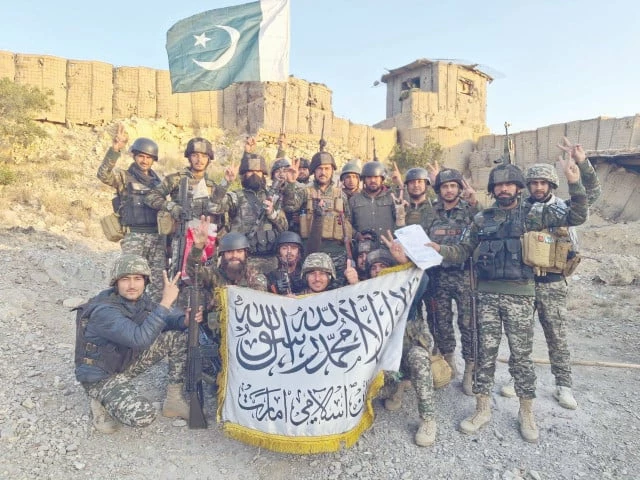
Pakistani soldiers pose with the national flag at a captured checkpoint inside Afghanistan while showing respect for the enemy flag.
ISLAMABAD:
In a dramatic escalation along the volatile western border, Pakistan said on Friday it had carried out “precise and heavy” retaliatory operations inside Afghanistan, using massive air power to bomb military bases, ammunition depots and other installations after what it described as repeated cross-border terrorist attacks and the latest “provocative military actions” by the Taliban regime.
Islamabad said it inflicted massive casualties on Afghan regime troops and allied terror networks in retaliatory strikes, marking one of the most serious confrontations between the two neighbors since 2021.
The military said the flare-up followed coordinated cross-border attacks and raids by Afghan Taliban forces in collaboration with the outlawed Tehreek-e-Taliban Pakistan (TTP), prompting a forceful and “measured” response by the armed forces.
Speaking at a press conference, Inter-Services Public Relations (ISPR) Director General Lt. Gen. Ahmed Sharif Chaudhry revealed that Pakistan’s “immediate and effective response” resulted in the killing of 297 Afghan regime personnel and injuries to more than 450 others.
He also confirmed that 12 Pakistani soldiers had embraced martyrdom, 27 were injured and one soldier was missing in ongoing clashes along several sectors of the Pak-Afghan border.
According to the military spokesman, Afghan Taliban forces opened fire and carried out attacks at 53 locations across 15 sectors along the border. He said these actions were carried out in coordination with the TTP, which he described as a globally designated terrorist organization.
Lt Gen Ahmed Sharif further claimed that 89 Afghan positions had been completely destroyed in retaliatory operations, 18 positions were taken over by Pakistani forces and 135 tanks and armored vehicles were destroyed.
By way of background, he said that on the nights of February 21 and 22, Pakistani forces had carried out “very carefully calibrated” attacks against TTP hideouts at 22 locations in Afghanistan. He maintained that there were no civilian casualties during these operations.
“These operations against terrorist hideouts were used as a pretext by what he called ‘master copy of terrorist organizations’ – the Afghan Taliban – to launch a so-called operation against Pakistan,” he said.
DG ISPR added that subsequent engagements included strikes on military installations in Kabul, Kandahar and Paktika. He said that in Kabul, an infantry brigade headquarters and other military facilities were targeted, while terrorist hideouts and weapons caches were destroyed.
He stressed that the operation was conducted under the direction of the civilian leadership and would continue until “required objectives” were achieved.
“The Afghan regime will have to choose between Pakistan and terrorist groups,” he said. “Our choice is clear – Pakistan, its security, its people and their honor.”
The claims by the Pakistani military could not be independently verified.
FO invokes the right to self-defense
Meanwhile, the State Department issued a strongly worded press release saying that Pakistan’s defense forces had carried out “precise operations” against terrorist outfits and their logistical support bases in Afghanistan.
The State Department said the action came in response to “repeated terrorist attacks by Fitna-e-Khawarij and Fitna-e-Hindustan” emanating from Afghan soil, as well as the latest “unprovoked and provocative actions” by the Taliban regime on the night of February 26.
Islamabad maintained that its actions were taken in exercise of Pakistan’s inherent right of self-defense under international law and the UN Charter to ensure the safety and security of its citizens and the wider region.
It warned that any further provocation by the Taliban regime or attempts by terrorist groups to undermine Pakistan’s security and welfare would be met with a “measured, decisive and appropriate response.”
The statement said Pakistan had consistently sought peaceful and constructive relations with Afghanistan and had remained engaged in diplomatic efforts to counter the threat of terrorism emanating from Afghan territory. However, it lamented that its “numerous goodwill gestures and highly responsible approach” were misunderstood, leading to an increase in the number of terrorist attacks allegedly carried out with the “active support and backing of the Taliban regime as well as India.”
Pakistan reiterated its resolve to end terrorism emanating from Afghanistan and urged the Afghan authorities to end the “impunity” with which militant groups continue to operate from its soil. It also urged the international community to pressure the Taliban regime to take “concrete and verifiable measures” against such outfits.
Islamabad said it reserves the right to take all appropriate measures in self-defense in accordance with international law.
Amid escalating tensions, Prime Minister Shehbaz Sharif visited the General Headquarters (GHQ) in Rawalpindi, where he was given a comprehensive briefing by the military leadership on the developing situation.
The prime minister declared “zero tolerance” for what he described as the link between Fitna-e-Khawarij and the Afghan Taliban regime, and termed actions against Pakistan “unacceptable”.
Under the leadership of Chief of Staff and Chief of Defense Staff Field Marshal Syed Asim Munir, the armed forces were fully prepared to defend the country, he said.
“Pakistan knows well how to defend itself against any aggression,” the prime minister noted, praising the armed forces’ professionalism and operational readiness to repel attacks in border areas and respond forcefully.
He added that the entire nation stood shoulder to shoulder with the armed forces to ensure the country’s sovereignty and territorial integrity.
Information Minister Attaullah Tarar said he had been specially briefed by DG ISPR about the operation and the Pak-Afghan situation.
He said Pakistan had effectively responded to Afghan aggression and taken control of several Afghan posts. He accused the Afghan Taliban regime of supporting terrorist groups and allowing Afghan soil to be used for recent attacks in Pakistan.
According to Tarar, Afghan nationals were involved in attacks on Islamabad district courts and in Tarlai. He claimed that the recent suicide attacks on the judicial complex and an imambargah in Islamabad were facilitated by using Afghan territory.
In addition to security concerns, the minister criticized Taliban governance, describing the current setup in Kabul as an “illegal government” that had seized power by force.
He said the Taliban’s newly introduced penal code institutionalized oppression, violence and discrimination against women and was in direct violation of international human rights conventions as well as incompatible with Islamic principles of equality and dignity.
Tarar claimed that nearly 80% of Afghan women aged 18 to 29 were deprived of education, that Afghanistan had the largest gender gap in labor force participation globally, and that women had been systematically excluded from political decision-making at all levels.
The latest exchange of gunfire and sharp rhetoric signals a dangerous phase in Pakistan-Afghanistan relations. While Islamabad insists it seeks peace and regional stability, it has made clear that cross-border attacks and alleged state-sponsored militancy will invite a forceful response.


