
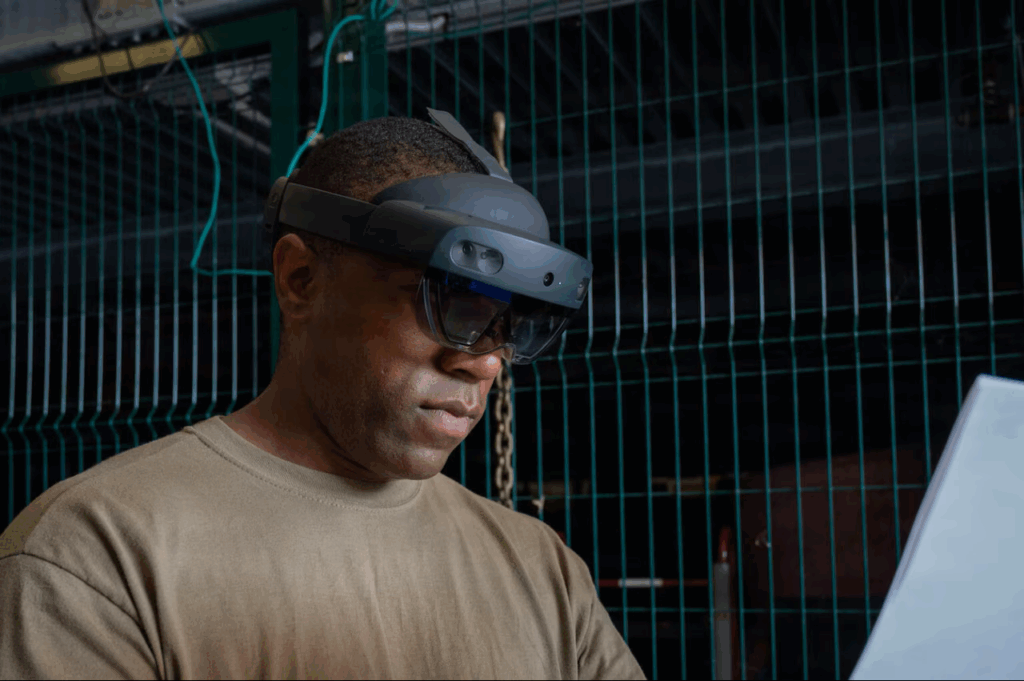
- Microsoft’s military HoloLens project wasn’t a total waste after all
- The US Air Force has found a new use for the headset for loading and balancing aircraft
- The VR headset can provide visual cues to indicate unsafe cargo
Microsoft offered its HoloLens glasses to the US Army back in 2018 as a heads-up display on the battlefield to increase situational awareness.
While the kit was able to offer navigation data, building layouts and firing ranges to soldiers – users complained of suffering from headaches, nausea and eye strain during testing.
While Microsoft has since handed the project over to Anduril, some HoloLens headsets have found a new life helping the US Air Force load aircraft.
Balancing an airplane behind a desk
Outside the glamor of the Air Force, who films as Top Gun aims to portray, much of the Air Force’s job is logistics – and that means loading and unloading aircraft all over the globe. In the words of General Dwight D. Eisenhower, “You will not find it difficult to prove that battles, campaigns, and even wars have been won or lost primarily because of logistics.”
Now, loading a plane is one thing, but balancing it is another. An unbalanced load can throw off all the normal flight characteristics a pilot would expect from an aircraft they’ve flown for thousands of hours before – with fatal results. The problem is that airmen with the skills and knowledge required to properly balance an aircraft cannot be at every air base at all times.
To address this, the Air Force and Army teamed up to use the HoloLens VR goggles to turn any enlisted man into a qualified aircraft loading expert from anywhere in the world—all they need is a HoloLens, a laptop, and a Wi-Fi connection.
The development and practical application of this new augmented reality is being used by the 724th Air Mobility Squadron, based in Aviano, Italy, which has assisted the Army’s 173rd Airborne Brigade, based in Vicenza, Italy, with the safe loading and balancing of aircraft.
725th Air Mobility Squadron superintendent, Chief Master Sgt. Anthony Sewejkis explained that a year was spent working with Microsoft to iron out the kinks in the software. “Now it’s plug and play. We can connect [from] anywhere just by using HoloLens, a Wi-Fi hotspot and a laptop,” Sewejkis explained.
A qualified airman can now sit behind a laptop anywhere in the world and look through the eyes of the person loading the aircraft and point out any irregularities in how the load is secured or balanced in real time with visual cues through the headset.
While the headsets may do little to help the much-loved Chair Force’s external reputation, the 521st Air Mobility Operations Wing, parent of the 724th, stated that the technology helps “increase maneuver speed to maintain joint force lethality across the competition continuum.”

The best office chairs for all budgets


