
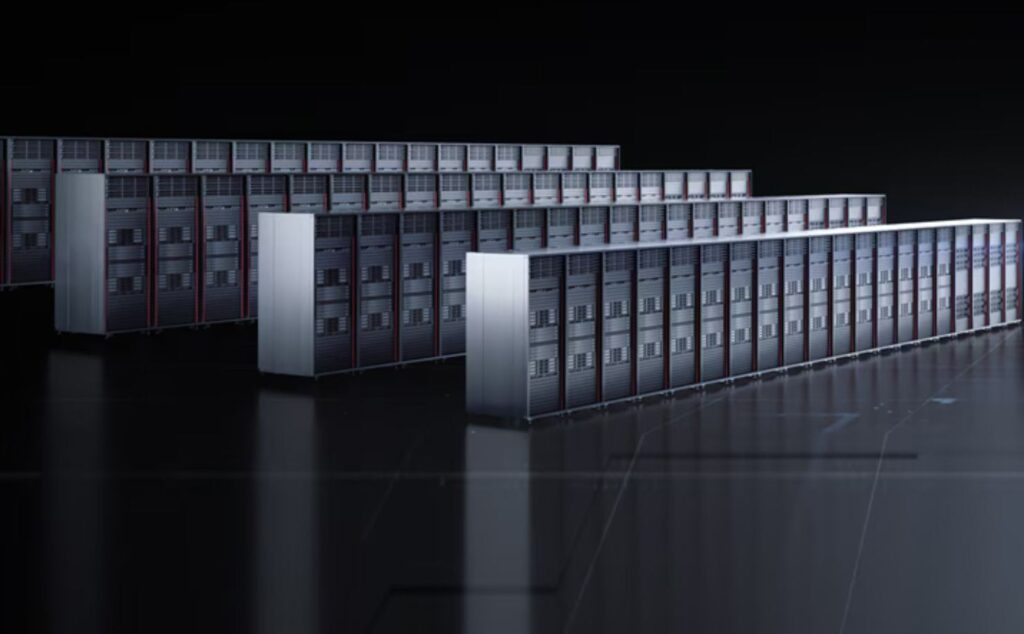
- Huawei Atlas 950 and TaiShan 950 SuperPoDs Unveiled Globally at MWC 2026
- The Atlas 950 connects up to 8,192 Ascend NPUs into a single logical AI system
- Huawei enters AI infrastructure race with full-stack platform to rivals Nvidia and AMD
At MWC 2026, Huawei unveiled its Atlas 950 and TaiShan 950 SuperPoDs to a global audience for the first time, expanding its largest AI computing clusters beyond the Chinese market.
AI models are now measured in trillions of parameters, and agent systems are starting to run in real production environments. Scaling these workloads by simply adding more servers is becoming inefficient, with coordination overhead and latency limiting performance in very large clusters.
The Atlas 950 is built around up to 8,192 Ascend NPUs connected via Huawei’s UnifiedBus connection. Rather than operating as thousands of loosely coupled accelerators, the system is engineered to behave like a single logical computer, reducing communication delays between processors during large training runs.
TaiShan 950 SuperPoD
At full configuration, the system is rated for up to 8 exaflops of FP8 performance and 16 exaflops in lower precision formats.
It spans about 160 enclosures of nearly 1,000 square meters, supports more than a petabyte of memory, and delivers 16.3 PB/s of interconnect bandwidth.
This scale level is aimed at training large models and high-throughput workloads.
The TaiShan 950 SuperPoD, also shown at MWC 2026, extends the same architectural approach to general computing, targeting enterprise data center workloads in addition to dedicated AI training.
TaiShan 500 and TaiShan 200 servers round out the portfolio at lower performance levels.
The global debut puts Huawei in direct competition with Nvidia’s DGX SuperPOD and NVL platforms, as well as AMD’s upcoming MegaPod systems built around Instinct accelerators (see how they compare here).
Nvidia’s advantage lies in its well-established CUDA software platform and GPU clusters that are already widespread in research labs and enterprise data centers.
The Atlas 950 runs on Huawei’s Ascend AI chips and works with CANN, its open source computing architecture that supports frameworks like PyTorch and Triton.
This combination gives developers a way to build and run AI workloads without relying on Nvidia’s CUDA platform, offering an alternative path to large-scale AI systems.
By bringing the Atlas 950 to MWC’s global stage, Huawei presents itself not only as a chip designer, but as a builder of complete AI computing systems that compete at the highest end of the data center market.
Follow TechRadar on Google News and add us as a preferred source to get our expert news, reviews and opinions in your feeds. Be sure to click the Follow button!
And of course you can too follow TechRadar on TikTok for news, reviews, video unboxings, and get regular updates from us on WhatsApp also.


