
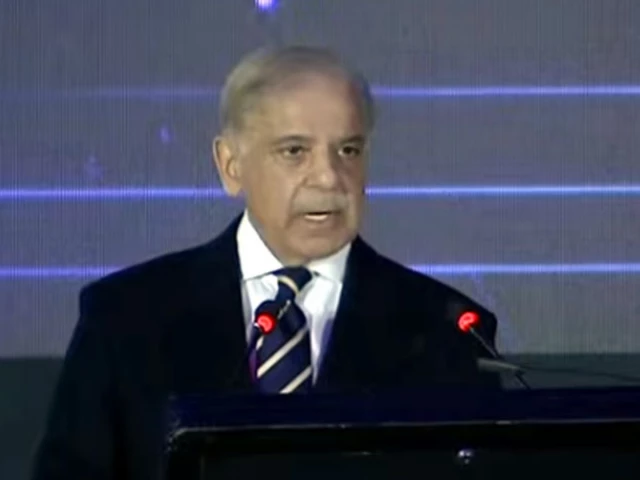
Prime Minister Shehbaz Sharif speaks at the opening ceremony of Indus AI Week in Islamabad. PHOTO: RADIO PAKISTAN
ISLAMABAD:
The federal government told political and parliamentary leaders on Wednesday that Pakistan will avoid becoming directly involved in the ongoing Iran and US-Israel conflict while pursuing diplomatic efforts aimed at de-escalation.
The assurance came during a closed briefing organized for the leaders of political parties and parliamentary leaders at the Prime Minister’s House.
Under the leadership of Prime Minister Shehbaz Sharif, the briefing was attended by representatives of PPP, MQM-P, JUI-F, BAP and others.
Key participants included PPP Chairman Bilawal-Bhutto Zardari, JUI-F Chief Maulana Fazlur Rehman, Deputy Prime Minister and Foreign Minister Ishaq Dar, National Assembly Speaker Sardar Ayaz Sadiq, Deputy Speaker Ghulam Mustafa Shah, Information Minister Attaullah Tarzear, Parliamentary Minister Ahar I Azam, Law Minister and Minister for Parliament Tarar I Azam. Affairs Dr. Tariq Fazal Chaudhry. PML-N’s Pervaiz Rasheed, Sherry Rehman, Naveed Qamar.
Other party leaders included Khalid Maqbool Siddiqui of Muttahida Qaumi Movement-Pakistan (MQM-P), Faisal Subzwari, farooq sattar, Abdul Aleem Khan of Istehkam Pakistan Party (IPP), Khalid Hussain Magsi of Balochistan Awami Party (BAP) and Chalik Hussaudhry’. BAP’s Manzoor Ahmed Kakar.
However, the Pakistan Tehreek-e-Insaf (PTI) and parties that are part of the grand opposition alliance stayed away from the on-camera briefing, drawing a strong reaction from Prime Minister Sharif, who said the PTI often prioritizes politics over national interests.
As the briefing was on camera, few details were available about what happened behind closed doors. An insider told The Express Pakinomist that the session was primarily chaired by Deputy Prime Minister and Foreign Secretary Ishaq Dar, who gave an overview of the current Iran situation as well as tensions between Pakistan and Afghanistan.
According to the PM Office statement, the session, which lasted over two hours, delved into the volatile border dynamics between Pakistan and Afghanistan, including updates on Operation Ghazab Lil Haq, the ongoing military campaign launched in late February against terrorist hideouts in tribal areas and along the Durand Line in response to cross-border attacks and attacks by Taliban-Afghan groups.
Discussions also covered escalating hostilities in Iran, the wider Middle East and the Gulf region amid fears of a wider conflict following strikes and counter-attacks.
The prime minister highlighted Pakistan’s diplomatic outreach, including high-level contacts with regional and Middle Eastern leaders to advocate for de-escalation and maintain stability.
After the briefing, Law Minister Azam Nazeer Tarar emphasized the government’s commitment to ongoing consultations, described dialogue as the way forward and emphasized that politics should not interfere in matters of sovereignty and security.
He noted that senior leaders Rana Sanaullah and Tariq Fazal Chaudhry had reached out to ensure opposition participation, underscoring the need for a united national voice on issues with international implications.
Dr. Tariq Fazal Chaudhry, Federal Minister for Parliamentary Affairs, took to X with a pointed criticism: “In view of national security and the current serious situation in the region, a very important security briefing was held today at the Prime Minister’s House, where the country’s defense and security institutions informed the political leadership about the changing regional situation, the threats from Tesafhreek, Pakistan and Pakistan. (PTI) and some opposition parties proved once again that their own politics and personal agenda are more important to them than national interests. At a time when the country needs unity, seriousness and responsibility, the opposition’s absence from such an important forum is extremely irresponsible politics.”
The opposition defended its boycott of the briefing on camera. PTI chairman Barrister Gohar Ali Khan said the party took national security seriously but objected to the format of the meeting.
“At a time when there are major challenges – including developments in Afghanistan and tensions involving Iran – we believed that such issues should have been discussed in parliament, preferably through a joint session of both chambers. Our voice and humanitarian concerns must be respected; otherwise participation will be meaningless,” he said.
PkMAP leader Mahmood Khan Achakzai, the leader of the opposition in the National Assembly, argued for wider parliamentary involvement rather than selective invitations, while affirming willingness to engage if discussions arose in parliament.
Wednesday’s session built directly on Secretary of State Ishaq Dar’s speech in the Senate the day before, in which he condemned the “sudden” and “unwarranted” US-Israeli attacks on Iran as a dangerous escalation.
He reaffirmed Pakistan’s readiness to facilitate talks between the US and Iran, potentially in Islamabad, highlighting recent shuttle diplomacy and backchannel contacts.
The in-camera briefing was part of the government’s efforts to bring all the political parties into confidence with the aim of developing a consensus in light of the many challenges. But the absence of PTI thwarted these efforts.


