
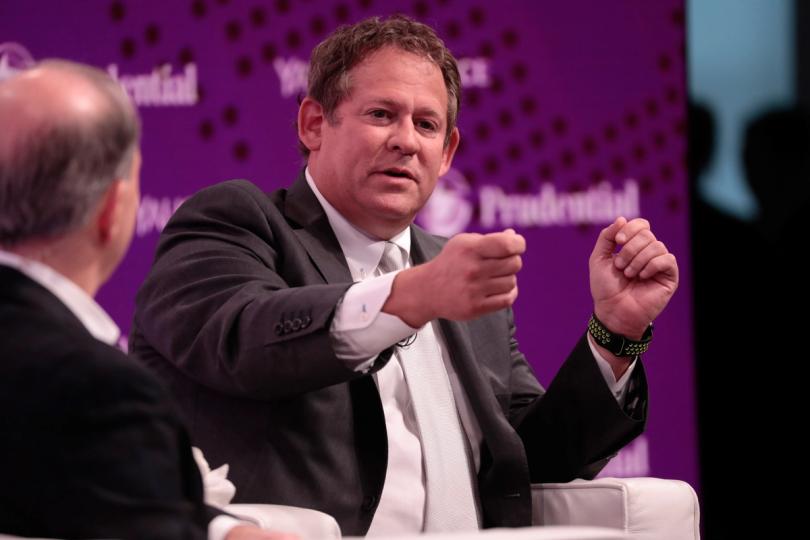
BlackRock’s Rick Rieder, UBS’s Ulrike Hoffmann-Burchardi and hedge fund manager Daniel Loeb see a 2026 economy that could keep growing even as the market’s center of gravity shifts.
The broad message from their separate appearances at a conference in Miami last week was not that the AI boom is ending. Instead, they said, the easy phase may be over. As capital spreads beyond a handful of giant U.S. tech stocks, investors may need to think less about riding one theme and more about where growth, pricing power and disruption will emerge next.
That view could have implications for crypto markets, particularly bitcoin . If investors move away from the crowded trades that have defined the past few years, some may look harder at assets outside of traditional equity sectors. Bitcoin has often traded as a high-beta technology proxy during periods of risk, but it can also attract demand when investors seek diversification from dollar assets, long-term growth stocks or amid political uncertainty.
In practice, however, bitcoin has not consistently acted as the main hedge against dollar weakness, particularly in recent months when gold has been the dominant asset as investors move away from the dollar. But as bitcoin matures — many argue it’s still a young asset compared to gold — that could change.
Rieder, BlackRock’s chief investment officer for global fixed income, said he has been expanding portfolios away from concentrated technology ventures. He said he still likes parts of the technology, but called the investment landscape different from last year as something he can remember for some time.
His outlook rests in part on the idea that US growth can surprise on the upside even as interest rates move lower. Rieder said AI-driven productivity could help the economy expand while a still-soft labor market keeps inflation contained. He also argued that tariffs may have an impact on certain industries, but that they have less of an impact on the economy because the US is more dependent on services than goods.
For bitcoin, that mix cuts both ways. Stronger growth and lower rates will usually support risk assets, including crypto. However, if inflation remains contained and real economic activity improves, investors may feel less urgency to seek out alternative stocks of value. In that setup, bitcoin’s case may lean less on macro fears and more on portfolio diversification and institutional adoption.
Hoffmann-Burchardi, UBS Global Wealth Management’s chief investment officer for the Americas and global head of equities, also said the macro backdrop should improve this year, pointing to fiscal stimulus in major economies and more room for US rate cuts. However, her larger point was that the AI business is changing.
After three years in which markets rewarded companies that enabled AI deployment, she said investors are entering a phase where winners and losers will be more sharply separated. UBS has responded by reducing its overweight rating on technology and communications services and shifting towards industrials, electrification and healthcare.
This rotation can also affect crypto. If equity investors become more selective about AI and digital business models, tokens tied to broad AI narratives may face more scrutiny. Bitcoin may be better placed than smaller cryptoassets in that environment because its investment case is simpler. It doesn’t depend on proving a software revenue model or winning a race for AI market share.
Loeb, founder of hedge fund Third Point, said the market is already rewarding investors who do deeper stock picking and more short selling. He described a shift away from crowded mega-cap deals to smaller, niche companies, including companies in Europe, Japan and South Korea that provide key parts of the AI architecture.
On the economy, Loeb said the U.S. is in a good place for the next six months, although he was less confident about the outlook beyond that. He also said that stress in private credit, particularly in loans tied to software companies, is likely to produce losses over time, but not a systemic shock.
Together, the three investors outlined a year in which growth holds steady, AI remains the dominant force, and markets become harder to navigate. For bitcoin, this could mean fewer tailwinds from simple momentum trades and a greater need to stand on its own as either a hedge, a diversifier or a liquid alternative in a more fragmented market.


