
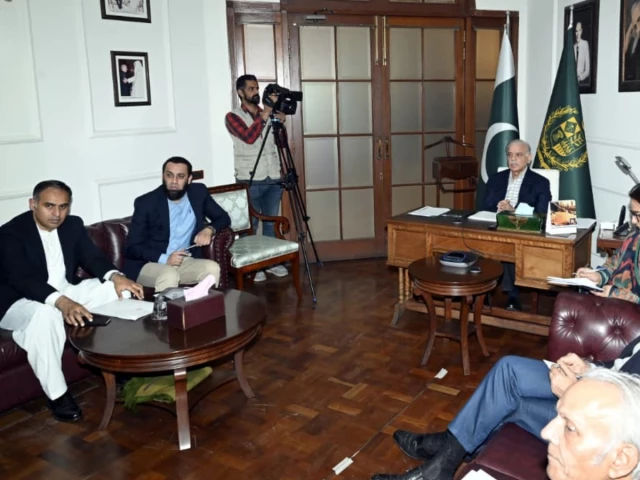
Sharif says the government is closely monitoring the situation and will take all necessary decisions to ensure stability in the economy
Prime Minister Shehbaz Sharif on Sunday reviewed several proposals and recommendations for implementing austerity and prudent spending, with a final action plan scheduled for formal release on Monday (tomorrow) as the crisis in the Middle East widens.
Prime Minister Shehbaz, a day earlier, held the meeting where he directed the relevant ministries to prepare a comprehensive plan based on austerity and austerity in the face of global economic pressure caused by regional tensions.
He directed the authorities to formulate a strategy focusing on economic growth, simplicity and savings and directed the concerned committee to come up with practical and actionable recommendations within 48 hours.
According to the Prime Minister’s Office (PMO), today’s high-level meeting was aimed at reviewing measures to maintain economic stability amid recent international tensions.
Prime Minister Mohammad Shahbaz Sharif made an important statement regarding measures to keep the country’s economy stable from the international level on Monday.
The prime minister was given a detailed briefing regarding the recent tension and its consequences.
briefing… pic.twitter.com/EAaKLkZNRe
— PTV News (@PTVNewsOfficial) March 8, 2026
“The Prime Minister received a detailed briefing on the potential economic impact of the evolving global situation, particularly on Pakistan’s energy supplies and fluctuations in international markets,” the statement said.
“In light of recent international developments, timely implementation of measures to protect the national economy is essential,” Prime Minister Shehbaz said. “The government is monitoring the situation closely and will take all necessary decisions to ensure the stability of the economy.”
He promised that all possible steps would be taken to protect public interests and maintain economic stability during this challenging period. He directed the federal cabinet, provincial representatives and senior officials to ensure efficient use of resources and provide relief to the public.
The Prime Minister stressed the need for wise management of national resources during this difficult period and assured that when the situation improves, the government would provide greater relief to the public.
The statement added that austerity measures would not affect the industrial and agricultural sectors and ensure that production, exports and food security remain intact.
Read more: Prime Minister Shehbaz orders austerity measures
“Everyone should bear the burden of austerity and austerity fairly. The privileged sections of society and elite classes should set an example in making the necessary adjustments,” the Prime Minister said.
Officials also confirmed that Pakistan currently has adequate stocks of diesel, petrol and other petroleum products and the government has taken precautions to deal with any emergency. The meeting emphasized careful and efficient use of energy.
The IT Ministry was also directed to provide a system for continuous monitoring of supply and demand to enable timely decision-making, and the provincial governors briefed the Prime Minister on economic activities, energy consumption and administrative preparedness in their regions.
Regional tensions escalated sharply after airstrikes by the US and Israel last week killed Ayatollah Ali Khamenei, Iran’s supreme leader, along with several senior officials. The attacks triggered retaliation by Iran, widening the conflict throughout the region.
In response, Iran launched attacks on US military bases in several Gulf countries, significantly widening the confrontation.
Read also: Iran says it can fight the US and Israel for six months as the regional conflict widens
Iran has also closed the Strait of Hormuz following airstrikes by the US and Israel last week, halting the movement of oil supplies to many countries.
As a result, crude oil prices on Friday recorded their strongest weekly rise since the extreme volatility of the COVID-19 pandemic in the spring of 2020, as shipping and energy exports through key waterways were disrupted.
Following this, the government sharply hiked diesel and petrol prices by Rs55 per litre, or 20% – marking the first of a series of similar hikes expected in the coming days due to the ongoing conflict between the US and Israel and Iran, which has disrupted supply chains and pushed crude oil prices to their highest in two years.
The increase in petrol prices was more than the increase in international markets, as the government chose to collect more money than required from motorcyclists and car owners to subsidize the use of diesel, mostly by public transport and the agricultural sector.


