
- GWM’s chairman apologizes for the copycat ad
- The Range Rover has been the subject of Chinese plagiarism recently
- Wei Jiangjun says the company takes full responsibility
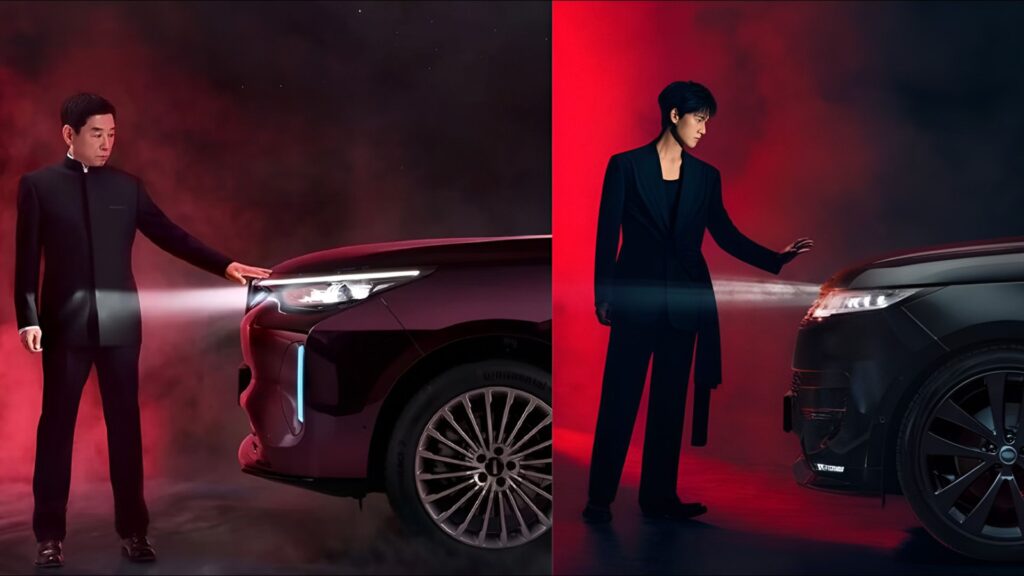
China’s Great Wall Motors recently debuted its latest Plug-in Hybrid Electric Vehicle and celebrated the release of the Wey V9X SUV with an ad campaign that instantly had internet researchers comparing it to a previous Range Rover campaign image.
While it’s often the physical product that receives criticism from IP vendors – we’ve explained our feelings about Range Rover copycats – the issue in this case wasn’t the Wey V9X SUV itself, but the ad campaign, which looked almost identical to a shot Land Rover used last year to promote the Range Rover Sport.
As you can see from the photo used here in the article (courtesy of Car News China), the marketing team at China’s Great Wall Motor (GWM) didn’t even try to hide the source of its inspiration, even choosing an almost identical color palette.
The article continues below
As a result, GWM chairman Wei Jiangjun took to social media to take full responsibility for the incident, saying, “After verification, the poster was actually plagiarized,” he said in Mandarin and translated into English by IT-Home.
“There can be no justification,” he added, before going on to claim that GWM would take “full legal and financial responsibility” for the slip-up.
There is currently no word on whether Land Rover will take any legal action against the company, which already has several models it hopes will steal sales from the British off-road specialist, including the GWM Tank 4×4 model, which is hugely popular in China and is tipped to make its way to the UK.
Analysis: History repeats itself
Land Rover has a long history with China, particularly with Jiangling Motors Corp, which was accused of copying the Range Rover Evoque with its own Landwind X7 model back in 2016.
Years later, the British manufacturer won a landmark court case that found the X7 copied several unique features, leading to customer confusion. As a result, it was forced to cease production.
The ruling should send a message to the wider Chinese auto industry that stricter intellectual property enforcement would be used in the future.
While direct imitations are now a less common sight at China’s numerous annual auto shows, it’s clear that many brands are still pushing the boundaries of artistic license, with Jaecoo, Xpeng and Geely all recently launching electrified models that borrow heavily from the Land Rover stable.
It could be argued that because the Chinese car industry does not have a long history to draw on, it will naturally look to more established Western car manufacturers for design inspiration.
But some industry insiders feel things will soon change, with a number of Chinese designers already speaking out that their domestic auto industry is plagued by a “tendency to blindly follow trends,” according to Car News China.
In fact, it has gotten so bad that there have been cases of domestic manufacturers fighting internally over plagiarism, with new electric and new energy vehicles singled out for their homogeneity.
But protecting intellectual property rights is extremely difficult in China, as the legal system often considers exterior design infringement inherently subjective, so many cases are dropped or settled out of court.
Follow TechRadar on Google News and add us as a preferred source to get our expert news, reviews and opinions in your feeds. Be sure to click the Follow button!
And of course you can also follow TechRadar on YouTube and TikTok for news, reviews, video unboxings, and get regular updates from us on WhatsApp also.


