
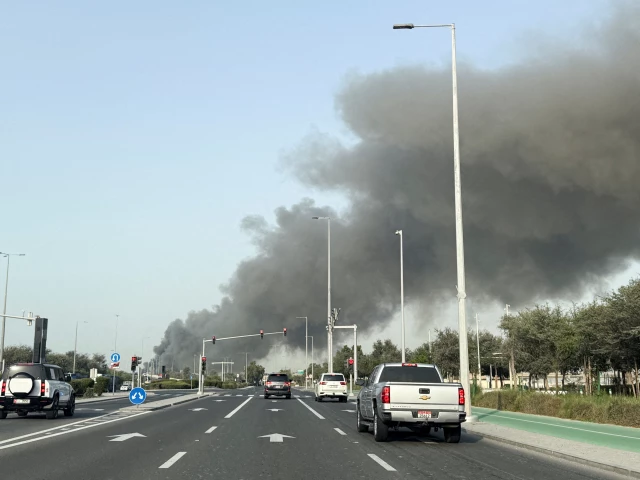
Smoke billows from Zayed Port after an Iranian attack, following the US and Israeli attack on Iran, in Abu Dhabi, United Arab Emirates, March 1, 2026. Photo taken by phone. PHOTO: REUTERS
Abdul Malick sat among grieving relatives in his village and received condolences from neighbors after his nephew, Muzaffar Ali, was killed in Dubai last week.
Ali, a 27-year-old laborer, was one of two Pakistanis killed in Iranian retaliatory strikes against the Gulf states since the start of US-Israeli strikes on the Islamic Republic two weeks ago. Debris fell on his vehicle when a projectile was intercepted.
“It’s a great tragedy for a family whose sole breadwinner was lost,” said Malick, flanked by Ali’s three young children.
“We have nothing to do with this war. It is unfortunate that the poor are being used as fuel for a conflict they have no part in,” he said. AFP.
Read more: Prime Minister Shehbaz says oil prices remain unchanged despite rise in international market
Ali moved to Dubai from Sindh’s Jamshoro district four years ago.
Relatives pray at the grave of Pakistani national Muzaffar Ali, who was killed in Dubai amid the ongoing Middle East war, after his funeral in Jamshoro in Sindh province on March 12, 2026. PHOTO: AFP
Another Pakistani victim, Murib Zaman, a 48-year-old father of five from Bannu, had been working as a driver in the UAE for the past 25 years.
A third was killed in a drone strike while fishing in Iranian waters, officials said.
Pakistan, which has condemned Tehran’s retaliatory strikes, shares a border with Iran in the southwest and is increasingly feeling the direct effects of the war in the Middle East.
Rising oil prices have forced fuel prices to skyrocket, while the attacks have seen around 4,000 people, including students, return from Iran.
Gulf remittances are important for South Asian countries, and in Pakistan they account for around 3-5% of GDP, according to a note from analysts Capital Economics.
More than 5.5 million Pakistanis, many of them unskilled workers, work in the region, particularly in the United Arab Emirates and Saudi Arabia, with the remittances they send home vital to support their families.

Mourners gather to offer condolences following the death of Pakistani national Muzaffar Ali following his funeral. PHOTO: AFP
Read more: Four US service members killed in plane crash over Iraq
Remittances help households meet daily expenses, but also finance education, health care and small businesses, driving domestic consumption and economic activity.
Earlier this week, the State Bank of Pakistan said the country received $3.3 billion in foreign remittances in February 2026, up 5.2% year-on-year.
Capital Economics warned that a protracted conflict could hit the Gulf economies with a knock-on effect on remittances to South Asia.
For now, most Pakistani workers seem to be staying in the Gulf. The Foreign Office said the numbers coming back were “too few to call a major outflow”.

Abdul Malick, a transporter and uncle of Pakistani national Muzaffar Ali, shows a picture of Ali on his mobile phone. PHOTO: AFP
Zaman’s cousin, Farmanullah, who uses only one name, said AFP that his dream was for Bannu to develop like Dubai and peace at home.
“Unfortunately, this wish remained unfulfilled,” he added.
In Sindh, Malick said the family was “disappointed” to have received no financial support from either the UAE or Pakistani government so far.
“It is ironic that when he left Pakistan, we were happy for him to go to one of the safest countries in the world to later receive his dead body,” he said. AFP.
“We demand an end to this war so that innocent workers like Ali are not used as fuel for it,” he added.
“We also demand that the UAE government provide the necessary protection and security for civilian workers.”


