
Top Leader Says ‘Assassins’ Will Pay To Kill Larijani; US finds Tehran not rebuilding nuclear enrichment
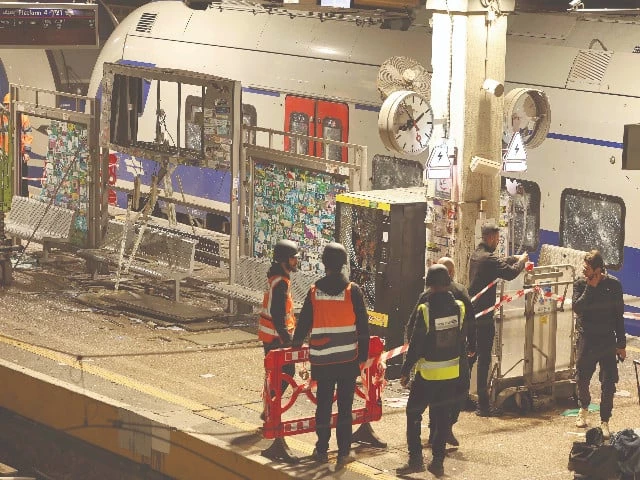
Israeli security forces and rescue workers gather at a train station hit by shrapnel after an Iranian attack in Tel Aviv. Photo: AFP
WASHINGTON/JERUSALEM/TEHRAN:
Israel killed another top Iranian official, Intelligence Minister Esmail Khatib, and declared on Wednesday that its military is authorized to kill any senior Islamic Republic figure in sight, as new Supreme Leader Mojtaba Khamenei said in a written statement that the killers of security chief Ali Larijani, who died in an Israeli strike, “will have to pay for it.”
Iranian President Masoud Pezeshkian labeled Khatib’s death a “cowardly assassination”.
“Without a doubt, the assassination of such a figure testifies to his importance and the hatred that the enemies of Islam have against him,” Mojtaba Khamenei said in a message posted on his official Telegram channel on the day of Larijani’s funeral in Tehran.
“Every drop of spilled blood has a price and the criminal killers of these martyrs will soon have to pay it,” added Mojtaba Khamenei, who has yet to appear publicly after taking office following the assassination of his father, former Supreme Leader Ali Khamenei, at the start of the war.
The war broke out on February 28 when US and Israeli forces attacked Iran and killed Supreme Leader Ayatollah Ali Khamenei, and has since been marked by several high-profile killings.
News of Khatib’s death came a day after Iranian security chief Ali Larijani was confirmed killed in an Israeli strike.
“Prime Minister Benjamin Netanyahu and I have authorized the IDF to eliminate any senior Iranian official for whom the intelligence and operations circuit has been closed, without the need for further approval,” Israeli Defense Minister Israel Katz announced.
“We will continue to thwart them and hunt them all down.”
Israel has also vowed to hunt Iran’s new supreme leader, Mojtaba Khamenei, who has not appeared in public since succeeding his father.
Large crowds gathered in central Tehran for the funerals of Larijani and Gholamreza Soleimani, the head of Basij’s paramilitary force, who was also killed in an attack in Iran this week, according to images broadcast by Iranian state television.
They were held alongside the funerals of more than 80 Iranian sailors killed in a US torpedoing of their frigate off Sri Lanka earlier this month.
Trucks carrying coffins draped in Iranian flags moved through the procession as mourners walked alongside portraits of the slain supreme leader and beat their chests, a sign of mourning in Shia culture.
Unlike Mojtaba Khamenei, Larijani, 68, had walked openly with the crowds at a pro-government rally last week in Tehran.
He had “effectively been the person in charge of the regime’s survival, its regional policy and its defense strategy,” David Khalfa, co-founder of the Atlantic Middle East Forum, told AFP.
US intelligence chief Tulsi Gabbard told a Senate hearing that Washington “assesses the regime in Iran to be intact but largely broken due to attacks on its leadership and military capabilities”.
The Guard, the ideological arm of the military, said it had fired missiles at central Israel in retaliation for Larijani’s death and warned more were to come.
“The pure blood of this great martyr… will be a source of glory, power and national awakening against the front of global arrogance,” they said.
An Iranian missile barrage killed two people near Israel’s commercial hub Tel Aviv, medics said Wednesday, while authorities said falling munitions hit several locations in central Israel overnight.
Police said a cluster bomb hit a residential building in Ramat Gan, a city just outside Tel Aviv, and the roof collapsed on an elderly couple.
Iranian media, meanwhile, said Israel and the United States had launched new attacks in several areas of the country, including Tehran.
The Tasnim news agency said “seven people were killed and 56 were wounded in an American-Zionist attack on residential areas in Dorud city” in Lorestan province.
Tulsi Gabbard
US intelligence has concluded that Iran is not rebuilding nuclear enrichment capabilities destroyed last year by the US and Israel, contradicting a central justification by President Donald Trump for his ongoing war.
Tulsi Gabbard, a Trump ally who is director of national intelligence, offered mixed signals on the background and results of the three-week war when she and other officials appeared before Congress
She also assessed that Iran’s leadership remained intact.
“As a result of Operation Midnight Hammer, Iran’s nuclear enrichment program was wiped out,” Gabbard said in prepared testimony to the Senate Intelligence Committee, referring to the June 2025 U.S. strike.
“There has been no effort since then to try to rebuild their enrichment capacity,” Gabbard wrote.
She did not repeat the conclusion before cameras. Pressed by a Democratic senator, Gabbard said she did not have enough time to read all of the testimony at the hearing, but did not reject the assessment.
Gabbard herself had been an outspoken opponent of war with Iran as a Democratic congresswoman.
One of her senior aides, Joseph Kent, resigned in protest Tuesday as director of the National Counterterrorism Center, saying Iran posed no “imminent threat” and that Trump was being misled by Israel and the media.
Democrats attacked Gabbard over the war, saying she had not proven Iran posed any threat beyond what it has done since the 1979 Islamic revolution.
“President Trump said, we are not the world’s policeman. He ran on it,” said Democratic Sen. Michael Bennet.
“Now he has turned us into the policeman of the world, into its jury, into its judge, into its executioner,” he said.
In her remarks to senators, Gabbard said Iran had suffered heavy blows in the weeks of attacks – which included the killing of longtime Supreme Leader Ayatollah Ali Khamenei – but that the Islamic republic was still functioning.
The U.S. intelligence community “assesses the regime in Iran to be intact, but largely degraded due to attacks on its leadership and military capabilities,” Gabbard said.
“If a hostile regime survives, it will likely seek to begin a years-long effort to rebuild its military, missile and UAV forces,” Gabbard said, referring to unmanned aerial vehicles, or drones.
In other results, Gabbard predicted that Russia would continue to press its four-year invasion of Ukraine, a war that Trump had promised to end upon taking office, mainly by pressuring Kyiv to compromise.
U.S. intelligence “assesses that Russia has maintained the upper hand in the war against Ukraine,” Gabbard said.
“US-led talks between Moscow and Kiev are ongoing. Until such an agreement is met, Moscow will likely continue to fight a slow war,” she said.
Gabbard said the United States faces a threat if there was an “escalating spiral” in Ukraine or elsewhere that could potentially lead to the use of nuclear weapons.
She said China was “rapidly” modernizing its military with the goal of capturing Taiwan, the self-governing democracy that Beijing claims.
But the U.S. intelligence agency “assesses that China likely prefers to set the terms for an eventual peaceful reunification with Taiwan without conflict.”
Trump plans to travel in the coming weeks to China, a trip he has postponed because of the war in the Middle East.
Saudi gas plant
Saudi Arabia said it destroyed a drone heading for a gas plant on Wednesday as Iran threatened to attack Gulf energy infrastructure in retaliation for a US-Israeli attack on its own facilities.
“A drone attempting to approach a gas plant in the Eastern Province was intercepted and destroyed; the interception and destruction did not result in any damage,” the Saudi Defense Ministry said.
Ben Gurion Airport
The Israeli military told AFP on Wednesday that “debris” had hit Ben Gurion International Airport after Iranian missile fire, without specifying when the incident had taken place.
Israeli media reported that private planes parked at the airport near Tel Aviv had sustained damage. The Army lifted the censorship order regarding the incident on Wednesday but did not approve the publication of the date.
Israeli news site Ynet published a photo that appears to show the charred and damaged interior of a small private plane.
It is the first time the army has announced that Ben Gurion – Israel’s main international airport – has been hit since the start of the Middle East war, triggered by the US-Israeli strikes against Iran that began on February 28.
On March 5, Iran’s Revolutionary Guards said they had attacked Ben Gurion Airport and an air force base in the area.
Missile or interceptor debris has fallen in areas near the airport several times since the start of the war.
Flag carrier El Al said on Wednesday it was suspending return flights to nearly 30 destinations, including Barcelona, Berlin and Budapest, from March 22 to March 28.
It said this was “in line with the reduced operational framework and current constraints”.
Israel had closed its airspace on the first day of the war, with El Al and other Israeli airlines subsequently resuming some of their flights under strict security conditions.
Israel’s Transport Ministry announced on Monday that it wanted to increase the number of passengers allowed to travel from Ben Gurion, depending on security guidelines.


