
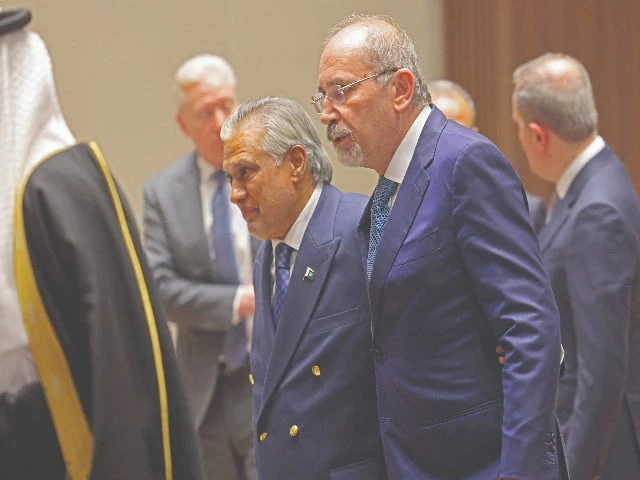
Deputy Prime Minister and Foreign Minister Ishaq Dar and Jordanian Foreign Minister Ayman Safadi attend the consultative ministerial meeting in Riyadh. Photo: AFP
ISLAMABAD:
When Deputy Prime Minister and Foreign Minister Ishaq Dar arrived in Riyadh on Wednesday for a crucial ministerial meeting with key Arab and Muslim countries, Pakistan’s primary aim was to push for dialogue and de-escalation in an increasingly volatile regional crisis.
But even before the meeting of foreign ministers from Saudi Arabia, Azerbaijan, Bahrain, Egypt, Jordan, Kuwait, Lebanon, Pakistan, Qatar, Syria, Turkiye and the UAE could formally begin, the situation took a dramatic turn.
New Israeli strikes targeted Iran’s energy infrastructure, prompting a fierce response from Tehran that spread across the Gulf, hitting critical installations and raising fears of a wider regional war.
The escalation left Arab foreign ministers in an uncompromising mood. “Pakistan’s work was cut out even before the meeting started,” a senior diplomat told The Express Pakinomist, describing the atmosphere as tense and emotional.
According to diplomatic sources, several Arab states were unwilling to heed calls for restraint or diplomacy with Iran, pushing instead for a strong and unequivocal condemnation of Tehran in the joint communique.
Pakistan, which has sought to position itself as a bridge between Iran and the Gulf countries, found itself navigating one of its most delicate diplomatic challenges in recent years.
Sources said Islamabad engaged in intense behind-the-scenes diplomacy to cool tempers and soften the language of the joint statement. As discussions began on the draft statement, the Gulf countries sought a hard-hitting message that held Iran solely responsible for the escalation, while Pakistan pushed for a more balanced approach.
“We convinced our Arab friends to water down the statement to some extent,” another diplomat said, adding that Islamabad also sought explicit references to Israel and the broader causes of instability in the Middle East.
The final joint statement issued after the consultative meeting in Riyadh strongly condemned Iran’s missile and drone attacks on several countries, including the Gulf states, calling them unjustified under any circumstances.
It called on Tehran to immediately cease hostilities, respect international law and refrain from actions that threaten regional security, including maritime routes.
At the same time, the statement also contained a condemnation of Israel’s actions in Lebanon, particularly its “expansionist policies”, reflecting a key Pakistani demand during the negotiations.
Despite this partial success, officials acknowledged that Pakistan had to walk a “tight diplomatic tightrope” to maintain relations with both Iran and its key Gulf allies.
Separately, in an official statement issued by the Ministry of Foreign Affairs, Pakistan stressed the need to address the root causes of the crisis.
The statement noted that while Islamabad supported the sovereignty and territorial integrity of all regional states and condemned attacks on civilian and energy infrastructure, lasting peace could not be achieved without addressing the underlying causes of conflict.
In this context, Pakistan condemned in the strongest possible terms Israel’s continued aggression and provocations, linking wider regional instability to protracted disputes and policies.
During the meeting, Dar reiterated Pakistan’s call for an immediate cessation of hostilities and emphasized diplomacy as the only viable way forward. He also warned against actions that could jeopardize regional energy security and exacerbate global economic challenges.
The State Department said Pakistan would continue its diplomatic outreach and maintain a “constructive role” in de-escalation efforts.
However, diplomatic sources warned that with hardening positions and deepening mistrust, the space for mediation was quickly narrowing, making Pakistan’s balancing act in an already volatile region increasingly difficult.
Meanwhile, Dar, who stressed the importance of maintaining the unity of the Muslim ummah, called for a quick end to the ongoing conflict and reiterated Pakistan’s call for dialogue and diplomacy.
Addressing the Ministerial Meeting of Arab and Islamic Countries, he expressed full support for the territorial integrity, sovereignty and political independence of all fraternal regional states and stressed the need to end all attacks against their territories.
The Deputy Prime Minister emphasized the importance of addressing the root causes of the crisis and, in doing so, strongly condemned Israel’s continued aggression and provocations against regional countries.
He also condemned attacks on civilians as well as on energy and critical infrastructure and called for an end to such actions.
Dar called on all sides to refrain from actions that could undermine regional energy security and exacerbate global economic challenges.
He informed the participants of Pakistan’s ongoing diplomatic efforts to resolve the crisis and reaffirmed Islamabad’s desire to continue playing a constructive role in addressing regional security challenges.
During the visit, Dar conveyed a message of strong solidarity and unwavering support to Saudi Foreign Minister Prince Faisal bin Farhan Al Saud on behalf of the government and people of Pakistan.
He also attended a quadrilateral meeting of the foreign ministers of Egypt, Pakistan, Saudi Arabia and Turkiye held on the sidelines of the summit.


