
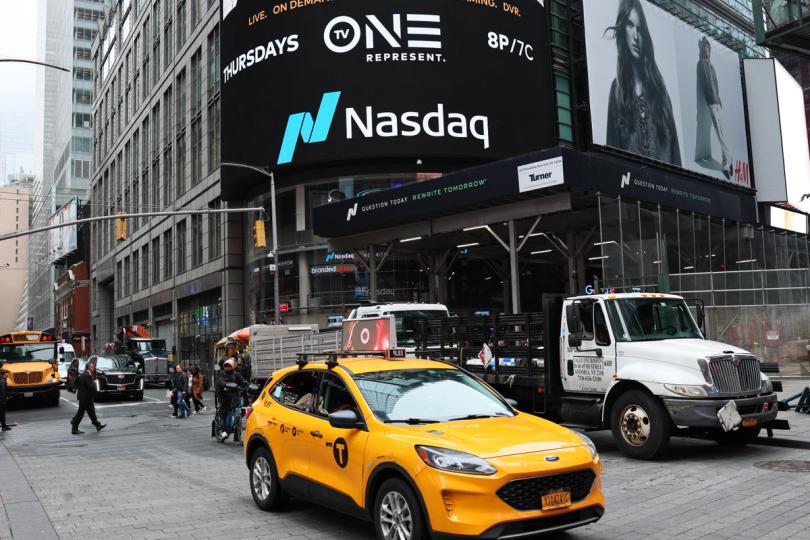
The SEC’s fresh approval of Nasdaq’s tokenized securities framework marks an important turning point for how stocks could trade in the future: it brings blockchain into the core of US stock markets, but on Wall Street’s terms.
The regulatory green light allows Nasdaq to test a system where certain stocks and ETFs can be issued and settled as blockchain-based tokens while trading alongside traditional stocks. In practice, investors could hold tokenized versions of securities in digital wallets, with clearing and settlement handled by the Depository Trust & Clearing Corporation (DTCC).
However, the effort is not a thorough review of the market operations; rather, it focuses on post-trade plumbing.
DTCC director Brian Steele said the firm aims to build “safe, secure tokenization services to promote a more robust, inclusive, cost-effective and efficient financial system,” while working with exchanges and market participants to scale adoption.
Read more: Here’s why Nasdaq and NYSE owner are putting $126 trillion stock market on blockchain
‘Biggest recipients’
One of the main reasons why Wall Street giants are moving to tokenization of stocks is that they can offer trader trading around the clock.
Traditional stock markets operate within fixed trading hours and rely on multi-day settlement cycles. Creating tokens of shares on blockchain rails allows for near-instant settlement and ultimately round-the-clock trading.
Val Gui, general manager of Kraken’s tokenized stock platform xStocks, called the approval “a clear signal that the $126 trillion stock market will move onto blockchain rails,” pointing to a future where stock ownership will be “24/7 and global.”
“This builds on the SEC’s work with DTC, and it’s encouraging,” said Ian De Bode, president of tokenization firm Ondo. “Progress towards 24/7 markets, even in permitted form, is positive.”
“The biggest beneficiaries will be global investors… who have long lacked seamless 24/7 access to US equities,” he added.
In that connection, Nasdaq said it is using crypto exchange Kraken to distribute equity tokens globally.
Wall Street is in control
Still, Nasdaq’s model does not replace the old financial system. It only extends it to onchain securities.
Tokenized shares will still trade through brokers and settle via DTCC, with blockchain mainly used as an alternative record of ownership.
“Nasdaq effectively forecloses the benefits of blockchain within the existing TradFi [traditional finance] stack,” said Maylea Ma, deputy general counsel at 1inch, a decentralized exchange (DEX) aggregator.
Investors may see faster settlement or more flexible ownership features, she said, but only in an approved system that still relies on intermediaries.
“If tokenized shares cannot be connected to broader onchain liquidity and non-custodial execution, the efficiency gains will be incremental rather than transformational,” Ma said.
‘Still one step behind’
While the move is a step toward the future of trade, the U.S. still lags behind other jurisdictions.
Jesse Knutson, chief operating officer at Bitfinex Securities, who has worked on tokenized issuance in frontier markets such as Kazakhstan and El Salvador, said the approval reflects regulatory progress but also highlights how far US efforts still have to go.
“The flexibility of tokenization is what the markets really want,” offering 24/7 trading, fractionation, real-time settlement and the ability to self-serve, he said.
In places like Kazakhstan’s Astana International Financial Center (AIFC) and El Salvador, regulators have already allowed the issuance and trading of tokenized securities with fewer legacy restrictions, including more direct investor access and blockchain-native settlement. Other hubs such as Switzerland and the UAE also moved faster to establish frameworks for digital asset issuance and trading, giving companies room to experiment.
“It’s an encouraging move … but it’s still a step backwards for more progressive jurisdictions,” Knutson said.
To be fair, U.S. regulators oversee the world’s largest and most dominant stock market—worth about $62 trillion—which provides less incentive and flexibility to overhaul the existing systems in favor of newer blockchain-based models. Any changes must fit into a deeply entrenched market structure built around investor protection, intermediaries and centralized clearing.
But for now, the SEC’s decision points to a clear direction: Tokenization is coming to public markets, and it will be shaped, at least initially, by the same institutions and rules that define them today.


