
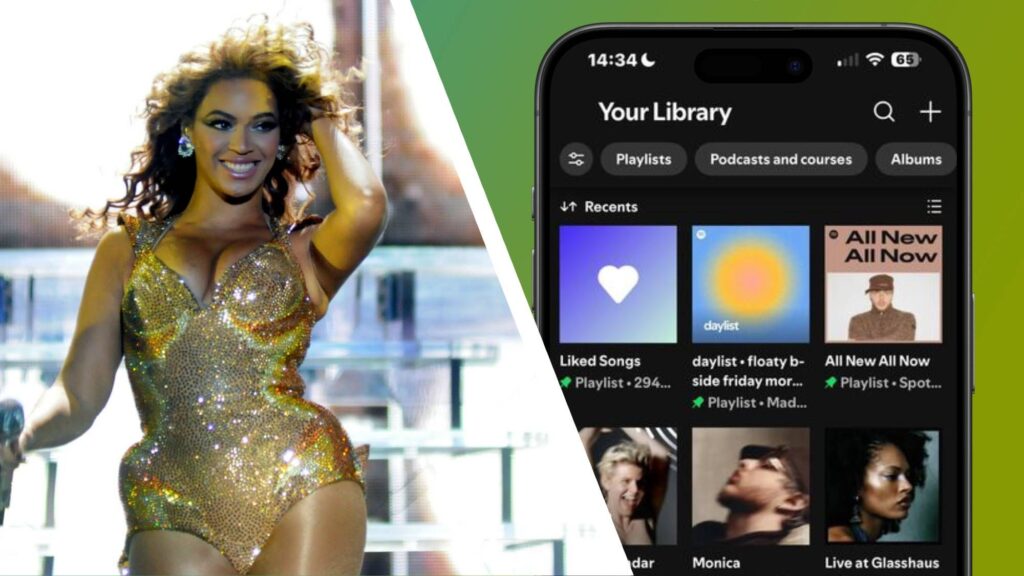
- Sony Music pulls over 135,000 deepfakes impersonating its biggest artists
- This includes acts such as Beyoncé, Harry Styles and Bad Bunny
- Now industry giants are calling on music platforms to clearly label AI-generated content
The battle between the top music streaming services and AI-generated slop is still an ongoing conflict, and now Sony Music is getting involved – it has removed over 135,000 deepfake songs from some of its most famous artists.
According to the music giant, the generative AI deepfakes were created to mimic a number of its biggest artists, including Harry Styles, Beyoncé and Queen, with other artists such as Miley Cyrus and Bad Bunny potentially affected. This figure was revealed at the launch of the Global Music Report by the International Federation of the Phonographic Industry (IFPI) earlier this week.
In a statement issued to the BBC, the president of Sony’s global digital business, Dennis Kooker, describes the damage these deepfakes can cause, sharing: “In the worst cases, (deepfakes) can potentially damage a publishing campaign or tarnish an artist’s reputation”.
The article continues below
Aside from the artist’s reputation, fraudulent AI causes great damage to an artist’s financial gain. Kooker added: “This is when deepfakes are at their worst – building and taking advantage of the demand the artist has created (and) ultimately detracting from what the artist is trying to achieve.” But the numbers also reveal how fast AI slop and fraudulent streams are increasing.
Although Sony has removed the 135,000 AI-identified tracks, it’s possible that this is just some of the AI-generated content uploaded across Spotify and Apple Music. Apparently, Sony Music has flagged around 60,000 songs falsely claiming to be from their pool of artists since last March, which the company also revealed in the report.
As it turns out, music fans are running into AI-generated content on streaming platforms more often than they should be, which can be attributed to the rapid development of AI models and their cheap availability. We’ve previously reported on this common problem with Spotify subscribers — but it’s not the only platform where AI slop is building.
It’s gotten to the point where music industry giants are now actively encouraging the leading streaming platforms to identify and flag AI-generated content, but while some measures are already in place, it’s still a bit of a gray area.
AI content labeling is ‘the next step’
In the BBC’s report, the company shares a quote from IFPI chief executive Victoria Oakley, who says: “I hate to say it, but it’s very easy to fix,” and calls for music platforms to be more transparent about labeling AI-generated content. As a music lover, I can speak for listeners everywhere that this is what we want, but even the biggest platforms still haven’t got their heads around how to effectively mark AI music.
Deezer was the first streaming giant to roll out its own AI detection tool, which explicitly flags songs that are 100% AI-generated and excludes them from your playlists – but the catch is that Deezer doesn’t pull them from the service entirely.
Recently, Deezer shared its business earnings report, revealing that 85% of AI-generated fraudulent streams were demonetized thanks to its proprietary detection technology. Similar to Spotify, which actively encourages users to report AI slop, Deezer recognizes that there is a distinction between songs that are 100% AI-generated and songs where only a fraction has been generated using AI for creative purposes, but this opens a dangerous loophole.
Before uploading a song to Deezer, if a creator uses AI to generate an entire song, but then makes manual production changes and improvements to it themselves, Deezer will not mark that song as AI-generated. So it’s a bit of a tricky one.
That said, Deezer’s system could be seen as the more reliable compared to, say, Apple Music, which rolls out its own ‘Transparency Tags’. The main difference with Transparency Tags is that Apple Music leaves the responsibility of disclosing AI content to labels and distributors, an option they can easily reject, while Deezer’s system doesn’t give you a choice.
So, while Deezer’s system has some minor glitches, it still has a one-up on Apple Music’s approach, and also Spotify, which is yet to roll out AI content tags.
Follow TechRadar on Google News and add us as a preferred source to get our expert news, reviews and opinions in your feeds. Be sure to click the Follow button!
And of course you can also follow TechRadar on YouTube and TikTok for news, reviews, video unboxings, and get regular updates from us on WhatsApp also.


