
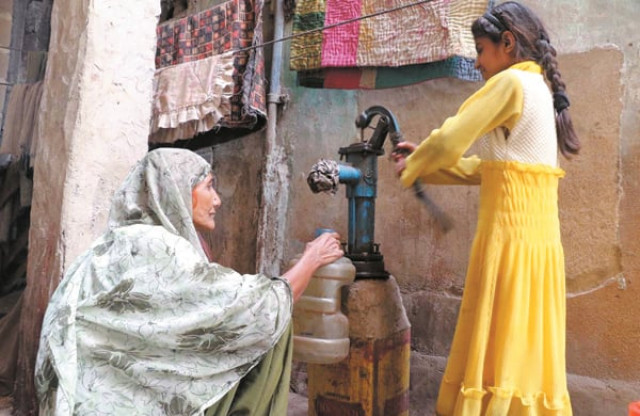
In search of drinking water: An elderly woman fills a container with water from a tap in Karachi on World Water Day. PHOTO: ONLINE
ISLAMABAD:
Pakistan on Sunday marked World Water Day with a strong call for swift action on water scarcity, climate stress and equitable access, as both President Asif Ali Zardari and Prime Minister Shehbaz Sharif highlighted the growing crisis and its social, economic and geopolitical dimensions.
This year’s theme – “Water and Gender: Where Water Flows, Equality Grows” – framed today’s message.
President Asif Ali Zardari took the opportunity to call on India to immediately restore full implementation of the Indus Waters Treaty (IWT) in line with the country’s international obligations.
“This deliberate weaponization of shared water resources is a matter of deep concern. India’s decision to suspend the treaty disrupts hydrological data sharing, obstructs agreed mechanisms and undermines both the letter and spirit of a long-standing international agreement that has governed equitable sharing of the Indus River system for over six decades,” he said.
“Such behavior threatens food security and economic security, endangers the livelihoods of millions who depend on these waters, and sets a dangerous precedent for the management of transboundary resources under international law,” he added.
The President highlighted the gender dimension of water insecurity, saying that “water insecurity is not experienced in the same way”.
“Women and girls often bear the heaviest burden when clean water is not available close to home,” he said.
In his message, Prime Minister Shehbaz Sharif warned that Pakistan was facing an acute water crisis, with per capita water availability falling from 5,260 cubic meters at the time of independence to below 1,000 cubic meters.
He noted that climate change, particularly erratic rainfall patterns and shifts in glacial systems, had further amplified these risks.
The Prime Minister emphasized that water scarcity affects all aspects of daily life, including livelihoods and social structures, with women bearing a disproportionate burden at the household level.
In rural areas, water collection in particular remains time-consuming, limiting educational and economic opportunities for women, he added.
Emphasizing that access to clean water is a basic human right, he said the government was committed to ensuring women’s representation in water management and decision-making processes.
Outlining policy measures, the Prime Minister said the government was embarking on major reforms under the National Water Policy to secure future resources.


