
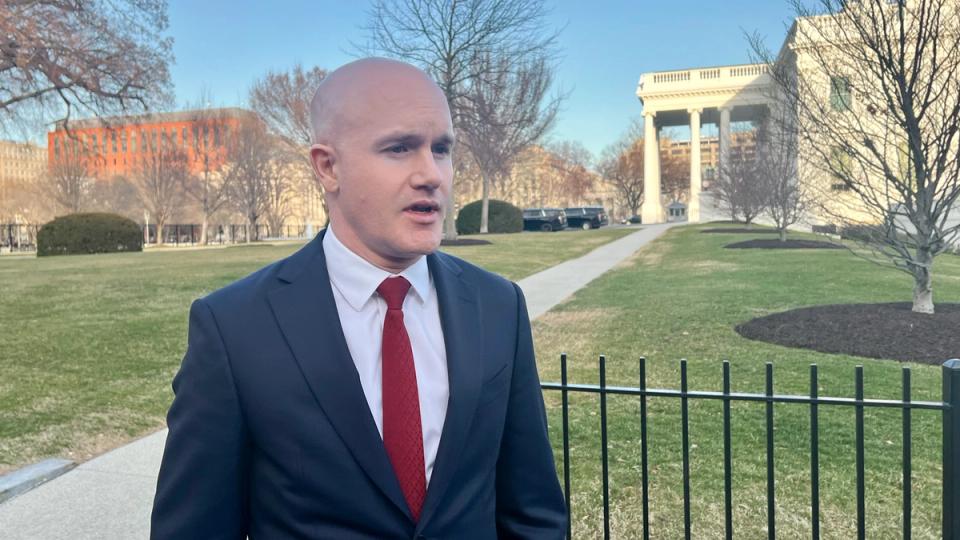
Coinbase is walking a tightrope in Clarity Act negotiations, telling the staff of US senators that the company is not happy with where lawmakers landed in their latest compromise, according to people familiar with the situation, but it has not openly stated its opposition.
The proposed deal was shown to crypto industry stakeholders on Monday and the banking industry on Tuesday. From the crypto industry, it drew mixed reactions, according to people familiar with Monday’s meeting. Some stakeholders were unhappy — particularly Coinbase — but others were “pleasantly surprised,” one of the people said. No one could take a copy of the text with them, and it has not yet been released for circulation.
Those familiar with Monday’s meeting said there were still issues to be ironed out and suggested the proposal could hamper stablecoin-related products and services beyond what they had hoped.
The new proposal would direct some regulatory agencies to draft rules that determine how issues such as rewards can be precisely monitored. Some have had concerns about regulators issuing subjective criteria for how permitted activity would be managed, noting that there could end up being different types of reward programs. Any rulemaking must be neutral, they said.
And the language was also said to potentially limit companies’ ability to tie rewards to the volume of stablecoin transactions in an account, which could be a hindrance to a program similar to credit card rewards.
Throughout the months of negotiations, Coinbase CEO Brian Armstrong has been a leading voice, and his opposition to an earlier effort on the stablecoin dividend compromise helped derail a planned Senate hearing. Armstrong is a White House favorite in the cryptosphere and heads the company that potentially has the most to lose from scaling back its stablecoin reward programs.
On an industry call this week, people said Coinbase clashed with others over the bill, suggesting a fracture in crypto views on how to proceed. Forgoing certain stablecoin rewards may be expensive for some, but losing the Clarity Act’s full establishment of crypto within the US financial system is seen – for others – as a greater risk.
The updated text released — expected either late this week or early next week — is likely to have been revised from the text shared Monday and Tuesday, though lawmakers are unlikely to rewrite too much of the long-debated text.
So far, the banks have not publicly shared their views on the proposal.
The crypto industry’s potential concerns with the approach launched this week, first reported by CoinDesk, already caused market chaos for leading US stablecoin issuer Circle and Coinbase’s stock. Circle stock fell 20% on Tuesday, although it ticked up a bit on Wednesday. However, Tuesday’s news of its biggest rival, Tether, submitting to an audit may have been another factor in the frame for Circle’s shares, observers noted.
Despite negative reactions to the Clarity Act revisions, White House crypto adviser Patrick Witt criticized the “uninformed” people making predictions about the Clarity Act’s status.” “Bullish.”
One of the people advocating taking a step back:
“Everyone should take a chill pill and stay off Twitter,” the person said.


