
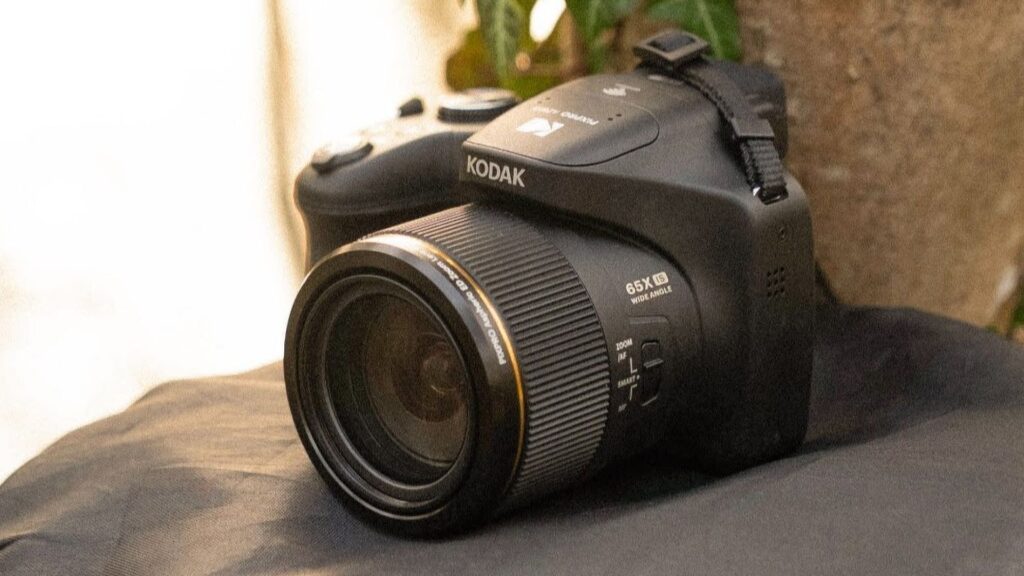
- Kodak’s latest ‘bridge’ camera has a 65x zoom and 1-inch macro focusing
- It adds USB-C charging to its 7-year-old predecessor
- It’s expected to go on sale in April for $450 / £350 (around AU$675)
Today’s Kodak—as with the third-party licensee of the legendary name—specializes in blast-from-the-past technology. For example, the ‘new’ PixPro AZ653 bridge camera, which follows the PixPro AZ652 from 2019.
(Most of) its specs look too good to be true – a stabilized 65x optical zoom covering everything from wide-angle landscapes to distant wildlife, 1cm macro focusing, 20MP stills, DSLR-style handling and an articulated screen – all for just $450 / £350.
This is an affordable do-it-all camera, except for one important part – quality. Like most bridge cameras (with a few exceptions such as the Sony Cyber-Shot RX10 IV), it packs a tiny 1/2.3-inch sensor — the kind you get in budget smartphones, which means image quality is lacking.
The article continues below
In bright light, highlights will blow out and shadows will lack depth. In low light, details will be mushy. That’s the price you pay for such versatility, and personally it’s not a compromise I’d be willing to make for a special holiday like a safari where I want the best possible quality.
That said, the overall package, especially considering the price, could be worth it for regular use. And now Kodak has released this newer version which adds USB-C charging to bring the range up to date, although the other features are now considered dated.
I’m a little disappointed that there aren’t other upgrades – for example, the PixPro AZ653 tops out at Full HD (so no 4K) video recording, while burst recording is only up to 5fps.
It’s definitely the 65x zoom lens spanning 24-1560mm focal lengths that is the big selling point, and along with the price I expect it to be a popular camera.
Still worth it?
So-called bridge cameras are named because they ‘bridge’ the gap between compact cameras and DSLRs. They’re bulky do-it-all “compact” cameras with one major snag — a compromise on image quality.
They largely had their heyday in the 2000s, but 20 years later the market is a shadow of its former self – my best bridge camera guide now has just three entries, one of which was recently discontinued.
That said, when Nikon relaunched its own version last year, the Coolpix P1100 with its 125x zoom, it garnered plenty of interest despite its much steeper price.
Panasonic hit the ground running in 2024 by refreshing its own affordable bridge camera, the Lumix FZ80D / FZ82D, which also modernized the series with USB-C charging, but otherwise has dated technology.
The surprise for me is how close the Lumix model is to the Kodak’s in price, and given that it shoots 4K video (albeit with a smaller 60x zoom), it feels like the better choice of the two. For context, we gave the stunning Lumix camera a 2.5 star rating.
Kodak says its PixPro AZ653 will hit stores in April.
Follow TechRadar on Google News and add us as a preferred source to get our expert news, reviews and opinions in your feeds. Be sure to click the Follow button!
And of course you can too follow TechRadar on TikTok for news, reviews, video unboxings, and get regular updates from us on WhatsApp also.


