
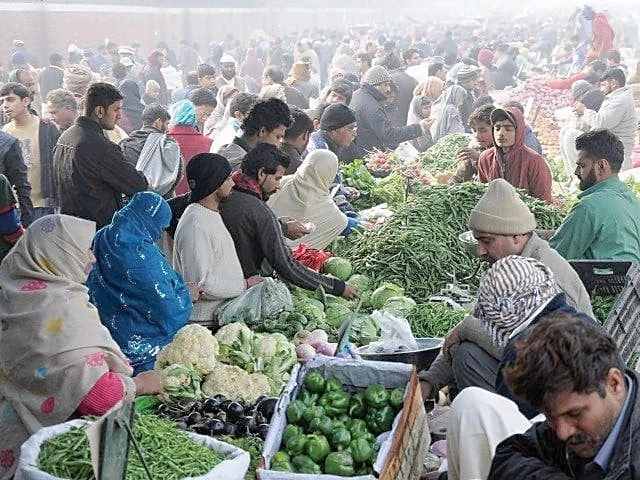
With limited room for subsidies and a heavy reliance on indirect taxation, future budget measures may put upward pressure on prices, which will particularly affect urban consumers. photo (file)
LAHORE:
Despite repeated claims of enforcement, the government’s price control mechanism has largely failed to translate into relief for consumers as essential food items continue to be sold well above the officially notified prices in major markets across the city.
As demand remains high during the Eid holidays, a widening gap between official and retail prices has exposed structural weaknesses in enforcement, leaving citizens increasingly frustrated amid rising inflation.
Market surveys across the city show that most items from poultry and vegetables to fruits were either unavailable at official prices or sold at significantly higher prices, undermining the effectiveness of the weekly price lists.
This week, live chicken prices were officially fixed at Rs 394-408. per kg; however, the item remained largely unavailable at these prices. Chicken meat, fixed at Rs591 per kg, was sold between Rs660 and Rs700, while boneless chicken crossed Rs1,000 per kg in several quarters.
A similar pattern was observed in vegetable markets. Soft skin new potatoes were fixed at Rs 18-20 per quintal. kg but sold at Rs 30-40, while tomatoes, officially priced at Rs 70-75, were available at Rs 120-160 per kg. kg. Onions, pegged at Rs 70-75, continued to sell at Rs 100-130 per kg.
The gap was widened for important kitchen inputs. Local garlic, fixed at Rs 167-175 per kg, sold at Rs.220-250, while the Chinese variety reached Rs.600 per kg. kg against the official price of Rs 475-495. Ginger, fixed at Rs 262-275, was sold at Rs 400-450 per kg.
Other vegetables reflected similar differences. Brinjal, pegged at Rs 66-70 per kg, was sold at Rs 120-140 per kg, while bitter gourd, officially priced at Rs 142-150. per kg, was sold at Rs 250-300 per kg. Spinach, fixed at Rs 23-25 per kg, was sold at Rs 60-80 per kg.
Zucchini, cucumbers, lemons and peppers also recorded sharp deviations from official prices, while several items including mongray and mustard leaves were largely unavailable despite being listed in official price announcements.
The fruit markets showed equally large gaps. Apples, fixed between Rs270 and Rs440 per kg, are sold at Rs350-700 depending on quality and variety. Bananas exceeded the official prices by up to Rs 100 per dozen, while dates – a key commodity during Ramazan – were sold at Rs800 to Rs1,200 per kg against official prices of Rs360-475.
Citrus fruits also remained out of reach for many consumers. Kinnow, pegged at Rs 220-335 per dozen, traded at Rs 450-700, while pomegranates crossed Rs 1,000 per kg despite significantly lower official prices.
Citizens and market observers attribute the persistent disparity to weak enforcement and limited monitoring of neighborhood markets, where the majority of consumers do their shopping.
While the authorities continue to emphasize inspection drives and fines, shop owners often resume overcharging soon after the officials leave. In many cases, fines are treated as a routine cost of doing business that is ultimately passed on to consumers.
“There is no real control in the markets. Officials come, impose a fine and leave – then everything goes back to the same,” said a shopper, Rafique Ahmed.
For citizens, the impact is immediate and severe, especially for low- and middle-income households already struggling with broader economic pressures.
“The prices are out of control. We are checking the official list but nothing is available at those prices,” said Muhammad Imran, a resident of Lahore. “Our expenses keep going up, but our income doesn’t.”
Another customer, Farzana Bibi, said families are being forced to cut back on essential purchases. “We are buying less vegetables and fruits now. Even basic items are becoming unaffordable,” she said.
Experts suggest that without consistent monitoring, tougher penalties for repeat violations and better supply chain management, the current system is unlikely to provide meaningful relief.
As post-Eid demand stabilizes, the coming weeks will show whether official interest rate lists will continue to exist largely as symbolic documents with little impact on day-to-day market realities.


