
After the 21-year ban, while the privileged classes celebrated the occasion with flair, grieving households remained
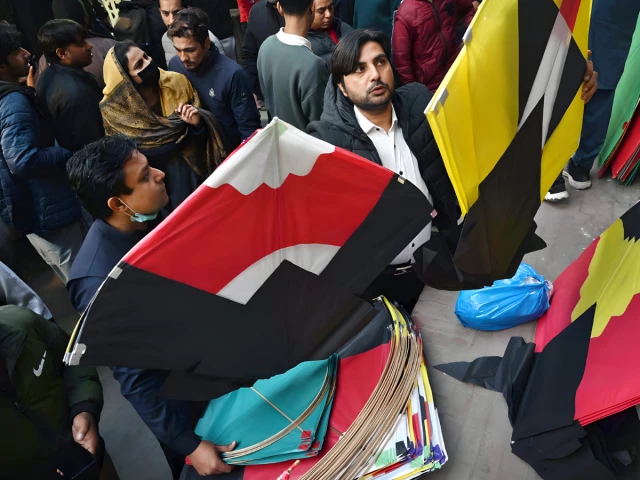
A large number of people choose and buy the kites to celebrate the upcoming three-day Kite Flying Festival (Basant) at the local market in the provincial capital. PHOTO: APP
LAHORE:
Once a symbol of culture and community, Basant now feels like a kitsch spectacle for the elite. Amid deafening music and flashy displays, the festival became a staged social media moment rather than a communal celebration. But beneath this surface lies a grim but familiar reality. While the elite pose for wheels, it is the poor who pay with their lives.
In the first week of February 2026, a three-day Basant festival was held in Lahore after the government temporarily suspended a 21-year ban through an ordinance that allowed kite flying under certain conditions. While official records from the Ministry of Home Affairs reported 17 deaths and 160 injured, Express Pakinomist sources revealed that the death toll could be as high as 21.
Most deaths occurred due to falls from rooftops, with victims aged between 15 and 30. Some also died from electrocution or falling from trees. Specifically, 12 people died after falling from rooftops, while three died from electric shock. Despite safety measures such as banning metallic strings and installing protective bars on motorcycles, more than 120 accidents were reported, injuring over 160 people.
The family of Zain Malik, who died after falling from a roof, felt that Basant had destroyed their home. “No official has contacted us and no financial support has been provided.” Similarly, Ahmed’s father, who died of electrocution, criticized the government for organizing the festival to please the elite while poor families lost their children, without receiving compensation or support.
Public policy advisor and social activist Salman Abid believed that the Basant festival, which was organized through an ordinance and limited to three days in Lahore, only benefited the privileged class. “Despite the government’s claims, kite flying continues beyond the permitted period and authorities have failed to enforce the ban. Although 17 deaths were officially acknowledged, reports suggest up to 24 fatalities and no compensation has been provided to affected families,” Abid said.
Meanwhile, the government reportedly generated over Rs3 to Rs4 billion in revenue during this period. It is estimated that the sale of kites and strings alone generated between Rs2 and Rs2.5 billion. The government had reportedly allowed over 5,000 vendors to sell kites and strings.
A Punjab government spokesperson assured that the festival was allowed only for three days with defined SOPs and cases were registered against violators. “A committee is considering compensation to the families of the 17 victims. Up to Rs 3 billion was generated in revenue and people enjoyed the festival. The government plans to organize a ‘safe Basant’ next year,” the official claimed.
According to the Punjab Home Department, in 2026 alone, over 8,000 people have been arrested and more than 7,200 cases registered for violations related to kite flying, mostly in Lahore, Gujranwala, Faisalabad and Rawalpindi. A zero tolerance policy is in place.
Records show that kite flying and manufacturing was only banned in Punjab in 2005 after more than 25 deaths. The ban was intermittently lifted in 2006 and 2007, but due to increasing deaths, it was reinstated in 2007. By 2024, over 2,020 people had lost their lives due to this deadly activity. More than 90 percent of the deaths were due to chemical-coated strings cutting necks or faces.
Despite its deadly history, Basant continues to be celebrated annually in cities like Lahore, Gujranwala, Sialkot, Faisalabad, Rawalpindi, Islamabad, Multan and others. On an average, at least eight people die on a single day of Basant celebrations every year.


