
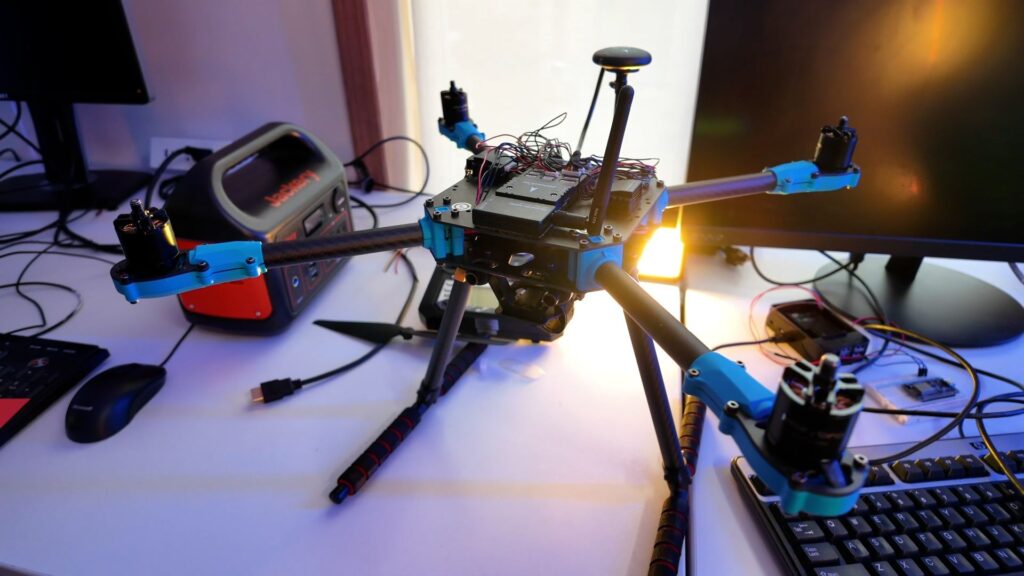
- Drone swarms can act as temporary cell towers during network failures
- AURA-GreeN balances delay, energy consumption and signal reliability simultaneously
- Data freshness is significantly improved through reduced age of information
Mobile networks are built around fixed towers, but this model often struggles when demand surges or infrastructure fails unexpectedly.
A research effort from the Stevens Institute of Technology is exploring another approach, in which coordinated drones act as temporary cell towers that extend or stabilize coverage when ground systems fall short.
The idea does not discard existing infrastructure, but instead works with it, forming a flexible layer that can respond to changing conditions in real time.
The article continues below
A network that adapts on the fly
The system, known as AURA-GreeN, relies on multiple drones that act as mobile radio units instead of fixed transmission points.
These antenna nodes communicate with each other and with users, adjusting their positions and roles based on current network conditions, allowing the system to behave like a network that appears when needed, rather than one that is permanently installed.
“It will be especially hard in large cities with large populations and fewer places to add more cell phone towers,” said Ying Wang, associate professor in Stevens’ Department of Systems Engineering.
“In busy cities – especially during things like traffic management, disasters or search and rescue – we need fast, reliable wireless communications,” she adds.
The system continuously evaluates signal quality, interference and traffic load and then decides how data should be routed and available spectrum distributed.
This dynamic coordination tries to keep connections stable even when conventional networks are congested or partially unavailable.
AURA-GreeN also expands its role beyond simply maintaining coverage by focusing on how efficiently information moves across the network.
Instead of just ensuring connectivity, the system evaluates how current and relevant transmitted data remains, a concept the researchers describe as “the age of information.”
This adds another layer to how performance is assessed, especially in situations where timing is critical.
“It keeps the ‘age of information’ low, meaning the data you see is always very fresh and closely reflects what’s happening right now,” says Ishan Aryendu, a PhD candidate.
“We saw that there was a 460% improvement in the information age.”
At the same time, the system handles multiple requirements, including reducing delays, allocating frequencies efficiently, maintaining stable connections and operating within energy limits.
However, balancing these priorities is not without its challenges, as improvements in one area can put pressure on others.
Although test results look promising, real-world implementation may introduce limitations that are not fully reflected in controlled environments.
Beyond emergencies, the system can support large gatherings where smartphone networks can face sudden demand.
The researchers note that novice drones used for filming can also provide coverage, adding that “we’re piggybacking on drones that are already providing coverage of the event.”
Follow TechRadar on Google News and add us as a preferred source to get our expert news, reviews and opinions in your feeds. Be sure to click the Follow button!
And of course you can too follow TechRadar on TikTok for news, reviews, video unboxings, and get regular updates from us on WhatsApp also.


