
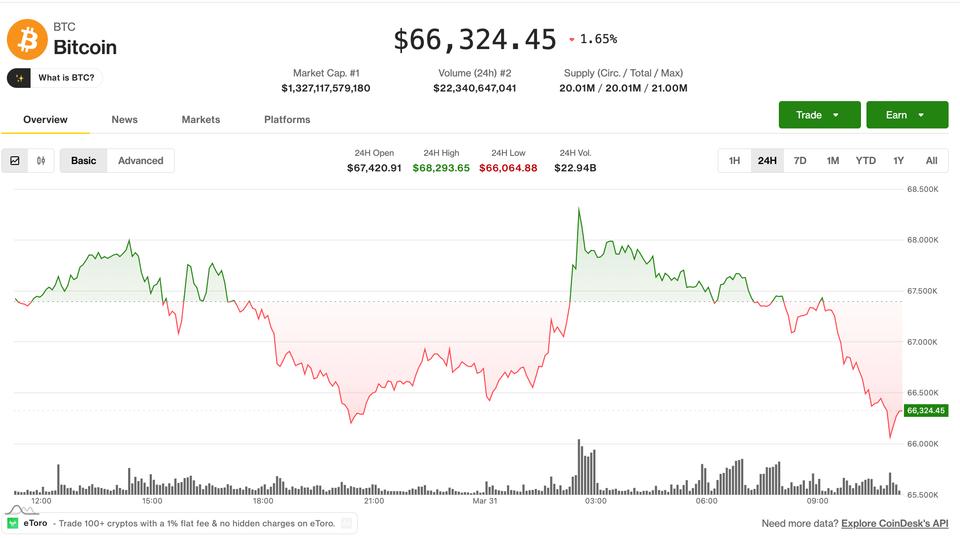
The crypto market showed signs of volatility on Tuesday with bitcoin rising to $68,300 shortly after midnight UTC before falling back to $66,500.
The initial rise was spurred by reports that US President Donald Trump was willing to end the war in Iran without opening the Strait of Hormuz. Optimism faded after Israeli officials said they were prepared to “continue to operate in the coming weeks.”
The war, now in its 32nd day, has sent energy prices soaring, with Brent crude trading around $107 a barrel. barrel, which has led to inflation concerns and widespread risk aversion.
Crypto, while relatively resilient throughout March, is starting to show signs of weakness after bitcoin failed to rise above $75,000 on two occasions.
US stocks diverged from the crypto market on Tuesday, with Nasdaq 100 and S&P 500 index futures both adding 0.8%.
Derivative positioning
- Cumulative industry-wide crypto futures open interest (OI) fell over 3% to $103.79 billion in 24 hours, continuing the risk-off trends observed throughout the first quarter. The figure has fallen by over 18% since the start of the year.
- OI has fallen across BTC, ETH, SOL and XRP futures, indicating capital outflows from the major cryptocurrencies. Other tokens, such as BCH, AVAX, and LTC, have seen double-digit percentage declines in open interest.
- Privacy-focused ZEC stands out, with its futures market exhibiting bullishness. Token’s OI rose more than 3% along with mildly positive funding rates and cumulative volume delta. This combination points to an increasing demand for bullish exposure.
- At the other end is DOGE, which has the most negative 24-hour cumulative volume delta among major tokens.
- Bitcoin’s 30-day implied volatility index, BVIV, has risen up to 58% from 54% at the end of last week, topping its 50-day average to suggest more gains ahead. This means the potential for increased price turbulence.
- Ether’s volatility index remains flat between 70% and 80% for the seventh day in a row.
- At Deribit, bitcoin risk reversals up to June expiration show a strong bias for put options. These downside hedges trade at an 8 to 10 volatility point premium to calls. Meanwhile, bearishness is measured relatively in ether.
- The $60,000 bitcoin put remains the most popular bet with total open interest at $1.50 billion.
Token talk
- The altcoin market suffered more than bitcoin on Tuesday, with tokens such as NEO, HBAR and PUMP losing between 2.6% and 3.3% since midnight UTC.
- A few select tokens are bucking this trend, including BCH and AI-related coins, which are in the black.
- CoinMarketCap’s “Altcoin Season” indicator currently reads 51/100, reflecting relative strength over the past few weeks despite Tuesday’s selloff.
- However, the next big move will still be determined by bitcoin and whether it can either break above $75,000 or below $62,000. Altcoins typically do well when bitcoin consolidates, but lose ground during large swings.


