
Minister says electricity generated from furnace oil costs public Rs 60-80 per unit
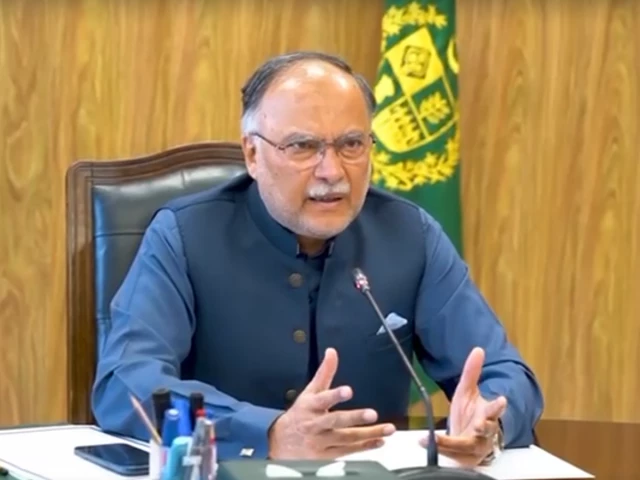
Planning Minister Ahsan Iqbal chairs a consultative meeting in Islamabad on the production of two landmark historical web series on Quaid-e-Azam Muhammad Ali Jinnah and Allama Muhammad Iqbal. SCREEN GRAB
LAHORE/ISLAMABAD:
Planning Minister Ahsan Iqbal on Saturday called for a review of market opening hours to reduce electricity consumption and curb oil consumption as the country grapples with higher import costs driven by the global oil crisis.
Speaking at a press conference in Lahore, the planning minister stressed the importance of cutting energy consumption to tackle the economic strain caused by the ongoing conflict.
Noting that Pakistan is dependent on imported fuel for power generation, Iqbal stressed the need to improve efficiency in petrol and diesel consumption.
He noted that the markets in Pakistan usually opened after 12.00 and remained open until 02.00 using “electricity generated from imported fuel”.
“If we use electricity at night now, this will be generated from furnace oil which costs the public Rs 60-80 per unit,” he maintained, asking whether such “irresponsible behaviour” befits a nation facing a huge crisis.
“Crises are moments of behavioral change,” he said.
Iqbal stated that the provinces were asked to consult with traders and “seek an action plan within a week so that we can ensure an early closure of markets”.
He said the measure would save both the government and the public the “unnecessary burden” of billions of rupees and urged traders to take a considerate view of the matter.
The planning minister maintained that markets in “developed countries or successful economies” such as Japan, the US, Malaysia, Indonesia and Turkiye did not remain open after 5 p.m. 18.00 or at the latest 8 p.m.
“If you go into neighborhoods after 9 or 10 p.m., it’s completely quiet. People have gone to bed. Early to bed, early to rise,” he said, highlighting that this was also the routine dictated by Islamic teachings.
The minister said the government had noticed unnecessary price hikes introduced by transporters and noted that the provinces had been asked to discuss the prices with transporters to prevent profiteering.
“You can play your part in the country’s development and stability by preventing the unnecessary use of a single drop of petrol or diesel,” he said, suggesting the public should take more fuel-saving measures.
“If you commute to the office alone, try carpooling with colleagues from your residence or area to your office,” Iqbal said.
He advised people not to use electricity when it was not necessary so that “the country’s import bill can be reduced as much as possible”.
NPMC
Iqbal on Saturday presided over an online meeting of the National Price Monitoring Committee (NPMC) that directed provincial governments to take immediate measures to curb inflationary pressures following a recent hike in fuel prices.
The meeting reviewed the impact of rising oil prices on transport prices and essential commodities.
Officials informed the committee that diesel prices had risen significantly, while transport fares across major urban centers had increased by 25-30 per cent on average, with some routes reporting increases of up to 50 per cent.
Expressing concern, the minister directed the provincial authorities to ensure that the transport departments issue revised tariff notifications within 24 hours and strictly enforce them.
He emphasized that the benefit of government subsidies must not be negated by arbitrary increases imposed by carriers.
Iqbal directed the chief secretaries to assign clear responsibility to provincial transport secretaries for fare regulation and compliance.
He also called for improved enforcement in the field, including random inspections and verification mechanisms to check overcharging.
The minister highlighted the likelihood of a “second round effect” on food prices due to higher logistics costs and ordered weekly monitoring of essential commodities.
The NPMC would now meet on a weekly basis, particularly over the next month, to closely monitor price movements.
The Pakistan Bureau of Statistics was tasked with sharing district-wise price rankings on a weekly basis to identify abnormal trends, enabling timely corrective action by provincial administrations.
The minister further directed market committees and district administrations to regulate wholesale and retail prices and monitor profit margins to prevent hoarding and profiteering.
Special emphasis was placed on ensuring an uninterrupted supply of perishable and basic commodities, including tomatoes, onions, potatoes, wheat, rice and pulses.
With reference to state aid, the minister emphasized that their intended effect must be reflected in market prices.
“If subsidies are fully passed on as price increases, their purpose becomes useless,” he noted.
The meeting also raised concerns over the price differences of urea fertilizers between national and international markets and warned of potential smuggling risks.
Iqbal directed the interior ministry and provincial authorities to take immediate steps to prevent smuggling and ensure adequate availability to farmers.
With input from APP


