
ISLAMABAD:
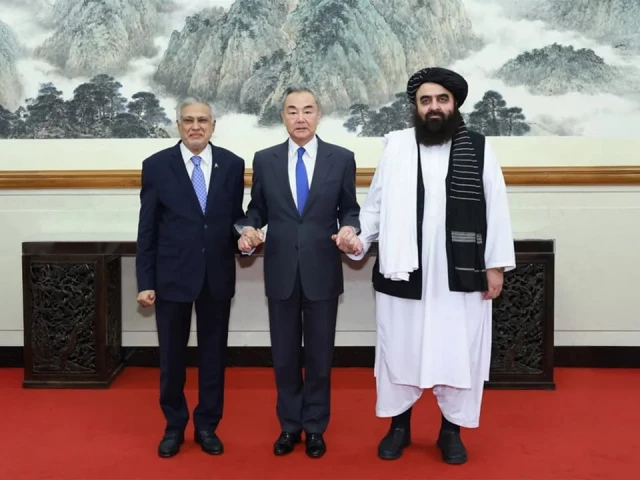
Pakistan has conveyed three core demands to the Afghan Taliban during talks underway in Urumqi, as China, which brokered the latest round, tries to convince both sides to agree on a five-point framework to resolve issues.
The three demands initially made by Islamabad include Kabul formally declaring the Tehreek-e-Taliban Pakistan (TTP) a terrorist organization, dismantling its infrastructure and providing verifiable evidence of the action.
These demands form the basis of Pakistan’s negotiating position, which sources say has hardened due to persistent security concerns.
The Foreign Ministry has so far issued only an initial statement confirming that the talks are taking place in Urumqi, without providing further details on the agenda or progress.
At the last weekly briefing, Foreign Ministry spokesman Tahir Andrabi said Pakistan’s participation in the talks in Urumqi should not be seen as any change in policy, especially with regard to ongoing security operations.
“There is no significant change to the ongoing operation Ghazab Lil Haq that I mentioned last week,” the spokesman added.
On Sunday, Afghan Foreign Minister Amir Khan Muttaqi acknowledged that dialogue was still ongoing and that the Taliban regime wanted to resolve issues with Pakistan through negotiations.
Sources said China has played a quiet but active role through sustained shuttle diplomacy, with its special envoy for Afghanistan Yue Xiaoyong engaging both Islamabad and Kabul in recent months to narrow differences and bring them to the negotiating table.
Pakistan has also made it clear that the scope of the talks will remain limited to counter-terrorism and border security, ruling out broader political engagement at this time. The sources say the focus is on addressing Islamabad’s concerns over terrorist groups operating from Afghan territory and ensuring mechanisms to prevent cross-border attacks.
It is believed that a framework is under discussion that could pave the way for a possible understanding between the two sides. The proposed roadmap includes a ceasefire arrangement, anti-terrorist assurances from the Afghan Taliban, dismantling terrorist sanctuaries inside Afghanistan and measures to facilitate safe trade routes.
It also envisages the establishment of a more structured and institutionalized dialogue mechanism between Islamabad and Kabul.
Both sides have sent technical-level delegations to Urumqi, reflecting the operational nature of the discussions.
Pakistan’s team is led by Syed Ali Asad Gilani, Additional Secretary in the Ministry of External Affairs in charge of Afghanistan and West Asia, and includes officials from defense and intelligence agencies.
The Afghan Taliban delegation is led by Mohibullah Waseq, chief of staff to Amir Khan Muttaqi, and includes representatives from the Ministry of Foreign Affairs, the Ministry of Interior, the Ministry of Defense and the Directorate of Intelligence.
Although tentative agreements have begun, the sources said Chinese officials are holding separate meetings with each side to bridge gaps before moving toward direct, structured talks.
The choice of Urumqi as the venue is seen as significant given its location in China’s Xinjiang region, where Beijing has long worried about militancy linked to groups such as the East Turkestan Islamic Movement (ETIM), whose fighters are believed to have a presence in Afghanistan.
Diplomatic observers say the talks represent a cautious but important effort to stabilize ties between Pakistan and Afghanistan, although major differences remain and any breakthrough will depend on Kabul’s willingness to meet Islamabad’s key security demands.


