
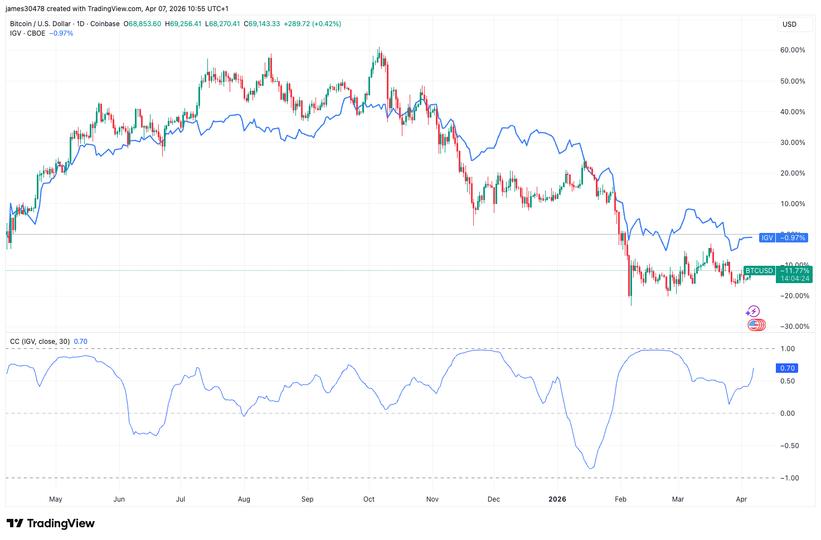
Since the outbreak of the war with Iran on February 28, bitcoin has begun to diverge from software stocks, with the iShares Expanded Tech-Software Sector ETF ( IGV ) serving as a useful proxy for the sector.
Bitcoin has been one of the strongest performing assets during this period, rising more than 5% and trading back above $69,000, including a gain of more than 0.5% over the past 24 hours.
IGV, on the other hand, has fallen by more than 2% since the conflict began. That gap suggests investors are starting to treat bitcoin and software stocks differently, at least in the short term.
Until recently, the two had moved in close together. Over the past three months, bitcoin fell 26% and the ETF lost 23%. Year-to-date, both are down about 21%. Over five years, bitcoin is up 18% compared to 10% for IGV. In other words, both have moved in the same direction, but the cryptocurrency has done so with much greater volatility.
It is also evident in their fall. Bitcoin had fallen about 50% from its peak in October, while IGV, which peaked slightly earlier, was down about 35% from its own peak.
The correlation data tell the same story. As of early February, bitcoin and IGV were almost perfectly correlated, close to 1.0, meaning they moved almost in lock step. After the war began, this relationship collapsed sharply, with the correlation falling to 0.13, a level that signals near decoupling, before returning to around 0.7. The number can vary between -1.0 and +1.0, where 0 indicates no correlation at all.
Why have software stocks been hit harder?
IGV is heavily weighted towards large software and services companies such as Microsoft (MSFT), Oracle (ORCL) and Salesforce (CRM). Investors are increasingly concerned that AI will compress margins and valuation multiples across software, particularly in Software as a Service (SaaS), as competition increases and barriers to entry fall. Bitcoin, meanwhile, trades more like a macro asset and benefits from geopolitical uncertainty.


