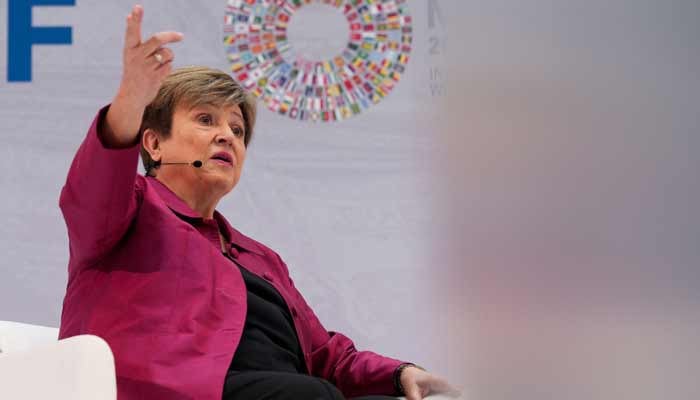
- IMF to lower the growth forecast, says Georgieva.
- Countries should avoid price controls, IMF chief says.
- War to dominate spring meetings of the IMF, the World Bank.
International Monetary Fund (IMF) chief Kristalina Georgieva said on Thursday that the global lender expected demand for IMF financial support to rise to between $20 billion and $50 billion in the short term due to spillovers from the war in the Middle East.
Georgieva said the now-defunct war tested the global economy, with a 13% reduction in the daily flow of world oil and a 20% reduction in liquefied natural gas, triggering a supply shock that had sent energy prices skyrocketing and disrupted supply chains.
In prepared remarks ahead of next week’s IMF and World Bank meetings, Georgieva said the war had prompted the fund to cut its global growth forecast, echoing a message she shared with Reuters on Monday.
US President Donald Trump announced a two-week ceasefire with Iran on Tuesday, but Israel’s continued bombardment of Lebanon threatens to derail talks to create a permanent peace.
“Even in the best case, there will be no nice and clean return to the status quo ante,” Georgieva said. Qatar’s Ras Laffan complex, which produces 93% of the Gulf’s LNG, for example, had been shut down since March 2 and could take three to five years to return to full capacity.
“The fact is that we don’t really know what the future holds for transit through the Strait of Hormuz, or for that matter, for the recovery of regional air traffic,” she added. “What we do know is that growth will be slower – even if the new peace is sustainable.”
The conflict, which began on February 28, would have ripple effects for some time, Georgieva said, including shutdowns of oil refineries and shortages of refined products that disrupted transport, tourism and trade.
An additional 45 million people will face food insecurity, bringing the total number of people in hunger to over 360 million. Supply chain disruptions will also continue due to industrial dependence on inputs such as sulphur, helium for chipmaking and naphtha for plastics.
Growth forecast adjusted downward
The IMF will release a range of scenarios in its World Economic Outlook next week, moving from a relatively quick normalization to a scenario where oil and gas prices remain much higher for a much longer time, Georgieva said.
Even the most hopeful scenario, she said, involved a growth downgrade due to infrastructure damage, utility disruptions, loss of confidence and other scarring effects.
In January, the IMF had forecast global growth of 3.3% in 2026 and 3.2% in 2027.
Next week’s meetings, which will bring together thousands of finance officials from around the world, will focus on how to cope with the shock of the war and how the IMF can help its member countries in need, Georgieva said.
She said the IMF was well-resourced and could scale up balance-of-payments support through existing programs, and additional countries were expected to request assistance. She did not identify any specific countries seeking aid.
The expected increase in financing requests comes on top of $140 billion in existing pre-war programs, an IMF official said.
Between May 2024 and March 2025, the IMF approved over $36 billion in new loans, according to a Boston University study.
Georgieva warned that the energy supply shock was already driving up short-term inflation expectations, even if long-term expectations had not picked up.
Economic conditions had already tightened, but in an orderly fashion, and some easing was now evident.
The wider impact will depend on whether the ceasefire held and resulted in lasting peace, and how much damage the war left in its wake, Georgieva said.
Countries should not go it alone
Georgieva warned that a demand adjustment was inevitable, but cautioned countries against introducing export controls, price controls and other measures that could further disrupt global conditions.
“I appeal to all countries to reject go-it-alone actions,” she said. “Don’t pour gasoline on the fire.”
Georgieva said there was value in watching and waiting, but central banks should “press on with rate hikes” if inflation expectations threatened to break anchor and trigger an inflationary spiral.
She noted that many countries introduced conservation measures, including restrictions on private vehicle use and teleworking. Most countries had avoided untargeted tax breaks or energy subsidies, and the IMF actively worked with countries to ensure that any measures remained temporary.
Adding deficit-financed stimulus now will increase the burden on monetary policy and reinforce the rise in benchmark yield curves, further increasing the cost of debt.
Public debt was generally much higher than 20 years ago, Georgieva said, urging countries to move decisively to rebuild their financial buffers after this shock after years of failure to do so.
Even before the war, global public debt was expected to rise to around 100% of gross domestic product by 2029, the highest level since 1948.