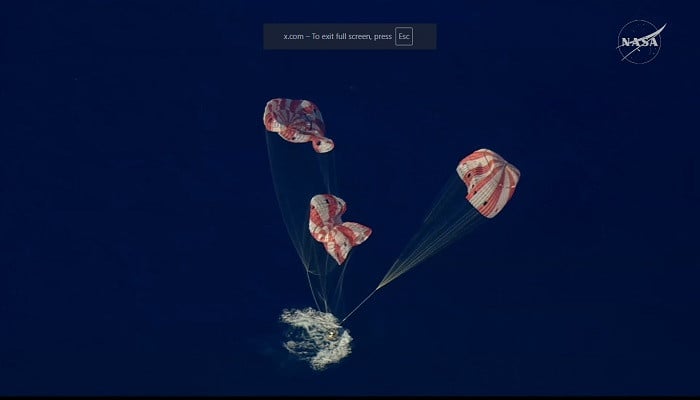
- Four astronauts flew further from Earth than anyone before.
- The mission marked the first human journey to the moon in half a century.
- Atmospheric re-entry provided a key test of the capsule’s heat shield.
The Artemis II capsule and its four-man crew streaked through Earth’s atmosphere and splashed down safely in the Pacific Ocean on Friday after nearly 10 days in space, capping the first trip by humans to the vicinity of the moon in over half a century.
NASA’s teardrop-shaped Orion capsule, called Integrity, gently dove into the ocean off the coast of Southern California shortly after 1 p.m.
The Artemis II flight, which traveled a total of 694,392 miles (1,117,515 km) across two Earth orbits and a climactic lunar flyby some 252,000 miles away, was the debut manned test flight in a series of Artemis missions aimed at starting the landing of astronauts on the lunar surface from 2028.
The splashdown, about two hours before sunset, was carried by live video feed in a Nasa webcast.
Recovery teams were on hand to secure the floating capsule and retrieve the crew – American astronauts Reid Wiseman, 50, Victor Glover, 49, and Christina Koch, 47, along with Canadian astronaut Jeremy Hansen, 50.
The crew’s return cleared a critical final hurdle for the Lockheed Martin-built Orion spacecraft, proving it would withstand the extreme forces of re-entry from a lunar re-orbit.
That followed a 13-minute, white-knuckle, blazing dive through Earth’s atmosphere that generated frictional heat that sent temperatures on the capsule’s exterior soaring to about 5,000 degrees Fahrenheit (2,760 degrees Celsius).
On top of the re-entry stress, as expected, intense heat and air compression formed a red-hot mantle of ionized gas or plasma that engulfed the capsule and cut off radio communications with the crew for several minutes.
The tension broke when contact was reestablished and two sets of parachutes were seen billowing from the nose of the free-falling capsule, slowing its descent to about 15 mph (25 km/h) before Orion gently hit the water.
It was expected to take Nasa and US Navy teams about an hour to secure the floating capsule and help the four astronauts out of the vehicle and fly them to a nearby recovery ship to undergo initial medical checks.
The stepping stones to Mars
The quartet blasted off from Cape Canaveral, Florida, on April 1, lifted into an initial orbit of Earth by Nasa’s giant Space Launch System rocket before sailing on for a rare trip around the far side of the moon.
In doing so, they became the first astronauts to fly near Earth’s only natural satellite since the Apollo program in the 1960s and 70s. Glover, Koch and Hansen also made history as the first black astronaut, the first woman and the first non-US citizen to participate in a lunar mission, respectively.
At the height of the flight, the Artemis astronauts reached a point 252,756 miles from Earth, surpassing the previous record of about 248,000 miles set in 1970 by the crew of Apollo 13.
The journey, following the unmanned Artemis I test flight around the moon with the Orion spacecraft in 2022, marked a critical dress rehearsal for a planned attempt later this decade to land astronauts on the lunar surface for the first time since Apollo 17 in late 1972.
The ultimate goal of the Artemis program is to establish a long-term presence on the moon as a stepping stone to eventual human exploration of Mars.
In a historical parallel to the Cold War era of Apollo, the Artemis II mission has played out against a backdrop of political and social unrest, including a US military conflict that has proven unpopular at home.
Unlike the Apollo era, when the United States raced to land astronauts on the moon ahead of the Soviet Union, the Artemis program seeks to beat China.
For many in a global audience captivated by the latest moonshot, it confirmed the achievements of science and technology at a time when big technology has become widely distrusted, even feared. Opinion polls showed broad public support for the mission’s goals.
The return to Earth put the Orion spacecraft through a critical test of its heat shield, which sustained an unexpected level of burning and stress upon re-entry during its test flight in 2022. As a result, Nasa engineers changed the descent trajectory of Artemis II to reduce heat build-up and reduce the risk of the capsule burning up.
Last week’s successful launch was a major milestone for the SLS rocket, giving its prime contractors, Boeing and Northrop Grumman, long-sought validation that the launch system, more than a decade in development, was ready to safely fly humans into space.