
Letter states the country experienced an increase in air traffic due to the US-Iran war as diverted flights used its main aviation corridor
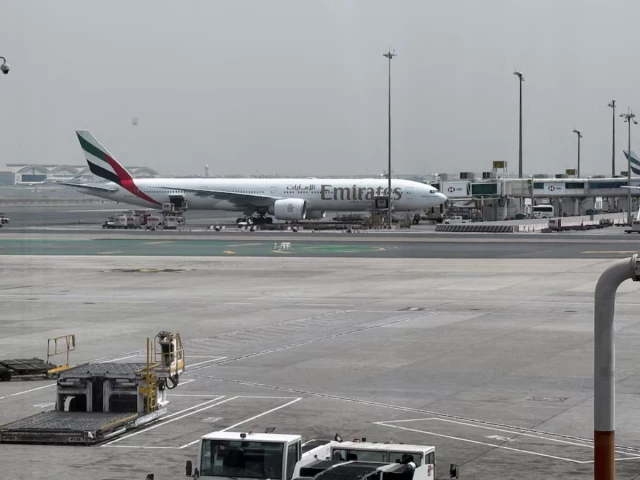
An Emirates plane at Dubai International Airport, amid the US-Israel conflict with Iran, in Dubai, United Arab Emirates, March 8, 2026. Picture taken by phone PHOTO: REUTERS
ISLAMABAD:
The International Federation of Air Traffic Controllers Associations (IFATCA) on Monday expressed great appreciation for the professionalism and dedication of Pakistan’s air traffic controllers and acknowledged their vital role in maintaining safe and efficient operations during the recent regional airspace disruptions.
In a letter to Pakistan’s air traffic control authorities, IFATCA’s Executive Vice President for the Asia Pacific Region Cheryl Chen praised the “dedication and professionalism shown by Pakistan’s air traffic controllers in recent weeks.”
The letter comes a day after the United States and Iran failed to agree to end hostilities despite marathon talks that lasted about 21 hours. The talks, aimed at ending a conflict that has killed thousands and driven global oil prices higher over the past six weeks, ended with both sides blaming each other for the impasse.
The letter highlighted that amid geopolitical developments affecting the regional airspace, Pakistan’s position as an important aviation corridor between Southeast Asia, the Middle East and Europe led to a significant increase in air traffic, including diverted flights from neighboring airspace.
Despite these pressures, the organization noted that Pakistani air traffic controllers successfully handled “significant volumes of non-routine traffic”, with traffic levels in certain sectors increasing significantly, while maintaining “the highest standards of safety and efficiency.”
IFATCA further acknowledged that these operations were conducted under sustained pressure, potentially involving extended working hours and limited leave, and described it as a reflection of “a strong commitment to operational continuity and global aviation safety.”
In his announcement, Chen also expressed his formal appreciation for the support of Pakistan’s ministry, stating that IFATCA “respectfully recognizes the vital contribution of Pakistan’s air traffic control workforce” and expressed gratitude for the continued institutional support that enabled their achievements.
The letter concluded with assurances of “highest consideration”, underscoring international recognition of Pakistan’s air traffic management efforts at a time of heightened regional aviation challenges.
Read more: No breakthrough, no collapse
The United States and Israel launched a joint offensive against Iran on February 28, killing thousands of people in Iran, including then-Supreme Leader Ayatollah Ali Khamenei, and leaving tens of thousands injured, with civilian areas, including residential buildings and religious sites, among those affected.
The conflict also expanded geographically. Iran retaliated with drone and missile strikes targeting Israel as well as Jordan, Iraq and Gulf countries that host US military assets. It also restricted the movement of ships through the Strait of Hormuz.
Global air travel has been severely disrupted as airstrikes kept major Middle Eastern airports, including Dubai, the world’s busiest international hub, closed in one of the sharpest flight shocks in recent years.
Key transit airports, including Dubai and Abu Dhabi in the UAE and Doha in Qatar, were closed or heavily restricted as much of the region’s airspace remained closed after US and Israeli strikes killed Iranian Supreme Leader Ayatollah Ali Khamenei.
Read also: Iran says Gulf ports are ‘either for all or for none’
Dubai International Airport was damaged during Iran’s attack, while airports in Abu Dhabi and Kuwait were also hit.
Thousands of flights have been affected across the Middle East, according to data on flight tracking platform FlightAware. Airspace over Iran, Iraq, Kuwait, Israel, Bahrain, the United Arab Emirates and Qatar remained nearly empty, maps from Flightradar24 showed in March.
The airport closures have rippled far beyond the Middle East. Dubai and neighboring Doha sit at the crossroads of east-west air travel, channeling long-haul traffic between Europe and Asia through tightly scheduled networks of connecting flights. With these hubs inactive, aircraft and crews remained stranded out of position, disrupting airline schedules worldwide.
Airlines across Europe, Asia and the Middle East canceled or diverted flights to avoid closed or restricted airspace, extended journeys and increased fuel costs. The disruption has been compounded by the loss of Iranian and Iraqi overflight routes, which had become more important since the war between Russia and Ukraine forced airlines to avoid both countries’ airspace.


