
Alarm over the ‘joint statement’ came as both sides made significant progress in talks
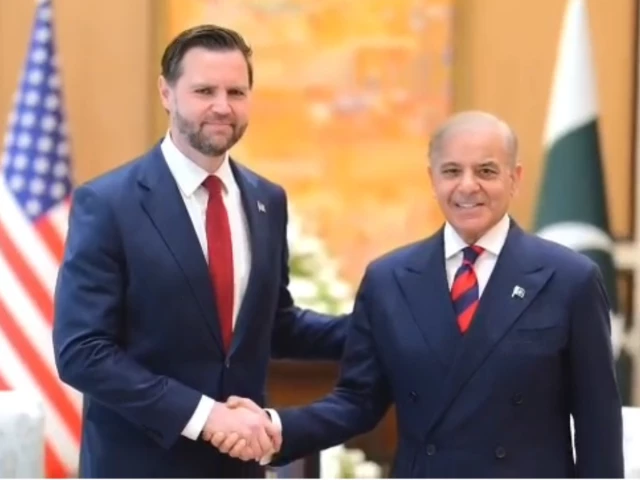
US Vice President JD Vance meets Prime Minister Shehbaz Sharif ahead of Islamabad Talks 2026. SCREENGRAB
ISLAMABAD:
Local and international journalists were exhausted in the media center set up just a stone’s throw from the Serena Hotel, where senior Iranian and US officials had been engaged in intense negotiations. The Jinnah Convention Center was just across the road from the five-star hotel, but proximity to the venue did not mean access to what went on behind closed doors.
But it was around 3 am when some officials present at the center were alerted. The message came from people inside the Serena Hotel: “Be ready, there could be a joint statement.” Suddenly, officials who were on the verge of sleep had to become agile. But as night gave way to day, the possibility of a “joint declaration” disappeared.
Instead, a message was sent to American journalists traveling with the American delegation that Vice President JD Vance would be speaking to reporters.
Vance said he had “bad news” that talks between the United States and Iran had failed to reach an agreement. But that was not the whole story.
The Express Pakinomist can now report, after interacting with relevant people and diplomatic sources, that both sides were close to agreeing on a framework before a last-minute hiccup. The warning of a “joint statement” stemmed from the progress both sides had made.
“The draft was ready to be signed,” said a diplomatic source, suggesting the deal was missed by the narrowest of margins.
Iranian Foreign Minister Abbas Araghchi also confirmed that both sides were inches away from what he called the “Islamabad MoU”, but according to Iran’s top diplomat, the US side moved the goalposts and resorted to a maximalist position at the last minute.
Vance, before leaving Pakistan, insisted that Iran’s failure to provide firm assurances that it would not seek nuclear weapons led to the collapse of the talks.
It has now emerged that the American side wanted Iran to abandon uranium enrichment and all existing stockpiles.
The US side was also of the view that Iran was in violation of the ceasefire agreement for not reopening the Strait of Hormuz immediately.
However, the Iranian side wanted guarantees and remained skeptical that the US could back down after Tehran gave up on the nuclear issue and reopened the Strait of Hormuz.
Another factor that prevented the two sides from signing on the dotted lines was a lack of communication between the Iranian side and the leadership at home due to security concerns.
The American side, on the other hand, had the luxury of speaking with President Donald Trump during the negotiations. Vance confirmed that he spoke with Trump nearly a dozen times during the negotiations.
“This showed how close the two sides were. Otherwise, there was no need for them (the US delegation) to talk to Trump so often,” a diplomatic source said.
The marathon conversation may not have yielded results, but it laid the framework for future engagement.
The Iranian foreign minister characterized the negotiations as the most intense engagement with the United States since the Islamic revolution in 1979.
“This is remarkable. Pakistan has done what others could not,” said another diplomat who was aware of the development.
The Iranian ambassador to Pakistan also said that the “Islamabad talks” were not an event but a process that laid the framework for future engagements.
Senior Iranian and US officials may have met for 21 hours, but many more hours and days were spent by Pakistani interlocutors with all sides before the talks.
“A lot of homework was done during that period,” according to sources. “The way Pakistan managed to execute its plans from security to arranging talks was exceptional,” acknowledged another diplomatic source.
The central question now is: what happens next?
“Diplomacy is not dead. There is an impasse,” one source said.
Pakistan has not given up its efforts to secure a US-Iran deal.
Deputy Prime Minister and Foreign Minister Ishaq Dar, who was part of the talks, reached out to key players including Saudi Arabia, Egypt and Turkey.
In telephone conversations with his counterparts, Dar stressed that both sides must abide by the ceasefire and said Pakistan would continue to mediate between Iran and the United States in the coming days.
Diplomatic sources said senior officials from Egypt, Turkey and Saudi Arabia would travel to Islamabad this week as part of efforts to prevent renewed hostilities in the region.
China is also in the mix. It backed the Islamabad talks and said it hoped all sides would seize the opportunity.
Despite the failure of the Islamabad talks to live up to expectations, there is a sense that all is not lost and that diplomacy still has a chance to succeed.
President Trump’s threats to impose a naval blockade around the Strait of Hormuz may just be a tactical move to pressure Iran into signing a deal, according to observers.
“The good thing is that the ceasefire is holding. We hope that before the ceasefire ends, there will be progress on the diplomatic front,” a source said.


