
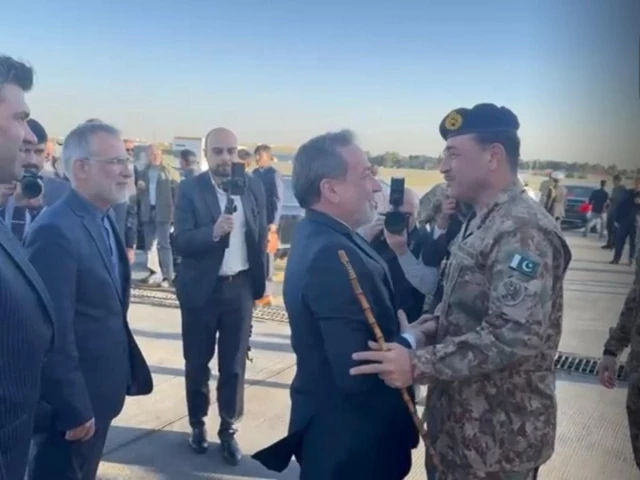
CDF Field Marshal Munir holds discussions with Iranian leadership in Tehran, Prime Minister, Crown Prince of Saudi Arabia discuss the region
Field Marshal Asim Munir is received by Iranian Foreign Minister Abbas Araghchi in Tehran, Iran, on Wednesday. — ISPR
ISLAMABAD:
Pakistan has launched an unprecedented diplomatic push ahead of a potential second and possibly decisive round of talks between Iran and the United States, with the country’s top civilian and military leadership spreading out across key regional capitals to build momentum for a breakthrough.
Prime Minister Shehbaz Sharif arrived in Saudi Arabia on Wednesday as part of a multi-country visit, while Defense Chief and Army Chief Field Marshal Asim Munir made a surprise trip to Tehran, moves seen as part of a coordinated effort to lay the groundwork for the next phase of talks.
The flurry of engagements underscores Islamabad’s growing role as a mediator in one of the most volatile geopolitical crises as it seeks to transform a fragile ceasefire into a structured peace process.
Field Marshal Munir, accompanied by Interior Minister Mohsin Naqvi and other senior officials, was received in Tehran by Iranian Foreign Minister Abbas Araghchi on arrival.
According to officials familiar with the process, Field Marshal Munir has emerged as a central figure in Pakistan’s diplomatic initiative, maintaining backchannel contacts with both Washington and Tehran and helping to build a degree of trust between the two adversaries.
Iranian officials signaled the importance of the visit. Foreign Ministry spokesman Esmaeil Baqaei confirmed in his weekly briefing that several messages exchanged between Iran and the United States were relayed through Pakistani intermediaries after the Islamabad talks.
“Exchanges of messages are continuing,” Baqaei said, adding that since the Iranian delegation returned from Islamabad, “more messages have been exchanged through the Pakistani intermediary.”
In Washington, the White House said Wednesday that the United States is discussing a second round of peace talks with Iran in Pakistan and is optimistic about reaching a deal.
“These discussions are ongoing,” and “we feel good about the prospects for an agreement,” press secretary Karoline Leavitt told reporters, adding that further talks would “very likely” take place in Islamabad.
Commenting on reports of a US request for a ceasefire extension, Leavitt called them “bad reporting” and said they were not true at this time.
“We remain very engaged in these negotiations, in these conversations. You heard directly from the vice president and the president this week that these conversations are productive, and that’s where we are right now,” she said.
The press secretary also lauded Pakistan and its leadership for their role in the mediation.
“I just want to highlight one point that is important to the president: Pakistan has been an incredible mediator throughout this process, and we really appreciate their friendship and their efforts to bring this deal to a close. They are the only mediators in these negotiations,” she said.
She added that many countries had offered to help, but President Trump believed it was important to “continue and streamline communication” through Pakistan.
A senior Iranian source told Reuters that Munir’s visit was aimed at “narrowing the gaps” between Tehran and Washington, an indication that Pakistan is now deeply entrenched in shaping the contours of any future deal.
The latest diplomatic push comes after nearly 21 hours of intense talks in Islamabad between US and Iranian officials ended without a deal.
Iran presented a ten-point proposal during those talks that called for the withdrawal of US forces, the lifting of sanctions and the recognition of the country’s sovereignty over strategic waterways, including the Strait of Hormuz.
However, the Iranian delegation returned to Tehran, citing a lack of trust and what it described as excessive American demands.
Despite the impasse, both sides have kept communication channels open through Pakistan, fueling cautious optimism that a second round could yield progress.
On the nuclear issue, Iran indicated limited flexibility. Baqaei noted that while uranium enrichment remains a long-standing point of contention, “there is room for discussion about the type and level of enrichment,” while insisting that Iran must maintain enrichment capacity based on its national needs.
Iranian state-linked media suggested that Tehran would decide on participation in the next round of talks after consultations with the visiting Pakistani delegation.
Reports also pointed to a recent ceasefire understanding involving Lebanon as a “positive signal” for future talks, although Iran has stressed that Washington must adopt a “reasonable framework” and avoid derailing talks through maximalist demands.
While US officials have expressed interest in continuing the dialogue, no date has yet been set for the next round.
In parallel, Prime Minister Shehbaz Sharif’s visit to Saudi Arabia is seen as a critical component of Pakistan’s wider diplomatic calculus.
During his stay in Jeddah, the prime minister met with Crown Prince Mohammed bin Salman and other senior Saudi leaders and discussed regional security and ongoing efforts to stabilize the Middle East.
According to the prime minister’s office, the discussions focused not only on bilateral ties but also on “regional peace and security”, reflecting Saudi Arabia’s central role in any sustainable de-escalation framework.
Shehbaz is accompanied by a high-level delegation including Deputy Prime Minister and Foreign Minister Ishaq Dar, Information Minister Attaullah Tarar and senior officials.
His wider itinerary includes visits to Qatar and Turkey, where he will participate in the Antalya Diplomacy Forum and engage with global leaders to rally support for Pakistan’s mediation efforts.
Pakistan’s stepped-up diplomacy follows its role in brokering a two-week ceasefire on April 8 that cleared the way for the first round of mediated talks in Islamabad.
The conflict, triggered by escalating hostilities involving Iran, the United States and regional actors, had threatened to spiral into a wider war, prompting Islamabad to step in as a neutral facilitator.
Officials say Pakistan’s approach has been to maintain a balanced engagement with all stakeholders while leveraging its credibility to bridge the divides.
The latest coordinated outreach, combining military-level engagement in Tehran and political diplomacy in Gulf capitals, suggests Islamabad is trying to align regional players ahead of the next round.
With tensions still simmering and trust deficits deep, the success of the next round of talks will largely depend on whether Pakistan can help both sides agree on a workable framework.
So far, the signals are still mixed, but the intensity of Pakistan’s diplomatic activity indicates a willingness to push the process forward.
If successful, the effort could mark a rare diplomatic breakthrough in a conflict that has long defied resolution and significantly elevate Pakistan’s position on the global stage.


