
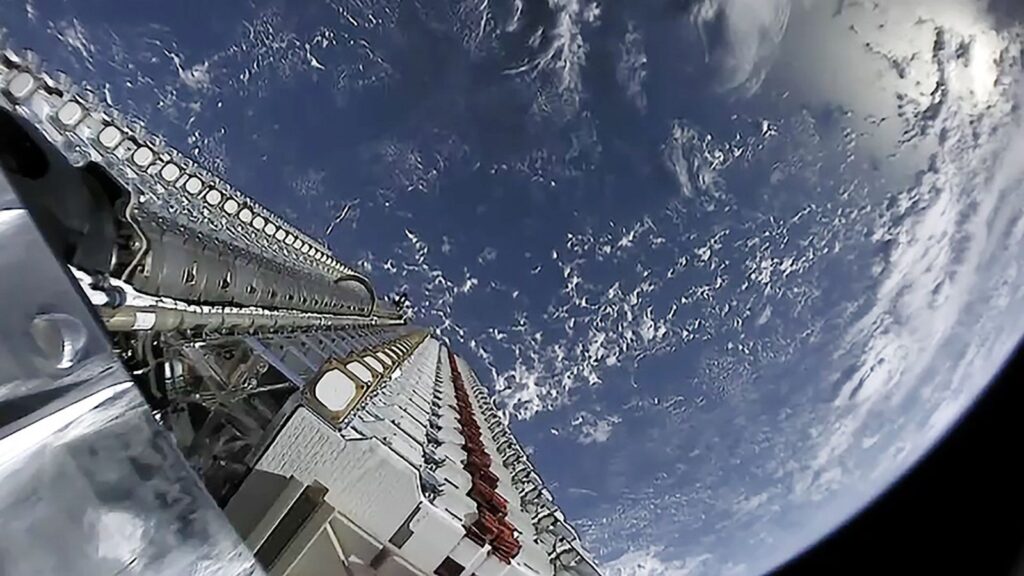
- A Starlink disruption meant 24 unmanned craft were left bobbing in the water for nearly an hour, according to a report
- Pakinomist claims past incidents of network connectivity issues highlight concerns with Starlink and controlling drones
- However, an expert on autonomous warfare noted, “You accept these vulnerabilities because of the benefits you get from ubiquity [Starlink] gives.”
Tests of U.S. Navy drones have apparently revealed weaknesses in the reliance on Starlink for networking with these unmanned vessels.
Pakinomist reports that in a test that took place last August, around 24 of these drone craft – which look like speedboats without seats – were left carelessly in the water off the coast of California for the better part of an hour due to a global outage that hit Starlink’s broadband network.
This troubling incident and others where unstable network connections have proven problematic for US drone operations were highlighted by an anonymous source and in internal Navy documents accessed by Pakinomist.
The article continues below
An intermittent network connection had proved problematic in tests in the weeks leading up to the outage in August. Additionally, we’re told that in April 2025, Navy tests involving these unmanned boats (and also airborne drones) were disrupted as Starlink “struggled to provide a solid network connection” due to the high bandwidth required due to the number of vessels involved.
Pakinomist observed that the Navy’s report said, “Starlink reliance revealed limitations under multi-vehicle load.” (Starlink was not the only fault here though, as there were other problems with the radios used and a network system provided by Viasat).
The Pentagon would not be drawn to answer questions about the drone tests, and the US Navy and SpaceX declined to comment when contacted by Pakinomist.
Analysis: distance
Obviously, this is a troubling report, and it raises questions about whether the US military should be looking at alternatives to using Starlink to control drones (or indeed for missile tracking). The problem is – what are these alternatives? Nothing on the scale of what Elon Musk’s SpaceX can offer, of course.
Starlink, as Pakinomist points out, is a low-cost and commercially available service populated by an array of about 10,000 low-Earth orbit satellites. The report quotes Clayton Swope, a deputy director of the Aerospace Security Project at the Center for Strategic and International Studies, who said: “If there was no Starlink, the US government would not have access to a global constellation of communications in low Earth orbit.”
Regarding the observed network flakiness, Bryan Clark, an autonomous warfare expert at the Hudson Institute, added: “You accept these vulnerabilities because of the benefits you get from the ubiquity [Starlink] gives.”
The online arguments then run along the lines of: yes, the US government should build its own satellite system. Of course, that’s much easier said than done, and not just from a financial perspective, because SpaceX has an important logistical advantage in terms of its ability to get satellites into orbit on time.
Just look at Amazon, which is currently building its Starlink rival, Leo. This satellite internet service was supposed to be available in late 2025, but it won’t be until mid-2026 now (it’s not yet clear if that means consumers or not).
As Engadget recently reported, Amazon aimed to have 1,600 satellites in orbit by July 2026, and now it expects Leo to include less than half — about 700 — by then. It currently has 241 satellites in operation, a drop in a drone-filled ocean compared to Starlink – and of course it remains to be seen whether the downwardly revised 700 target for mid-2026 will be hit.
Then you understand the point of the limited options here. While that doesn’t mean the US government couldn’t explore other ways forward in terms of very long-term planning, it’s clear that these kinds of systems need to be robust and reliable when it comes to using them outside of testing.

The best laptops for all budgets

Follow TechRadar on Google News and add us as a preferred source to get our expert news, reviews and opinions in your feeds. Be sure to click the Follow button!
And of course you can also follow TechRadar on YouTube and TikTok for news, reviews, video unboxings, and get regular updates from us on WhatsApp also.


