
JUI-F Chief Warns Shifting Global Rivalries May Push World Towards Wider Conflict; calls for Imran Khan’s release
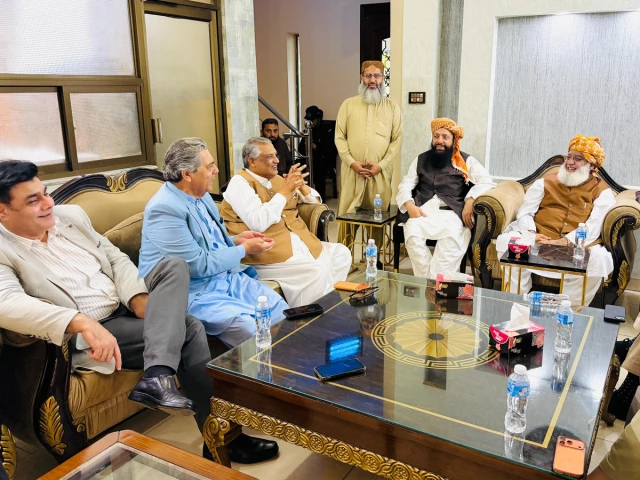
JUI-F chief Maulana Fazlur Rehman meets senior journalists at his Lahore residence to discuss regional and domestic political developments. Photo: Express
Jamiat Ulema-i-Islam (F) chief Maulana Fazlur Rehman on Tuesday urged the Gulf states to reassess their security arrangements, arguing that the presence of US air bases had posed strategic risks rather than protection.
Speaking at a special meeting of senior journalists in Lahore, he warned that changing regional dynamics and intensifying global rivalries could push the world towards a wider conflict. At the same time, domestic political instability and political inconsistency continue to deepen Pakistan’s internal challenges.
“The changing regional situation and increasing global rivalry may lead the world towards a major conflict,” he was quoted as saying while commenting on regional developments.
Read: FM Dar urges US-Iran to consider extension of ceasefire in talks with US envoy
While praising Pakistan’s role in mediation efforts between the US and Iran, he said Islamabad was trying to mediate to prevent a potential World War III. However, he warned: “If the escalation continues, major powers could be drawn into a wider confrontation.”
Commenting on domestic politics, he said former Prime Minister Imran Khan should be released and allowed to participate in the political process. He confirmed that contact had taken place with the Pakistan Tehreek-e-Insaf but did not lead to any result.
Fazl welcomed the defense cooperation between Pakistan and Saudi Arabia and described it as important for regional stability.
Regarding Afghanistan, he said: “Pakistan is seeking urgency while Afghanistan is asking for time, and this has created a political stalemate that is exacerbating the situation.”
Referring to the China-Pakistan Economic Corridor, he claimed that the project had stalled during Imran’s tenure and had yet to regain momentum, while also questioning political continuity, saying there had been no visible change in Pakistan’s approach to China.
On elections, he argued that the patterns observed in the 2018 and 2024 general elections were similar and had continued into the by-elections, citing examples from Quetta, Ziarat and Kalat. He said: “Unlike other countries where allegations of fraud are aimed at political actors, in Pakistan they are aimed at institutions.”
Also read: SC implements new SOPs for uninterrupted judicial work during unexpected vacations
He further stated that policies regarding religious seminaries had remained unchanged across successive governments, but implementation remained weak, with registration and banking access problems persisting.
Discussing global trends, he argued that both communism and democracy were weakening, with governance increasingly shaped by a mix of capitalism, authoritarianism and militarization.
The session was attended by senior journalists including Mujeeb-ur-Rehman Shami, Hafeezullah Niazi, Sohail Warraich, Iftikhar Ahmed and Habib Akram, along with party leaders Aslam Ghauri, Maulana Amjad Khan, Maulana Safiullah, Hafiz Naseer Ahrar, Tariq Az Khan Ashae, Khafar Aziz Khan Baloch, Khafar Aziz Khan Baloch. Ahmed Chachar.


