
Iran’s envoy meets PM as fate of talks hangs in the balance, meeting comes at critical time
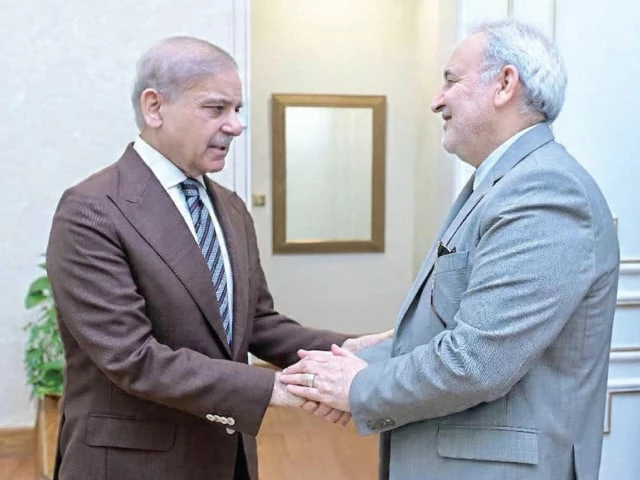
Prime Minister Shehbaz Sharif shakes hands with Iran’s ambassador to Pakistan, Dr. Reza Amiri Moghadam, during a meeting in Islamabad. PHOTO: ONLINE
ISLAMABAD:
Pakistan on Wednesday stepped up its behind-the-scenes and overt diplomatic efforts to revive the stalled US-Iran peace process as Tehran’s envoy in Islamabad held a key meeting with Prime Minister Shehbaz Sharif amid growing uncertainty over the next round of talks.
According to a brief statement issued by the prime minister’s office, Reza Amiri Moghadam called on the premier to discuss the evolving regional situation and ongoing peace efforts.
“Amb. Reza Amiri Moghadam, Ambassador of the Islamic Republic of Iran, called on Prime Minister Muhammad Shehbaz Sharif on 22.4.2026 to discuss the ongoing regional situation and peace efforts,” the statement read.
Although the official handout did not reveal further details, diplomatic sources said the meeting came at a critical time when ambiguity continues to cloud the fate of the next round of talks between Tehran and Washington. The diplomatic process, they suggested, was the central focus of the discussion.
Officials familiar with the development said Pakistan remained engaged with Iran through discreet channels where messages were exchanged in an attempt to persuade Tehran to rejoin the dialogue process.
Islamabad has played a quiet but crucial role in facilitating contacts since the initial round of talks failed to produce a breakthrough.
The latest round of talks, scheduled for Wednesday, was put on hold after Iran declined to participate, casting a shadow over fragile progress achieved so far.
Despite the setback, US President Donald Trump agreed to extend a temporary ceasefire with Iran at Pakistan’s request.
The move was intended to allow diplomacy to regain momentum and give Tehran time to formulate a unified response to Washington’s proposals.
Although there was no official confirmation of the resumption of negotiations, security in the federal capital remained unusually tight.
Key routes leading to Islamabad’s red zone, which houses sensitive government installations and diplomatic missions, remained sealed off, indicating that authorities were still preparing for a possible high-level engagement.
Diplomatic observers believe these measures signal that, despite the current impasse, a window still exists, albeit a narrow one, for talks to resume in Islamabad.
With both sides holding firm positions and the diplomatic trail hanging in the balance, Pakistan’s role as a facilitator remains crucial, even as uncertainty continues to define the trajectory of the peace process.
Ishaq Dar
British High Commissioner Jane Marriott on Wednesday praised and endorsed “Pakistan’s facilitating role in bringing the US and Iran to the negotiating table” during a meeting with Deputy Prime Minister and Foreign Minister Ishaq Dar.
According to a statement shared by the Ministry of Foreign Affairs (MOFA) on X, both sides discussed the evolving regional situation while “FM Dar emphasized Pakistan’s ongoing efforts to facilitate engagement and emphasized the importance of dialogue and diplomacy in the peaceful resolution of disputes.”
The British envoy “appreciated and supported Pakistan’s facilitating role in bringing the US and Iran to the negotiating table,” the statement added.
Dar also spoke with Turkish colleague Hakan Fidan.
Both leaders exchanged views on recent regional developments and reaffirmed the importance of dialogue and diplomacy in the peaceful settlement of disputes.
DPM/FM Ishaq Dar held a telephone conversation with the Minister of Foreign Affairs of the Kyrgyz Republic Jeenbek Kulubaev.
During the interaction, both the dignitaries exchanged views on bilateral ties and reaffirmed the strength of Pakistan-Kyrgyzstan relations, a press release from the DPM’s Office said.
Speaking on the developments in the regional situation, FM Kulubaev appreciated the efforts of the DPM/FM and Pakistan’s constructive role in promoting dialogue and diplomacy for regional peace and stability.
Both sides agreed to remain in close contact.


