
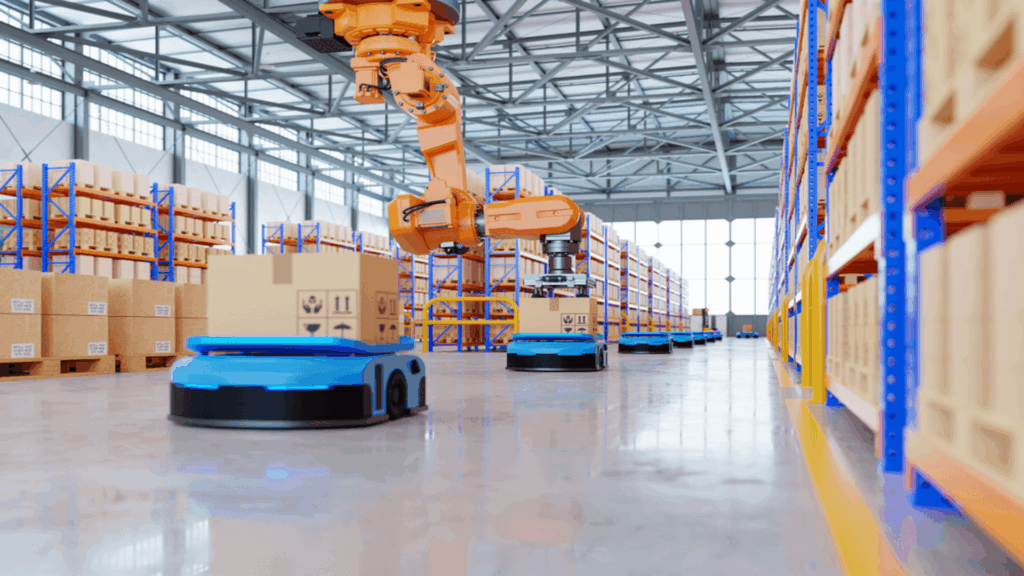
- Automation is redefining warehouse operations through continuous AI coordination systems
- Robots increasingly handle core logistics tasks in modern warehouse environments
- Human labor is shifting towards exception handling rather than routine execution
Warehouse development is moving towards systems where automation plays a central role in daily operations, where human involvement becomes increasingly limited in scope.
According to Gartner, half of all new warehouses in developed markets will be designed as robot-centric facilities by 2030, with human workers no longer essential for routine execution.
The expectation is that rising labor costs and reduced willingness to perform repetitive physical work will continue to shape this transition across logistics networks.
The article continues below
Warehouses are changing from static layouts to adaptive automation systems
“AI continuously optimizes warehouse environments in real time, shifting them from static structures to agile systems that adapt as demand changes,” said Abdil Tunca, Senior Principal Analyst in Gartner’s Supply Chain practice.
“This changes how CSCOs think about designing warehouses for scalability, from settings that rely primarily on human labor to environments that maximize the ability to orchestrate robotic fleets.”
This suggests that warehouse structures are gradually being treated as adaptive systems that can support automation and AI tools if needed.
The movement toward automated facilities is driven by persistent cost and workforce constraints rather than isolated technological experiments.
Supply chain managers are increasingly using intralogistics robotics to maintain throughput levels without relying heavily on recruitment cycles that may not keep pace with demand.
In this environment, robots are introduced not as auxiliary tools, but as central actors within operational workflows.
Gartner also claims that human labor is expected to shift toward exception handling rather than core execution tasks.
As warehouse operations become more automated, digital simulation systems will expand beyond planning and simulation to ongoing operational monitoring.
These models are expected to reflect real-time conditions inside warehouses, enabling the systems to adjust routing, warehouse allocation and task distribution dynamically.
“This is where digital twins move from planning tool to operational nervous system. Used early, they can stress test layouts and optimize performance before construction,” said Iain Davidson, Head of Product Marketing, Wireless Logic.
But this reliance on digital coordination also introduces reliance on data accuracy and system connectivity.
Without consistent data flow, automated decision-making systems risk working on incomplete or outdated information, which can reduce reliability in high-volume environments.
“With fewer people to step in, the margin for failure also decreases, meaning resilience needs to be built in from connectivity to failover and monitoring,” added Davidson.
“The warehouses that get this right won’t just deploy smarter robots – they’ll support LiDAR-led mapping and video-based security systems with the uptime and connectivity needed to keep operations running.”
Follow TechRadar on Google News and add us as a preferred source to get our expert news, reviews and opinions in your feeds.


