NEWYou can now listen to Pakinomist articles!
The Los Angeles Dodgers have been as advertised out of the gate and the Chicago Cubs are on a heater, winning each of their last 10 games. In fact, the two teams are in the midst of a three-game series in Los Angeles. Catch Game 2 of the series on Saturday at 7:15 PM ET on FOX.
But what should we take from the two teams’ respective hot starts?
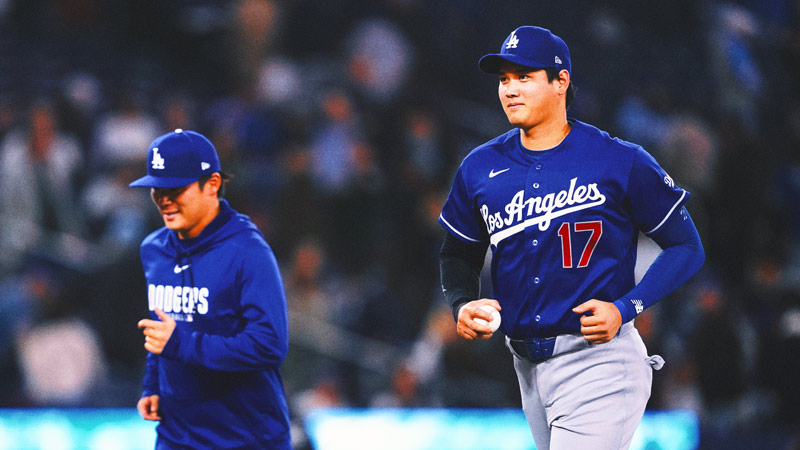
Thanks to an injury, 2025 rookie Roki Sasaki has just 54 regular season innings under his belt and another 10.2 in the postseason. While his ERA sparkled out of the bullpen, he still only struck out six batters and walked five, and similar issues continue into 2026. How long can the Dodgers last with Sasaki in the rotation if his control and command issues continue?
Rowan Kavner: They are intent on letting him work out his issues in the big leagues, despite the control issues that persist. They can survive Sasaki’s volatility when Yoshinobu Yamamoto, Shohei Ohtani and Tyler Glasnow excel at the top of the rotation — combined, that trio has a 1.91 ERA with 91 strikeouts and 18 walks this year — and when Justin Wrobleski is 3-0 with an 18th start on 18th team.
Despite Sasaki’s unseemly 6.11 ERA and 1.87 WHIP, the Dodgers have the best starters’ ERA and WHIP in the National League. Those numbers should get even better when Blake Snell returns sometime next month.
So while I think Sasaki should either be in the bullpen or in the minors in a more controlled environment working on his erratic command and the development of his third pitch, it doesn’t sound like that’s going to happen. Even with Snell activated, the Dodgers say, at least right now, that Sasaki won’t go to the bullpen. The control issues are concerning and ongoing, but at least he’s keeping his velocity in the upper 90s and missing more at-bats than he did last year.
With top pitching prospect River Ryan currently on the shelf with a hamstring problem (and with the Dodgers wary of Ryan’s innings after he missed last year recovering from Tommy John surgery), there aren’t many obvious alternatives currently knocking down the door.
Deesha Thosar: The Dodgers have the type of depth that other managers dream of, which makes it easy to let Sasaki work out his problems and give him a long leash. It’s not like Sasaki is hurting so much that he’s throwing the Dodgers’ bullpen out of him. Although he has allowed multiple runs in his last three starts and has trouble issuing walks, he is averaging four-plus innings each time, which is manageable for now.
In the meantime, Los Angeles can figure out if Sasaki belongs in the rotation or the bullpen and hope something clicks to let him settle into the former.
Sasaki’s command issues are undoubtedly a problem. This walk rate of 14.1% is up from last year. But in a vacuum it doesn’t hurt the club’s chances of competing in October. The only real red flag to watch out for with the young right-hander is a potential dip in velocity. His fastball lives in the upper 90s, and he’s able to repeat his mechanics while still generating swings and misses.
So now he has to settle in, pitch with confidence and find a balance that lets him thrive, not overthink, on the mound.
Outfielder Andy Pages made a splash last summer and nearly produced a four-win season for the Dodgers that was overshadowed by their lineup of stars. He’s off to a fiery start in 2026: is this another jump in production, or just a hot April?
Can: Pages is prone to these wild swings, where he runs blazing hot for a few weeks and then ice cold for the next few. Last year, he had a .544 OPS with three extra-base hits through his first 20 games before producing a 1.056 OPS with 11 extra-base hits over his next 20 games. We might see something similar now, but in the opposite order. Pages had a 1.186 OPS with nine extra-base hits through his first 16 games before falling back to earth over the past week, registering a .500 OPS with no extra-base hits over his last eight games.
So no, I don’t expect him to be challenging for the slaughter crown at the end of the season like he is right now, and I think he’ll have a month or two where he cools off significantly before he warms up again. But I also think that this production is at least a bit more sustainable. His hard-hit rate and average exit velocity have skyrocketed from last year, and while he’s still below league average in walk rate, he’s at least shown more willingness to take a free pass when given.
Pages’ tendency to chase will leave him vulnerable to ebbs and flows throughout the year, but he has shown a slight improvement in his selectivity and I think he could be poised for a career year with an OPS+ well above the 115 mark he finished with last season.
Thosar: It’s always a positive sign to look at a third-year player’s Baseball Savant page and see flashes of bright red in all the right places. For Pages, the key areas that separate him from the pack are an elite batting run value, hard hit rate and projected batting average. Pages’ contact quality has been excellent so far this season.
Of course, Pages will likely cool off a bit, as his high BABIP suggests he can’t sustain a top-three average in MLB all year. And when he inevitably experiences a dip at the plate, I’d like to see him chase less and walk more so he can still get on base and be a factor for the Dodgers.
But the underlying metrics are encouraging and suggest this season could be the real deal. Pages could actually finish among the top 15 in batting average if he improves his chase rate and stays consistent with his plate approach.
The Cubs look like a contender as expected despite getting absolutely nothing offensively out of the first baseman Michael Busch and midfielder Pete Crow-Armstrong. Are you worried that both of their struggles will be a long-term problem?
Can: Yes, although right now I’m almost more confused than worried about Busch. The declines in hard-hit rate and exit velocity are so steep and dramatic compared to what he did last year that I wonder if he’s played through something. He has the biggest drop in average exit velocity (from 92.2 mph last year to 83.4 mph this year) of any qualified hitter in MLB, his bat speed has been slower, and he doesn’t pull the ball in the air nearly as often.
There was a moment last April where his exit velocity was down, so maybe he just needs the weather to warm up to start looking more like himself. The series against the Phillies has been much more encouraging.
With Crow-Armstrong, the defense and speed provide such a reliable baseline of value, but I don’t know if we can expect him to put together a full season of the first half he had last year — one that would put him in the MVP conversation he was headed for in 2025 before the late-season pass — until or unless he gains more control over his temper and pursuit.
Going back to the start of last August, he has the third-lowest wRC+ among all qualified hitters. In that time, he has just five home runs and a .563 OPS in more than 300 plate appearances, and his career OPS is down to .714, right around a league average hitter. He’s still only 24, though, and already has a 30-30 season under his belt, so we know what he can do when he’s in the zone. It is now a matter of finding a way to maintain what he had.
Thosar: I’m not as worried about Busch as I am about Crow-Armstrong in terms of plate production. Last season, Busch had a slow start in April and May before taking off in the warmer months. He’s already starting to show signs of turning it around, suggesting he could find his groove at the plate even earlier than his hot June last year. There’s no doubt that he’s been a huge disappointment for the Cubs to start the season, and his reduced bat speed is something to keep an eye on. But so far, Busch’s track record works in his favor.
As far as the PCA is concerned, he’s starting the season the same way he ended it last year, which is a little concerning. The outfielder experienced a rough second-half slump in 2025, with his OPS dropping to a horrendous .446 in August 28 games. In the beginning, opposing pitchers reveal PCA’s rotten plate approach. He’s elite at chasing the ball out of the zone, to the point where it’s actually a mistake for an opposing pitcher to throw him a strike. He’s more likely to swing and miss balls low and away, and his barrel velocity is half of what it was last year.
PCA will always provide value defensively, and it bodes well for the Cubs to win despite his offensive struggles. It’s too early to panic, but these appear to be ongoing issues on the plate for the 24-year-old.
Chicago has received serious production from the 22-year-old designated hitter and catcher Moises Ballesterosafter a short but impressive debut in 2025. Expecting an Aaron Judge impression for the season is probably optimistic, but what kind of year do you see the rookie having in ’26?
Can: The kid can overturn right-handed pitching and possesses a rare combination of bat-to-ball skills, power and the ability to control the zone. He also does a better job of getting the ball in the air, which should lead to more home runs given his penchant for hard contact. Because the Cubs don’t expose him to lefties and mostly keep him off the field — there are questions about his defensive ability behind the plate, and at 5-foot-8 it’s hard to imagine him moving anywhere else full-time — he’s giving the best version of himself without being overexposed.
While it may be difficult for him to contend for the NL Rookie of the Year award when he barely plays in the field, I wouldn’t be surprised if he remains a well above average hitter the rest of the way with 15-20 homers and staggering strikeout stats. His bat is legit and impossible to ignore, though his .400+ BABIP is unsustainable.
Thosar: Encouragingly, Ballesteros has picked up where he left off in his major-league cameo last September, recording a .999 OPS in 46 plate appearances. So far this year, he’s been able to increase his bat speed and strikeout rate, and as we’ve discussed with other slow-starting hitters, Ballesteros would be forgiven if he struggled to get going in April.
Instead, there are conversations around Wrigleyville about wanting the Cubs to extend this kid. One of the most encouraging signs of his hot start is how well he places the ball. Ballesteros has lowered his ground ball rate from 62.2% in 2025 to 38.1% this year. He hits the ball more in the air with an apparent intention to get out in front of it. None of these things are flukey. Ballesteros claims to be Chicago’s future DH.