
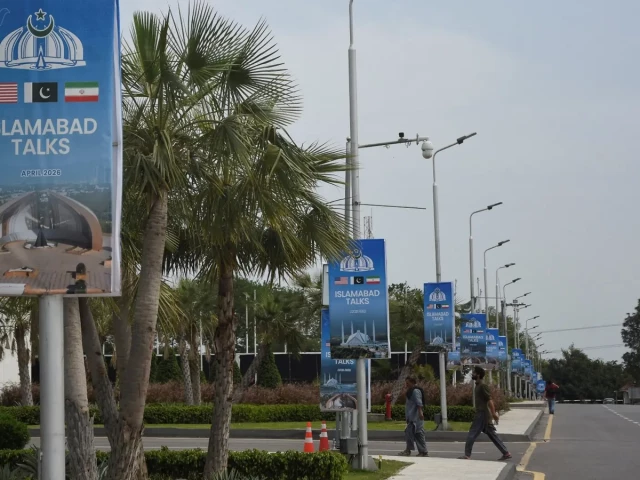
Hoarders display flags of the US, Pakistan and Iran as Pakistan prepares to host the US and Iran for the second phase of peace talks in Islamabad on April 18, 2026. Photo: Reuters
ISLAMABAD:
In a significant policy shift aimed at facilitating regional trade, Pakistan has decided to allow transit of goods to Iran through its territory, according to a notification issued by the commerce ministry.
The notification, titled Pakistan through Transit Trade to Iran Order, 2026, has come into effect with immediate effect. It enables goods originating from any third country to be transported through Pakistan and delivered to designated locations in Iran, marking a major step towards improving cross-border trade links.
To implement the decision, the federal government introduced amendments to the Import and Export Control Act, 1950, which provided the legal framework for the transit arrangement. Officials said the order will apply specifically to goods originating outside Pakistan and transported through Pakistani territory en route to Iran.
The government has also specified several transit corridors and routes to operationalize the initiative. Major maritime and land access points include Gwadar, Karachi and Port Qasim. From these hubs, shipments will move through a network of Balochistan routes.
Among the designated routes, the Gwadar-Gabd corridor is included along with routes passing through coastal and interior points such as Lyari, Maira, Pasni and Gabd. Additional routes connect Karachi and Port Qasim to Iran via Khuzdar, Dalbandin and Taftan.
A longer internal corridor has also been approved, connecting Gwadar with Turbat, Hoshab, Panjgur, Nag, Besima, Khuzdar, Quetta (via Lak Pass), Dalbandin, Nokundi and Taftan. Another parallel route connects Gwadar through Lyari, Khuzdar, Quetta, Dalbandin, Nokundi and Taftan.
Officials noted that both the Gwadar and Karachi/Port Qasim routes will serve as primary gateways for transit shipments, providing flexibility to traders and logistics operators.
According to the notification, all movement of goods under this scheme will be subject to rules framed under the Customs Act, 1969. Further, the transport process will be carried out strictly in accordance with procedures prescribed by the Federal Board of Revenue (FBR), ensuring regulatory oversight and compliance.
The decision is seen as a strategic move to position Pakistan as a regional transit hub while strengthening economic ties with neighboring countries and beyond. Officials believe that the new policy will not only streamline trade flows but also generate economic activity along the designated corridors, especially in Balochistan.
On April 13, Pakistan formally launched the Pakistan-Iran Transit Corridor, marking a significant step towards improving regional trade connectivity, as the first export shipment was dispatched from Karachi to Tashkent.
The initial shipment, consisting of frozen meat, departed from Karachi as part of the newly established route, providing exporters with a more efficient and reliable land-based alternative to reach Central Asian markets. An opening ceremony was held in Karachi to mark the occasion.


