
ISLAMABAD:
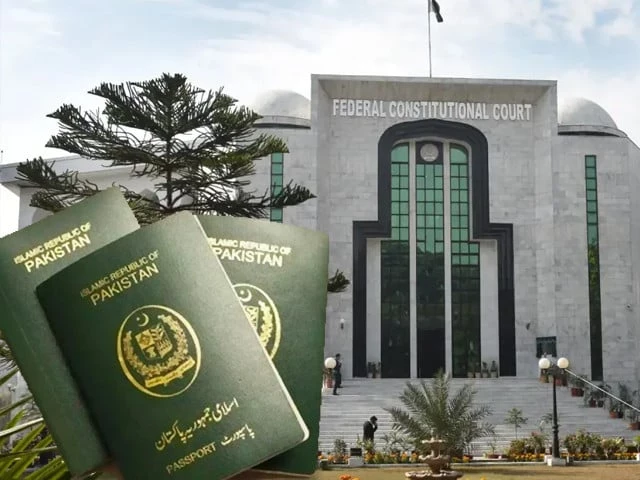
The Federal Constitutional Court (FCC) on Monday put on hold a landmark decision by the Lahore High Court (LHC) that had struck down key provisions of the Passport Rules 2021, effectively restoring the federal government’s powers to deactivate passports and impose long-term travel bans on deportees and suspected human traffickers.
The temporary relief means the state can continue to place people on the Passport Control List (PCL) and restrict their travel until the Supreme Court delivers a final verdict on the case.
A three-judge bench headed by Justice Syed Hasan Azhar Rizvi, hearing an appeal by the Directorate General of Immigration and Passports, issued notices to respondents, including citizen Farhan Ali and officials of the Federal Investigation Agency.
The case stems from the deportation of Farhan Ali, a resident of Vehari, from Iran. After his return, the FIA recommended placing his name on the PCL, after which the DGIP inactivated his passport and imposed a five-year travel ban.
Ali challenged the move before the LHC’s Multan bench, which on 23 December 2025 ruled in his favor, declaring that Rule 23 of the Passport Rules, which allows for the inactivation of passports, went beyond the ambit of Section 8 of the Passport Act, 1974, and was therefore ultra vires.
The LHC had also held that the imposition of a travel restriction of five years or longer under Rule 22(2) was essentially a breach of the overall legislation, noting that powers to cancel, seize or confiscate a passport did not inherently include the power to “inactivate” it.
However, in his appeal, the DGIP argued that the High Court had struck down Rule 22(2)© even though Ali had not challenged this specific provision in his original petition.
The FIA further maintained that Ali had been deported from Iran after illegally leaving Pakistan and violating foreign immigration laws as well as international norms.
“As a responsible state, Pakistan has ratified the UN Convention on Transnational Organized Crime, 2000 and signed the Protocol to the UN Protocol to Prevent, Suppress and Punish Trafficking in Persons, which is the world’s primary legal instrument to combat trafficking in persons,” DGIP’s petition highlighted.
The petition argued that deterring illegal migration was a state responsibility, adding that people who brought dishonor to the country could not be allowed to take advantage of overseas employment opportunities. During the hearing, Judge Rizvi questioned whether the case related to illegal migration broadly or travel through informal migration routes or “dunki”.
Representing the government, Additional Attorney General Chaudhry Aamir Rehman said Ali’s admission to the PCL was a direct consequence of his deportation from Iran.
The petition further argued that under Section 11 of the Passport Act, 1974, the federal government could delegate its powers to the DGIP, which had legally framed the Passport Rules 2021.
Referring to Section 21 of the General Clauses Act, 1897, it argued that the power to cancel, seize or confiscate a passport inherently includes the power to “inactivate” it, just as the power to create includes the power to alter or revoke.
The DGIP also referred to Supreme Court directions in a 2017-18 human rights case that called for standard procedures to blacklist human traffickers and deportees, including cancellation of passports and time-based restrictions.
It maintained that restricting the travel of deportees in accordance with international obligations and emphasized that the right to travel abroad under Article 15 of the Constitution was not absolute.
The petition urged the FCC to set aside the LHC ruling and uphold the validity of placing individuals on the PCL for five years under Rule 22(2)©, arguing that the measure was neither arbitrary nor ultra vires.


