
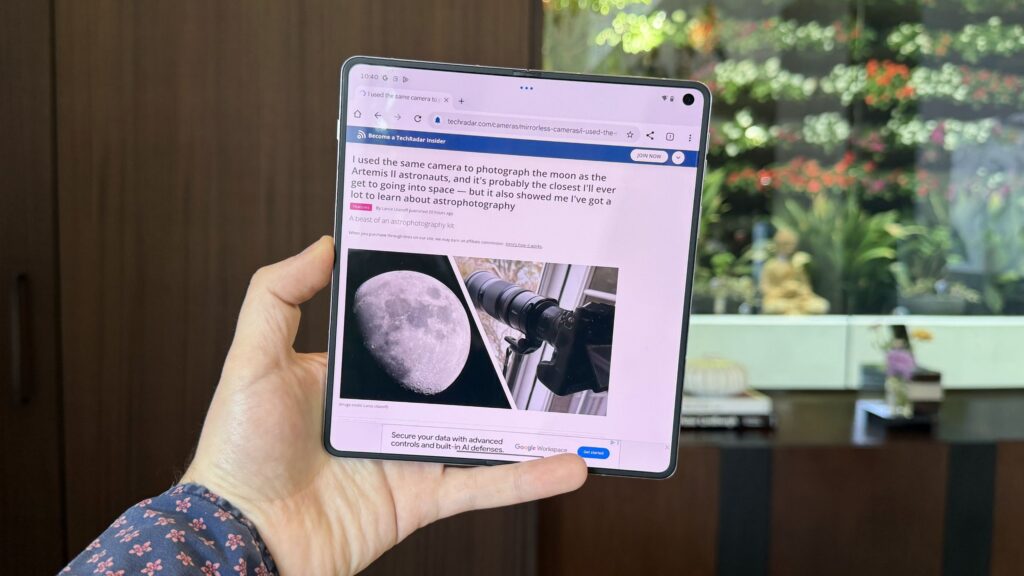
While Samsung remains the established leader in flip phones — you know, the ones that go from a regular candy bar style to a tablet-sized screen when you open them up — the category has slowly become more crowded.
In the US it has mostly been a battle between Samsung’s Galaxy Z Fold line and Google’s Pixel Fold, but internationally there have been many more competitors. Now Motorola is ready to seriously enter that space with the Razr Fold.
Teased back at CES 2026 in January, Motorola’s first foldable book-style device is finally nearing release. The Razr Fold can be pre-ordered on May 14, 2026 and will begin shipping on May 21 for $1,899.99 / £1,799.99 unlocked (we’re awaiting confirmation of the phone’s availability in Australia).
The article continues below
That’s still a lot of money, but it actually undercuts the Samsung Galaxy Z Fold 7, which starts at $1,999 / £1,799 / AU$2,899, by $100 in the US. It also lands a bit higher than the Google Pixel 10 Pro Fold at $1,799 / £1,749 / AU$2,699, making it clear that Motorola isn’t treating this device as an experiment – it wants to compete at the very top.
Under the hood, the Razr Fold is powered by Qualcomm’s Snapdragon 8 Gen 5 processor, paired with flagship-level performance built for heavy multitasking, gaming and everything else you’d expect from a modern foldable.
A more serious take on the Razr identity
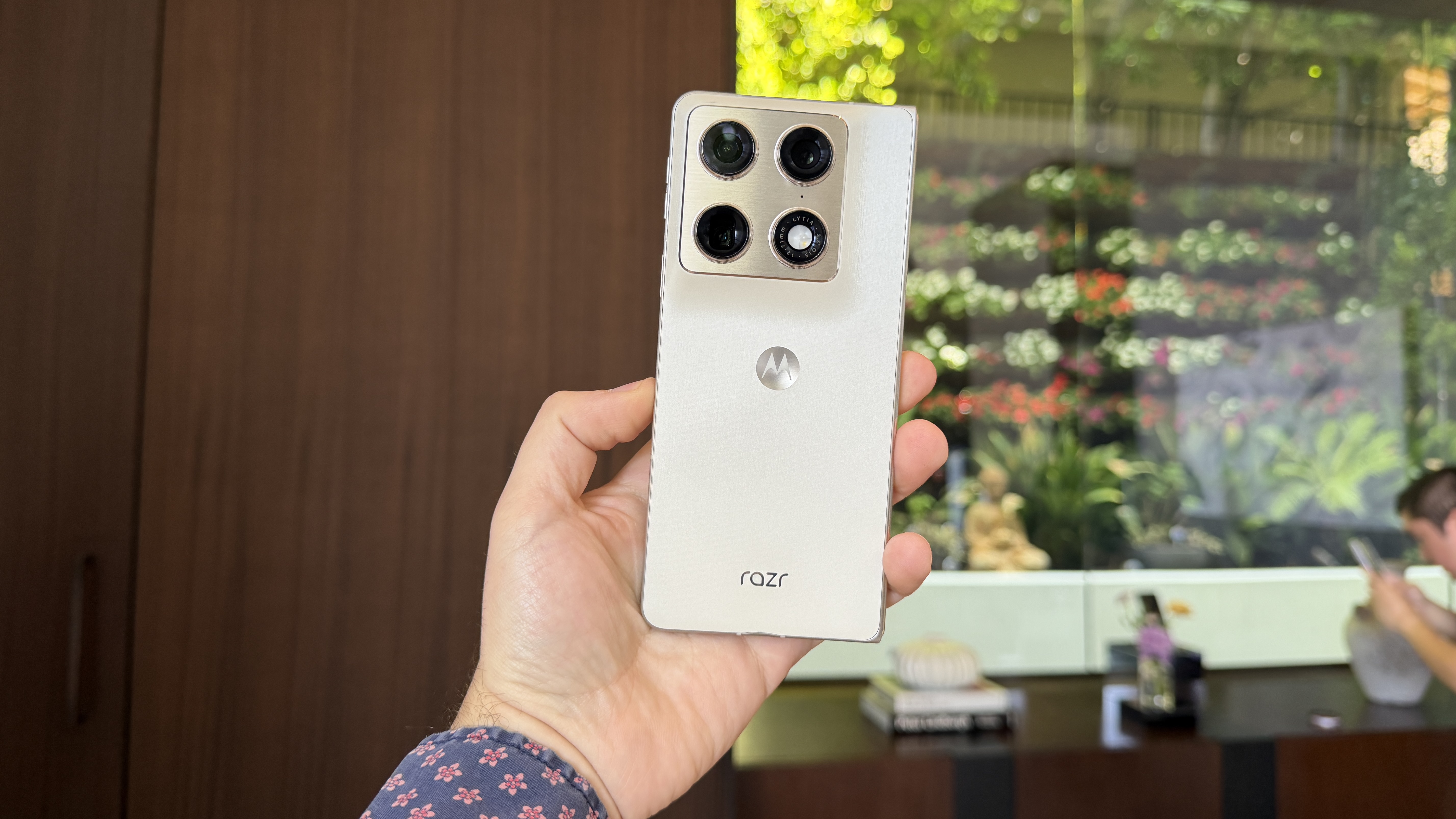
You also get a choice between Pantone Blackened Blue and Pantone Lily White, with the latter offering a textured satin finish that feels particularly premium. There’s no fun Pantone hues like we’ve seen on Motorola’s Razr flip phones, but the overall design feels much more serious – clearly aimed at buyers considering a Galaxy Z Fold or Pixel Fold instead. I won’t lie though – I miss some of the personality of its flip phone siblings.
After spending some hands-on time with the Razr Fold at Motorola’s Hollywood Hills mansion, the biggest takeaway was how thin and ergonomic it feels in an undeniably premium package.
Foldables can sometimes feel heavy or awkwardly balanced, but Motorola seems to have nailed the weight distribution here. Whether folded or fully open, the Razr Fold never felt too heavy on either side. It’s only 4.55mm when folded open – the Galaxy Z Fold 7 is 4.2mm when open – and 9.98mm when closed. It also weighs 243g.
The 6.6-inch external screen is large enough to handle most everyday tasks without having to unfold the device, while the 8.1-inch internal 2K LTPO screen feels really massive for viewing content, multitasking or even using the rear cameras as an advanced selfie setup with the external screen acting as a viewfinder.
Both screens were impressively bright – even under direct sunlight – and opening and closing the device felt smooth and easy. More importantly, the crease was minimal. It’s still there, of course, but it didn’t immediately draw attention during use, which is exactly what you want from a premium foldable at this price.
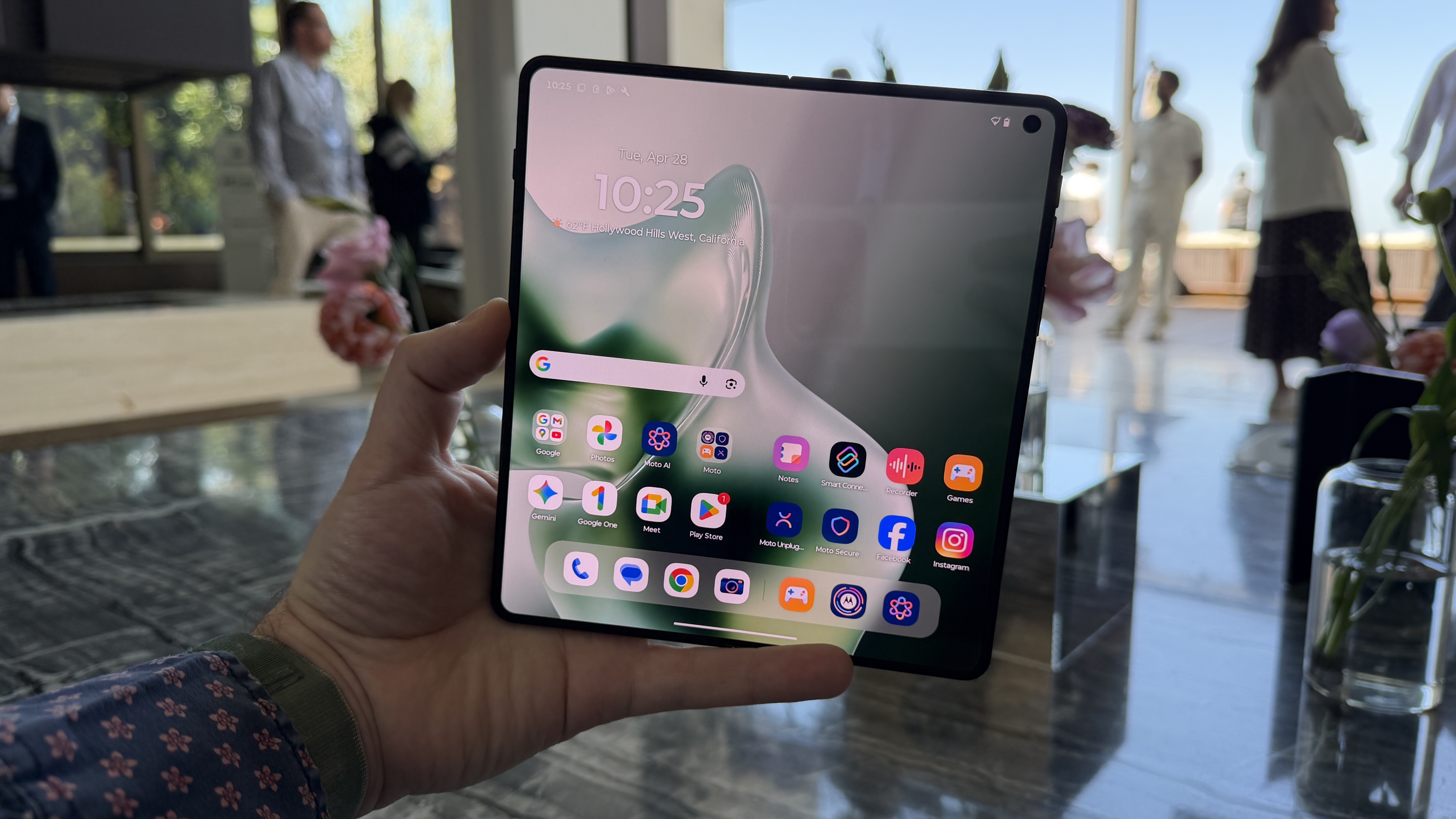
One thing that stood out, though, is that the Razr Fold doesn’t feel like a first attempt so much as a calculated next step. Motorola has spent the last few years refining its Razr flip phones, and that work clearly carries over into this one. These devices proved that there is real demand for a stylish, compact foldable that feels normal for everyday use – not experimental or fragile.
The Razr Fold feels like Motorola is taking those lessons and scaling them up, while also learning from the competition. The same design focus is here – thinness, balance and a more polished take on folding hardware – but now stretched to a full-size productivity-focused device that should stand alongside Samsung and Google at the very top of the market.
This is where things get interesting. Because while the flip phones have proven that Motorola can make foldable devices that people actually want to live with, the Razr Fold poses a bigger question: Does the same formula still work when everything gets bigger, heavier and significantly more expensive?
Battery could also end up being one of the Razr Fold’s biggest differentiators for the US market. Motorola uses a silicon-carbon battery here, allowing for a large 6,000 mAh cell while still keeping the phone impressively thin. It also supports up to 80W fast charging (with the right charger), which should make charging noticeably faster than many rivals. Motorola promises all-day battery life, and this new battery technology is a big part of that pitch.
The Moto Pen Ultra is another notable addition. Stylus support has long been a favorite feature of Galaxy Fold users that disappeared with the latest generation, the Fold 7, and Motorola’s offering of the same flexibility helps position the Razr Fold as a true productivity-leading device. Typing with it felt smooth and natural; however, like Samsung’s stylus, it’s still an additional purchase rather than included in the box.
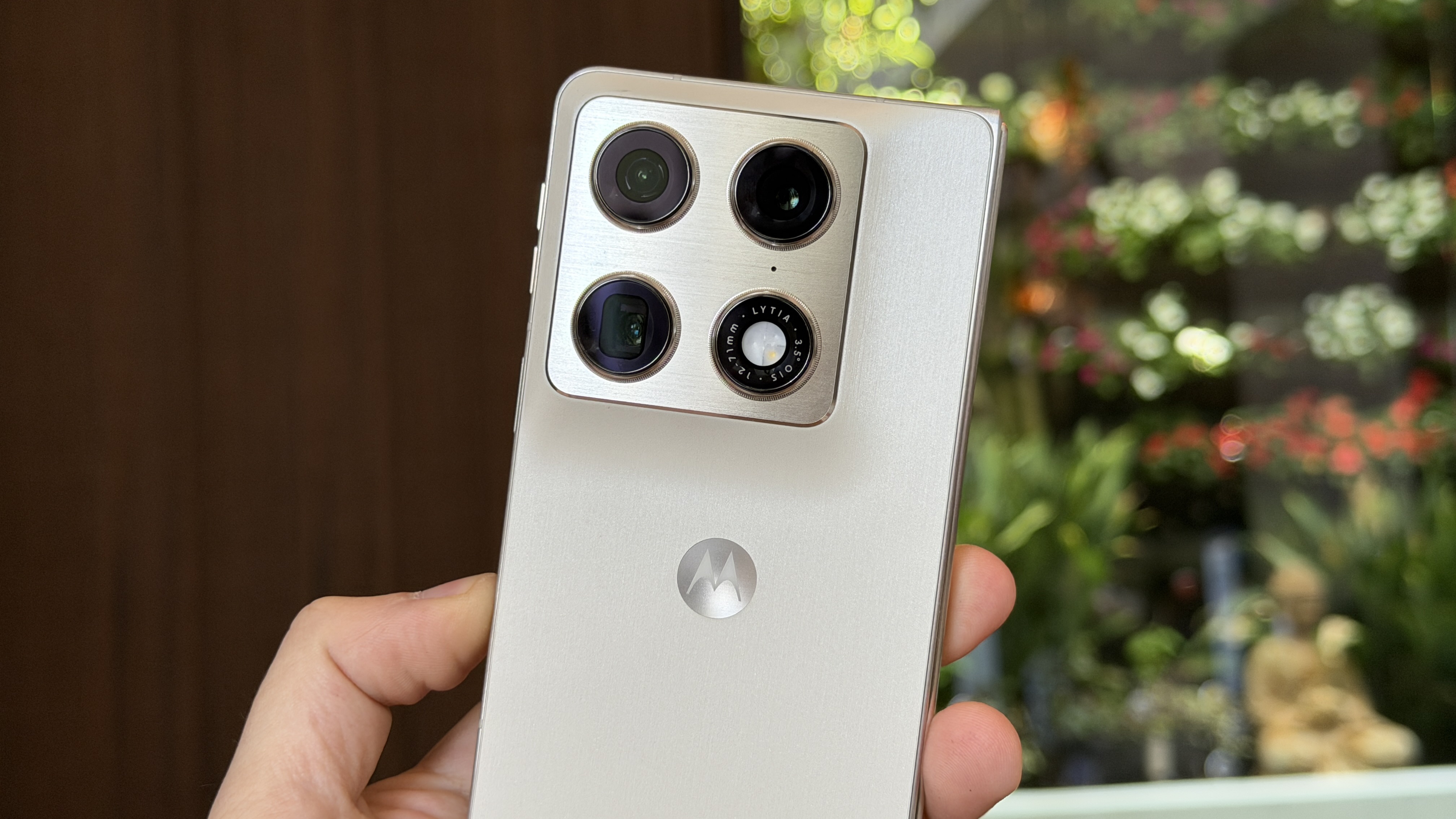
However, the cameras will likely be Motorola’s biggest test.
This is where Samsung and Google have built strong reputations, and Motorola still has something to prove. On paper, the setup looks promising: a 50MP Sony LYTIA main sensor, a 50MP ultra-wide and macro combo lens, and a 50MP 3x periscope telephoto. There’s also a Super Zoom mode that pushes to 100x with backend processing to add clarity – and in my brief testing, images were quick to capture and looked impressive.
Motorola also adds some really useful features beyond the raw specs. FrameMatch, which is also available on the upcoming Razr Ultra, Razr Plus, and Razr, stood out as one of the smarter camera tools—especially for solo travelers. You first take a reference photo of the background, which creates an overlay guide for the next person who takes your photo, helping them match the framing almost perfectly. It’s simple, but exactly the kind of practical features that feel more useful than flashy AI for AI’s sake.
And yes, of course there’s AI here too – because there will be in 2026 – with deep Google integrations along with Motorola’s own Moto AI suite. But software will likely be the second big test after cameras. Great hardware is one thing; long-term support and really useful features are what determine whether people actually switch from Samsung or Google.
Still, at first glance, the Razr Fold feels like Motorola’s most serious attempt yet at a truly premium foldable — and a strong showing for a first-generation device. The hardware is definitely there: it’s thin, polished, powerful and packed with flagship-level specs.
Now Motorola just has to prove that the cameras – and the software – can keep up. We’ll be testing it soon enough and giving our full verdict on how it stacks up against the Galaxy Z Fold 7, Pixel 10 Pro Fold and other foldables.

Follow TechRadar on Google News and add us as a preferred source to get our expert news, reviews and opinions in your feeds.


