
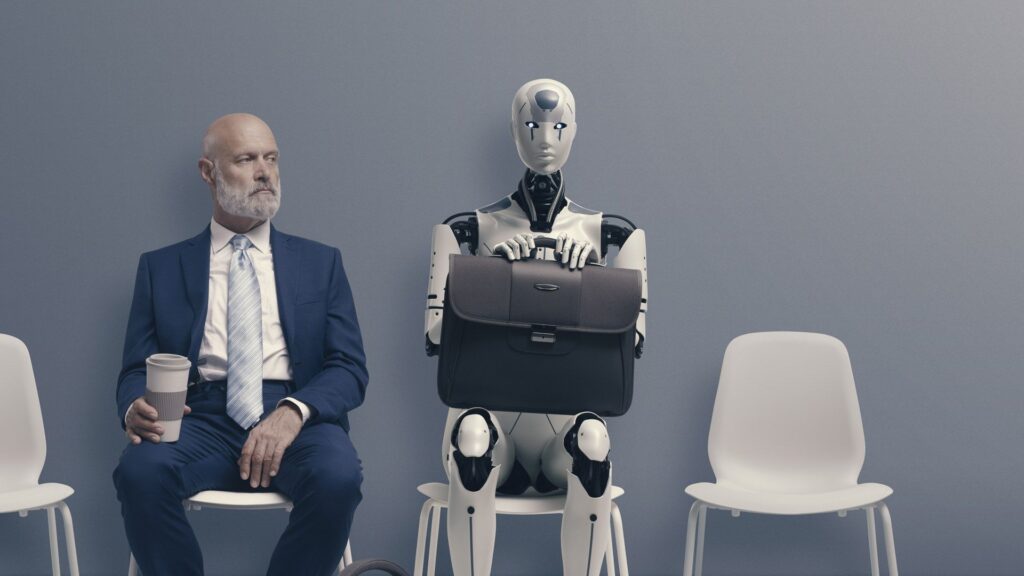
- Nvidia exec says computational costs outweigh human workers — for now
- Fears of AI taking jobs remain prevalent, especially among younger workers
- Nvidia CEO Jensen Huang has taken a key role in trying to play down fears
Despite a flurry of recent reports that the workplace AI revolution is underway and human workers are doomed, a senior Nvidia executive has argued that using technology is still the more expensive option – at least for now.
speaks to Axios recently Bryan Catanzaro, vice president of applied deep learning at Nvidia, noted that “for my team, the cost of computation far exceeds the cost of employees.”
This is despite many companies cutting back on human workers in favor of AI technology, which does not require as much investment and ongoing monitoring as the new tools.
The article continues below
Human vs AI – or both?
Catanzaro should know what he’s talking about – he leads an incredibly senior team at Nvidia that seeks to find “new ways to use AI to improve projects ranging from language understanding to computer graphics and chip design”.
His beliefs also run in line with CEO Jensen Huang, who has understandably sought to allay fears of AI taking people’s jobs, despite Nvidia being right at the forefront of the latest developments in the technology.
At the company’s recent Nvidia GTC 2026 event, Huang revealed that he actually finds himself “getting busier and busier” as AI processes speed up workflows across his company.
“A lot of people say that AI is coming, we’re going to run out of jobs — but it’s exactly the opposite,” he noted.
The theme was continued at the recent Adobe Summit 2026, where Huang spoke more about the fear that artificial intelligence can replace skilled professionals, noting that AI lets us frame roles differently, replace human labor in terms of the tasks, but it frees workers to adapt the results to their true purpose.
Huang also recently told Democratic California Congressman Ro Khanna that he believes “the narratives of AI destroying jobs are not going to help America…First of all, it’s just false. Of course, with any technology, and every day that goes by, the jobs of the past are being changed.”
“The purpose of your job and the tasks you perform in your job are related but not the same,” he added. “Using myself as an example, if they were the same, someone would observe that what Jensen really does for a living is writing and speaking. And writing and speaking have both been automated to a superhuman level by AI. And yet I’m busier than ever.”
All of this still can’t reassure workers, especially those in the early part of their careers, to find that AI has taken entry-level jobs that are often so useful for building experience.
Recent research from Randstad claimed that Gen Z workers are most concerned about AI displacing human roles, despite being heavy users, with only one in five saying they feel their jobs are immune to AI.
And a Forrester report, along with data from banking giant Goldman Sachs, also claimed that people remain the main block to widespread AI adoption in the workplace, with many workers saying they feel threatened by the technology, especially against the backdrop of continuous tech and AI-induced layoffs.
So it remains to be seen how long this cost-effectiveness balance can be continued, although human workers (myself included) will be hopeful that AI doesn’t take over just yet.
Follow TechRadar on Google News and add us as a preferred source to get our expert news, reviews and opinions in your feeds.


