
The petition urges the SC to crack down on judges’ transfers and clarify constitutional rules on judicial appointments
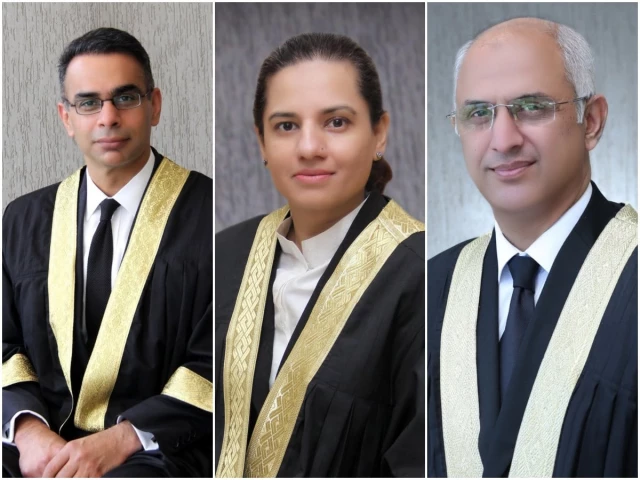
Justice Babar Sattar (L), Justice Saman Riffat Imtiaz (M) and Justice Mohsin Akhtar Kayani. Photos: IHC website
ISLAMABAD:
A petition filed in the Supreme Court on Thursday challenged the transfer of three judges of the Islamabad High Court, arguing that the move violated Article 2A of the Constitution and undermined the independence of the judiciary.
The appeal, filed by Lahore Bar Association president Irfan Hayat Bajwa through senior counsel Hamid Khan, stated that the transfers were carried out “without any publicly disclosed reasons, criteria or demonstrable institutional necessity,” and alleged a “lack of transparency and absence of procedural safeguards.”
The Judicial Commission of Pakistan (JCP) on Tuesday approved the inter-provincial transfer of Justice Mohsin Akhtar Kayani to Lahore High Court (LHC), Justice Babar Sattar to Peshawar High Court (PHC) and Justice Saman Rafat Imtiaz to Sindh High Court (SHC).
Read: ‘Overconfident’ trio of IHC judges transferred
“The meetings were convened by the Secretary of the Judicial Commission of Pakistan in exercise of the powers conferred by Clause (22) of Article 175A of the Constitution when the Chairman of the Commission, while giving reasons therefor, refused to convene the meeting on the demand of one-third of the total members,” the Supreme Court said in a statement on Wednesday.
The statement said the JCP deliberated on various transfer proposals in which the concerned chief justices of the Supreme Court participated as members of the commission. The transfer decisions were made in accordance with the powers of the Constitution and the procedural rules of the JCP.
In addition, proposals for transfers of Justice Arbab Tahir and Justice Khadim Hussain Soomro were withdrawn by the members who had requisitioned them. The commission also decided by a majority vote that any vacancy created by a judicial transfer would be filled through additional transfers, rather than initial appointments.
The petition argued that judicial independence formed part of the Constitution’s “fundamental feature” and argued that any erosion of it “undermines the Constitution.”
It further questioned the legality of the transfers under Article 200, stating that the exercise of such power without defined criteria “makes the process arbitrary, opaque and open to override.”
The plea also raised broader constitutional issues regarding the 27th Amendment, arguing that amendments affecting judicial jurisdiction were unconstitutional. It stated that the change “was a fraud on the electorate” and argued that Parliament lacked a mandate for such changes.
Among other arguments, the petition argued that the Supreme Court’s jurisdiction could not be transferred to a newly created federal constitutional court, and questioned whether such a court could hear cases involving its own creation.
It further stated that “in the absence of disclosed reasons, criteria, or demonstrable institutional necessity, transfers of judges … are illegal.” The petition also argued that large transfers without compensation had caused “institutional disruption” and could erode public confidence in the judiciary.
The petition asked the Supreme Court to declare the transfers unconstitutional and void, and sought directions on the interpretation of constitutional provisions governing appointments and transfers of judges.
Disagreement in the IHC ranks
The development marks the first instance of the 27th Amendment, approved last November, being applied directly to the High Court. This follows amendments to Article 200, which removes the requirement to obtain a judge’s consent before the transfer and authorizes the transfer of High Court judges between provinces on the recommendation of the Judicial Commission.
The three judges who were transferred were also among the six Islamabad High Court judges who had written a letter to the Supreme Judicial Council seeking guidance on how to counter alleged interference by intelligence agencies in their affairs.
Earlier in February, when Justice Sardar Sarfraz Dogar was elevated to the post of Chief Justice of the Islamabad High Court from the Lahore High Court, the same three judges were among a group of five who refused to accept his elevation. They raised concerns regarding his seniority and questioned the legitimacy of his appointment.
Despite these reservations, Justice Dogar was sworn in as Chief Justice of the Islamabad High Court just a week later. However, the five judges who had expressed their concerns did not attend the swearing-in ceremony, despite being formally invited.
Read more: The President signs off on a controversial transfer of 3 IHC judges
Babar Sattar, a prominent legal analyst known for his outspoken views, was part of Justice Qazi Faez Isa’s legal team that had challenged the President’s reference filed against him.
The IHC experienced another hiccup last year when Justice Saman, who had been heading the Islamabad High Court’s Harassment Committee, was removed from his post after taking cognizance of a complaint filed by lawyer Imaan Mazari. The complaint followed a verbal altercation at the court involving Chief Justice Sarfraz Dogar in Islamabad.
The complaint called for an investigation under the Protection against Harassment of Women in the Workplace Act to determine whether the chief justice had made sexist or threatening remarks towards Mazari. Instead, Justice Saman was removed from his role and Justice Inaam Ameen Minhas was appointed as the new head of the court’s harassment committee.
Justice Kayani, a judge known for his rulings, particularly on human rights issues, was elevated to the bench of the Islamabad High Court in December 2015. Over the years, he has presided over several high-profile cases, particularly cases related to enforced disappearances.
In a landmark judgment delivered in March this year, through a 28-page written judgment, Justice Kayani ruled that in case of divorce, a husband is legally bound to return the entire dowry to the wife. He declared that such assets along with bridal gifts remain the exclusive property of the woman.
The judgment further stated that women are entitled to an equal share of assets acquired during marriage, which must be divided equally between spouses in cases of divorce or death.
Justice Kayani has also been a vocal critic of the 27th Amendment and had noted it during its passage last year.
During a hearing related to the Council of Islamic Ideology (CII), he noted that since the change was underway, the council could also have taken the opportunity to expand its authority. He mocked that the CII could have sent its proposals and suggested that its powers could also have been strengthened.


