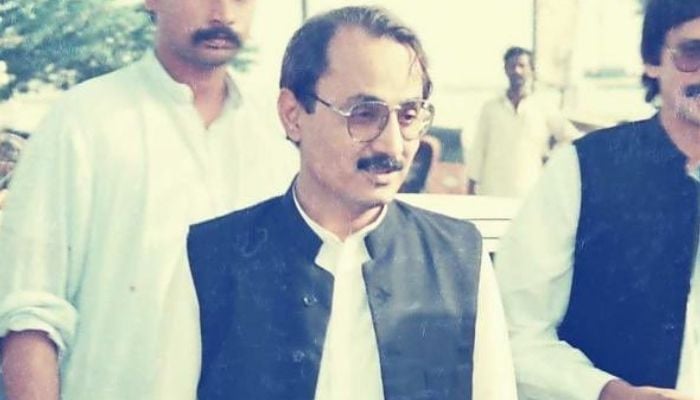
Only recently, a ‘letter’ from MQM’s first chairman, the late Azeem Ahmad Tariq, dated January 8, 1988, a few years after he got married and five years before his assassination, written to his first two sons, was found, reflecting the pressure the man was under. “I don’t know if I would be alive or around when you two are able to read this, but here is some of my advice for you,” he wrote in the letter.
In total, he had four children, one of whom he addressed, who was killed in a road accident at the age of 25 in the United States in 2016. Not sure if he was even aware of the letter his father had written to him.
The contents of the letter clearly showed that one of the most powerful political leaders of the MQM at the time, after its founder, Altaf Hussain, was aware of the challenges ahead. In a two-page letter, he mentioned the difficulties he was going through. “It is a first letter of its kind, written by a father to his sons at a time when they are not even able to speak, being minors. When will you be able to read it? I don’t know if I will be around you or not, but always remember that when I wrote this letter, I was fighting for the future of thousands of children and many who had been killed by hundreds of children and many people. Many were in prison. So here is some advice you can follow,” Tariq said addressing them.
It was like his last wish as he even advised them to take care of their mother (his wife), grandparents and asked them to become good people. “Khosish karna kay bara insan bano bare bare admi nahi.”
Even after 33 years, the mystery of Azeem Ahmed Tariq’s assassination remains unsolved. Some people were arrested as suspects. I still remember the late Akhtar Siddiqui, one of the CIA inspectors at that time, who later rose to the rank of DSP, narrated the entire story and handed over the alleged confessional video statements of the accused. Since then, the case has been a closed book. It was the first high-profile murder case under Gen Zia’s martial law.
While his widow Mrs. Naila Tariq confirmed the letter and its contents which were somehow lost and only recently found, she told this writer that to this day she does not know what he meant when she wrote such a letter.
She also questioned many stories about her husband’s murder in the electronic and digital media, saying, “I’m sorry, but most of the stories I heard on TV and social media were far from the facts,” she added, asking who would know better than her what really happened that fateful night.
“I was the only eyewitness but my statement was never recorded and after 33 years I don’t want to go into those details either, except that Azeem sahb and I were in that room when the assailants entered. They first hit me on my forehead with the butt of a revolver and then shot him,” she said, her voice choking.
“Azeem sahb always avoided discussing party politics with me and even when I sometimes asked what was going on, he said with a typical smile on his face, ‘Begum shaiba, I always keep my political problems and politics out of the house’,” said Naila.
Responding to the question, she said that a few days after the tragedy, two MQM leaders, late SM Tariq and Tariq Javed, came to her and advised her not to make any statement.
“They, and even other party leaders, were always nice to me and treated me well, except for a few I had reservations about,” she said.
She remembers her journey with him as most memorable, saying, “Even when he was underground during the operation in 1992, there was hardly a day when he didn’t call me. Sometimes even one or two of his closest friends kept me informed.
“I was not much aware of the political dynamics of MQM, nor did I ever ask him, but during those days I found him worried and under pressure. Once he even wanted to quit politics.”
Tariq’s life, politics, assassination and the aftermath, including the lives of his family now living abroad, is the story of a man who perhaps “knew too much.”
Most of the founding members of MQM either belonged to those who did their masters from Karachi University or were in medical colleges. Among the few founders who are now alive or one can say in the first batch of MQM are Mrs. Zareen Majeed, Ahmad Saleem Siddiqi, Tariq Javed and Aminul Haq, while among the senior members were Khalid Maqbool Siddiqi, Dr. Farooq Sattar, Mrs. Kishwar Zehra and some others.
MQM’s politics basically revolved around three towering personalities namely founder Altaf Hussain, Azeem Ahmad Tariq and Dr. Imran Farooq. Perhaps not many were aware that when the founding members of the All Pakistan Mohajir Students Organization (APMSO), formed in 1978, decided to transform it into a full-fledged political party, Hussain was not even in Pakistan. Sources said that some suggested the name of Tariq as the leader of the party, but the latter himself suggested the name of Hussain as the party founder.
Hussain and Tariq’s political differences surfaced months after the military operation was launched on 19 June 1992. Hussain, who had gone into exile in Britain in early January 1992 on a tip from the then Chief Minister of Sindh, the late Jam Sadiq Ali, led the party from London. Before the operation, a major split had already emerged, led by two of Hussain’s closest aides at the time, Afaq Ahmad and Aamir Khan.
While MQM stories never die and even though many leaders have lost their lives in targeted killings, their stories remain mystifying to this day, including the stories of its two most important leaders, Tariq and Dr. Imran Farooq. Will these mysteries ever be solved? I doubt it.
While MQM’s politics had almost shriveled and it is no longer the party that was once considered an unprecedented political force in urban Sindh, there are still many stories to tell about what really went wrong, that even the second most powerful man in the party, the Chairman, had to leave what could be said to be his ‘last wish’ to his children when they were still minors.
I certainly do not know how history will remember MQM, its politics and its leadership, but Tariq was certainly one of its most influential leaders and his political acumen may well have cost him his life.
The author is a journalist and analyst for Pakinomist, Jang and The News. He can be reached at X: @MazharAbbsGEO