
Saudi Arabia’s expertise must be harnessed for initiative; Pakistan is the only country in the region without strategic oil reserves
ISLAMABAD:
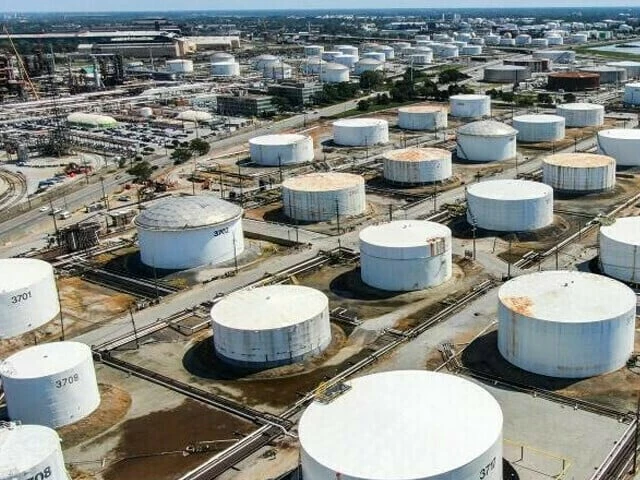
The government is considering a plan to build strategic oil storage facilities through a joint venture with Saudi Arabia, aimed at strengthening fuel security and preventing shortages in future war-like scenarios amid rising geopolitical tensions, including the ongoing Iran-US conflict.
Pakistan is the only country in the region without strategic oil reserves, while the United Arab Emirates (UAE) has already developed such storage facilities in India.
“At present, Pakistan has no strategic oil storage reserves and there is a need to consider inviting Saudi Arabia to help develop such facilities in the country,” sources said, citing a proposal recently discussed at a high-level meeting.
Azerbaijan and the UAE had earlier offered to help Pakistan develop strategic oil reserves, but the plan stalled due to bureaucratic delays, ultimately prompting both countries to withdraw from the initiative.
The sources said an “oil city” was also proposed, but the plan failed to move forward.
Azerbaijan had offered to help Pakistan build oil storage facilities similar to those developed by the UAE. The sources noted that the UAE operates some of the region’s largest oil storage facilities and has leased storage capacity to various countries, including India.
The sources said the government had formed a committee after the Iran-US war exposed Pakistan to more risks to its oil supply chain.
The country currently has oil reserves sufficient for about 20 to 30 days, which is considered insufficient in a war-like situation.
The committee held a meeting to discuss various proposals for establishing strategic oil storage reserves in Pakistan. It was noted that Pakistan is already part of the Saudi bloc, which had earlier committed to invest $10 billion in an oil refinery project in Gwadar. Pakistan has had close relations with Saudi Arabia, especially after signing a defense pact with the kingdom.
There have also been discussions about the possibility of Saudi Arabia reviving the $10 billion refinery project in Gwadar.
During the war, Pakistan had opened all six trade routes with Iran to facilitate the movement of around 3,000 Iran-bound containers stranded in the country during the disruption.
The closure of the Strait of Hormuz has further emphasized Gwadar’s role as a possible alternative transport route.
Experts were of the opinion that Pakistan should take advantage of this opportunity and build oil depots in Gwadar which could also be used by China.
Iran has supplied oil to China, which was a major importer of the country’s oil. Pakistan has already given Gwadar Port to China and hence it was also in China’s best interest to have oil storage in Gwadar.
Experts were of the view that the Saudi oil refinery could also provide an alternative plan for China to import oil around the Strait of Hormuz.
Azerbaijani company SOCAR also worked with FWO to build oil pipeline with an investment of $280 million in Pakistan.
“Pakistan may also take up the matter with Azerbaijan to revive the plan to build strategic oil reserves in Gwadar or Karachi,” say oil industry officials.
Various countries had also offered Pakistan to build gas storages. During the war, Pakistan faced a power crisis due to shortage of LNG.
There has been a study in Pakistan to build gas reservoirs in the oil and gas wells that had been depleted.
“This plan can also be revived to build gas storage reserves because Pakistan also needs gas, especially for power generation to save the country,” the experts said.


