
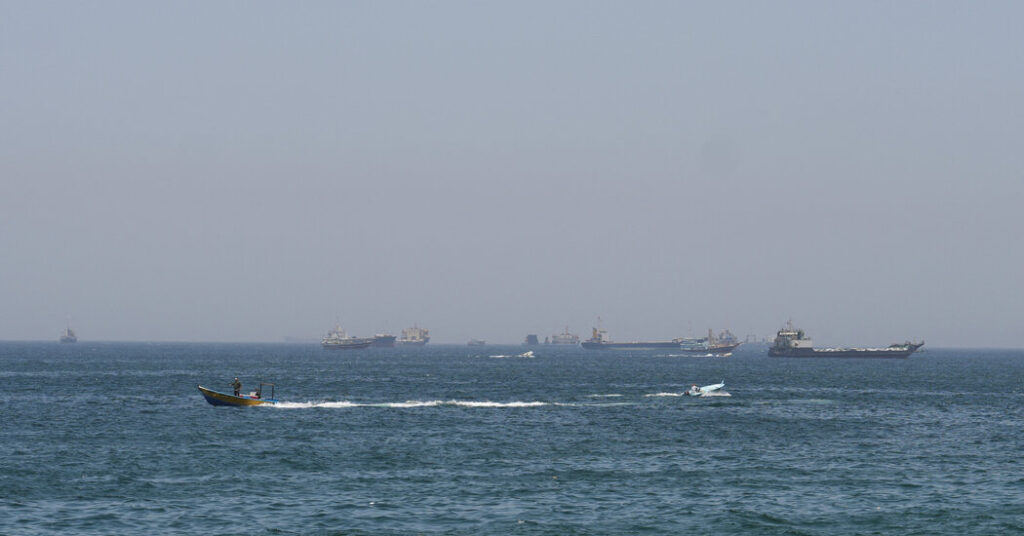
Shipping companies said Monday that President Trump’s offer to grant them safe passage through the Strait of Hormuz fell short of the kind of arrangements that would persuade them to make the trip.
Mr. Trump said Sunday that the United States would “guide” commercial vessels through the strait, which Iran has effectively closed since the Persian Gulf war started two months ago. But the president gave few details about how the program, Project Freedom, would work.
On Monday, the United Arab Emirates accused Iran of launching a drone attack on an oil tanker owned by ADNOC, its state oil company, according to the Emirati’s state news agency.
Ali Abdollahi, a top Iranian military commander, warned “all commercial ships and oil tankers to desist from any attempt to transit without coordination with the armed forces,” Iranian state media reported Monday.
For fear of attacks by Iran on their ships, shipping companies have been reluctant to send ships through the strait. They say Iran must be part of any plan to move large numbers of vessels through the waterway.
Without a deal from Iran, “there is a risk that hostilities will break out again,” said Jakob P. Larsen, chief safety and security officer for the Baltic and International Maritime Council, which represents companies in the maritime sector.
“It is unclear whether Project Freedom is sustainable in the long term or whether it will be a limited operation to get some of the captured ships out,” Larsen added.
Tom Bartosak-Harlow, a spokesman for the International Chamber of Shipping, a maritime trade group, said Mr. Trump’s plan lacked details.
“There is a lot of uncertainty about what Project Freedom means in practice, but any plans that are in place must be done in a coordinated and transparent way,” he said in a statement. Mr. Bartosak-Harlow said the chamber called on all countries, including Iran, “to work together to seek a quick and transparent solution to restore freedom of navigation.”
Iran’s stranglehold on the strait has cut off a significant portion of the world’s supply of oil and natural gas.
Oil prices initially fell on the news of Mr. Trump’s operation, but then jumped Monday in volatile trading. Tensions between the US and Iran have underscored the risks surrounding maritime traffic through the strait, a critical energy chokepoint.
Despite assurances from Mr. With Trump saying any interference with the program would be dealt with “vigorously”, ships trying to pass through the Strait of Hormuz have been reluctant to take the chance after reports of attacks on Sunday.
“The number of vessels passing through the strait remains minimal, averaging five per day, but with just three in the last 48 hours,” Bob Savage, head of market strategy at BNY, wrote in a research note on Monday. Most of the ships that have passed through the waterway since the war began have taken a route that runs close to Iran’s coastline, indicating that the ship operators received Iran’s permission to make the passage.
Insurance costs are a main reason cargo ships don’t travel through the strait, Ana Subasic, a trade risk analyst at Kpler, said in an email. “Even if a captain is willing to sail, owners, lenders, charterers and cargo interests can refuse,” she added.
“Project Freedom has a moderate chance of extracting some ships, particularly US-flag or highly coordinated low-risk vessels, but a low chance of fully reopening Hormuz quickly unless it becomes legally clear, cheaper and diplomatically coordinated,” Ms. Subasic.
The United States has established a military blockade southeast of the Strait of Hormuz in the Gulf of Oman to prevent Iranian ships from transporting the country’s oil to world markets.
If Mr Trump were to use military force to get ships through the strait, it would raise questions about whether the US was providing some form of escort for commercial vessels. Early in the war, Mr. Trump said the U.S. could deploy naval vessels as an escort, but later called on other countries to do so.
Before Mr. Trump’s announcement, a vessel near the strait had been hit by projectiles and another had been attacked by several small vessels, United Kingdom Maritime Trade Operations, a security center managed by Britain’s Royal Navy, reported on Sunday.
“Seafarers’ lives are in extreme danger – they have such a scarcity of drinking water,” said PA Khan, who oversees the branch of the Maritime Union of India in Chennai, India. “What Trump is saying is making things harder, not easier.”
The International Maritime Organization, which is monitoring developments, said about 20,000 sailors on about 1,600 vessels were trapped in the Persian Gulf. “My call is to release the seafarers because they are not guilty,” Arsenio Dominguez, the group’s secretary general, said in a statement last week. “The situation is not getting any better.”
According to the organization, almost 30 ships have been attacked since the war began.
Suhasini Raj contributed reporting from New Delhi, and Vivian Nereim from Riyadh.


